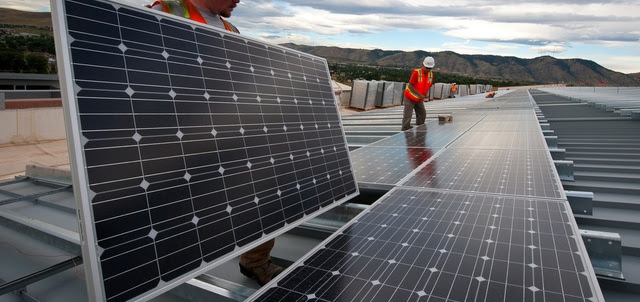
Solar Over Louisville seeks to increase solar power usage to 2 megawatts by next year. The Courier-Journal
One man's drive for cleaner energy has run up against historic preservation guidelines in a Louisville neighborhood.
A Louisville resident's rooftop solar installation has collided with one neighborhood's historic preservation requirements, setting what city officials described as a first-of-its-kind architectural design battle.
The dispute comes as a largely coal-fired city begins to weigh just how much it will embrace making clean solar power mainstream.
In a sign of solar's growing pains, however, city planners have told Clifton resident Mark Frazar that the solar panels he installed in December 2014 on his William Street home violate historic preservation rules because they are visible from the street. He was fined $100, and, after an appeal, his case has been set for a hearing by an architectural review board April 13 to determine whether they need to be removed.
"They are hanging their hat on visible from the street," saying that's not allowed, said Frazar, a project manager for an architectural firm, in an interview. "That's certainly making it pretty difficult."
Frazar has spelled out his case in correspondence obtained by The Courier-Journal through the Kentucky Open Records law.
"I ask you to take into account our need for lower energy consumption and renewable energy sources," and conditions specific to his home, he wrote to city planners. Solar panels need southern exposure, he said. At his home, he limited panels to a south-facing roof atop a rear, second-story camelback portion of his shotgun-style 19th-century home.
For their part, city officials insist their policies in neighborhoods with historic preservation rules do not hinder residents from adding solar panels.
Frazar should have sought what the city calls a certificate of appropriateness, said Develop Louisville spokesman Will Ford, who said this was the first time solar panels have gone before an architectural review committee after those solar panels had already been installed.
"If the homeowner would have consulted with the urban design team before installing the solar panels, they could have worked as a team to find a solution for the location of the solar panels on the property," Ford said. "Solar panels are treated like other proposed exterior changes in a historic district.
"Solar panels are not discouraged in historic districts, but they must fit within the guidelines of the historic district."
City solar push
Frazer said he was not aware of any limits on solar panels when he reviewed the guidelines in 2014.
Seven Louisville neighborhoods have been designated historic districts, requiring government oversight of exterior alterations, demolition and new construction and installation of solar panels: Butchertown, Clifton, Cherokee Triangle, Limerick, Old Louisville, Parkland and West Main Street.
His challenge comes at a time when Mayor Greg Fischer has blessed a Solar Over Louisville effort that seeks to persuade Louisvillians to install 2 megawatts of solar capacity this year. That's roughly enough capacity for 333 typical homes, said Nancy Givens with Solar Over Louisville. The Louisville Metro Council also last year passed a strongly worded resolution in support of solar power, encouraging the discussion and promotion of solar use on public and private buildings.
Frazar included that resolution in his appeal.
In August, The Courier-Journal reported that solar installers acknowledged that workarounds in historic districts are possible in some situations, but sometimes the limitations mean not enough panels can be put on a roof to cover a home's electricity needs, or the panels cannot be installed for optimum efficiency.
Frazar has support from the David Coyte, land-use and preservation chair of the Clifton Community Council.
"I am more than sympathetic," said Coyte. "My position is that if we don't allow such things (as solar panels) there won't be a future to value the history we are seeking to protect," citing concerns about global warming and a need for cleaner energy.
"We should welcome and support anyone in Clifton who is seeking to develop alternative energy resources," he said.
The Public Utilities Commission of Ohio on March 31 unanimously approved modified, yet controversial eight-year subsidy plans from AEP Ohio and FirstEnergy Corp.'s utilities designed to guarantee income for primarily coal-fired generation.
Opponents of the plans and related settlements have said they amount to "handouts" ranging from $1.9 billion for AEP Ohio and almost $4 billion for FirstEnergy.
"Although the non-signatory parties have raised numerous concerns regarding the stipulation, we are persuaded that the stipulation, as a package, benefits ratepayers and the public interest," PUCO said in its March 31 order.
AEP's revised PPA, which includes a 10.38% ROE, will begin June 1, 2016, and end May 31, 2024. It will guarantee income for the capacity, energy and ancillary service output of its ownership share in the OVEC units, as well as Cardinal unit 1, Conesville units 4 through 6, J.M. Stuart units 1 through 4 and W.H. Zimmer unit 1.
The settlement states that AEP will retire, refuel or repower Conesville units 5 and 6 and Cardinal unit 1 to only use natural gas by the end of 2029 and 2030, respectively. The PUCO order prevents the company from seeking any recovery from ratepayers for these costs through the PPA rider or any other cost recovery mechanism.
The approved stipulation also includes a commitment for AEP Ohio to procure 500 MW of wind capacity and 400 MW of solar capacity over the next five years.
FirstEnergy Corp.'s Davis-Besse Nuclear Power Station is part of its approved PPA rider.
Source: FirstEnergy Corp.
PUCO said that the record "demonstrates a projected net credit to customers of $37 million over the current ESP term through May 31, 2018, or $214 million through May 31, 2024, under the term of the PPA rider."
The commission directed AEP Ohio to limit customer rate increases tied to the PPA rider to 5% for the remainder of the current ESP plan.
AEP Ohio's original PPA plan was rejected by PUCO in February 2015, but regulators left the door open for future approval of a "reasonable PPA rider proposal" that demonstrated the financial need of the generation, was open to rigorous commission oversight and balanced the financial risk between the company and its ratepayers, among other factors.
FirstEnergy
As part of a settlement, FirstEnergy agreed to reduce its proposed income guarantee for the 2,210 MW W.H. Sammis coal plant and 908-MW Davis-Besse nuclear plant to eight years from 15 years and cut its ROE to 10.38%. It also promised at least $100 million in customer credits. The retail rate stability rider runs from June 1, 2016, through May 31, 2024. (Case No. 14-1297-EL-SSO)
Under the plan, FirstEnergy's Ohio utilities will buy the power from the plants owned by competitive subsidiary FirstEnergy Solutions Corp., as well as the company's stake in the OVEC plants, and then sell the output into PJM Interconnection LLCwholesale energy and capacity markets. Customers will receive rate credits or charges to offset power purchase costs.
PUCO said the record in the FirstEnergy case indicates that its rider will generate $256 million in net revenue over the eight-year term of its electric security plan.
The commission also implemented a mechanism to ensure that average customer bills do not increase through May 31, 2018, "taking into account any seasonal rate differential and any over and under recoveries of Rider RRS for prior periods."
The utilities base distribution rates will remain frozen for the eight-year term of the ESP.
Commissioners
PUCO Chairman Andre Porter and other commissioners defended their votes during the meeting.
"Retail electricity prices are down due partially to new fuels and resources being discovered, [including] in the vast Marcellus and Utica shale regions. Prices are also down because demand has decreased," Porter said. "While such low prices present benefits for consumers, they present challenges for those providing utility services. While there is much to the debate, I hope that we can all agree that we want for consumers to benefit from safe, reliable and cost effective electric services."
Commissioner Lynn Slaby emphasized his "belief in the free open markets competition is not compromised with this order."
"First, we should look at the market to provide competition, innovation and solutions for the retail electric service without intervention. There are times, however, when outside factors may dictate some intervention into a perfect world. This is especially true when an immediate response is necessary for protection of the public health and safety," Slaby said.
"If I had a crystal ball, this job certainly would be much easier," he added. "Without generation that can be called upon immediately, we would not have a basic, reliable utility grid."
A 'bad' deal?
Dick Munson, Midwest director of clean energy for the Environmental Defense Fund, said before the ruling that he expected the plans to be approved. He said EDF would be contemplating next steps.
"My observation is [these PPAs are] bad for consumers, bad for the environment, it's bad for markets," Munson said. "So, I guess the campaign will quickly pivot [to FERC and the Ohio Supreme Court]. I think that there's sympathy in reviewing such state-based subsidies as being contrary to competitive wholesale markets and my guess is … they'll get overturned pretty quickly."
PUCO spokesman Matt Schilling said intervenors may file motions for rehearing to the commission within 30 days of the order. After a final entry on rehearing from the commission, the intervenors may appeal to the Supreme Court of Ohio within 60 days.
"The consideration of that court, however, is whether the PUCO acted responsibly," Munson said. "And I think that you could make the case that they did not because there are better offers on the table from say Dynegy Inc. or Exelon Corp. The Supreme Court, typically, gives a lot of deference to state regulatory agencies, so I'd be somewhat surprised if anything happens there."
Munson, however, noted that there are already complaints against the proposals before FERC.
The AEP subsidiary and FirstEnergy have been battling with competitive power providers that threatened legal action if Ohio regulators did not reject the deal and filed a complaint with FERC seeking commission review of the PPA.
"We will join those," he said. "And then there will be filings before the federal court as well."
While the Sierra Club signed on to AEP's plan, citing its commitment to move away from coal, it still opposes FirstEnergy's rider.
"We intend to continue fighting FirstEnergy's illegal bailout, which is a terrible deal for customers," Earthjustice attorney Michael Soules, who represented the Sierra Club at the hearings, said in a news release. "Today's decision flies in the face of the evidence, which shows that this bailout would saddle customers with the financial risks of aging coal and nuclear plants, while providing FirstEnergy shareholders a hefty profit. FirstEnergy customers deserve better."
Article updated at 5:33 p.m. ET on March 31, 2016, to include additional information. Article amended at 8:46 a.m. ET on April 1, 2016, to clarify the rehearing process.
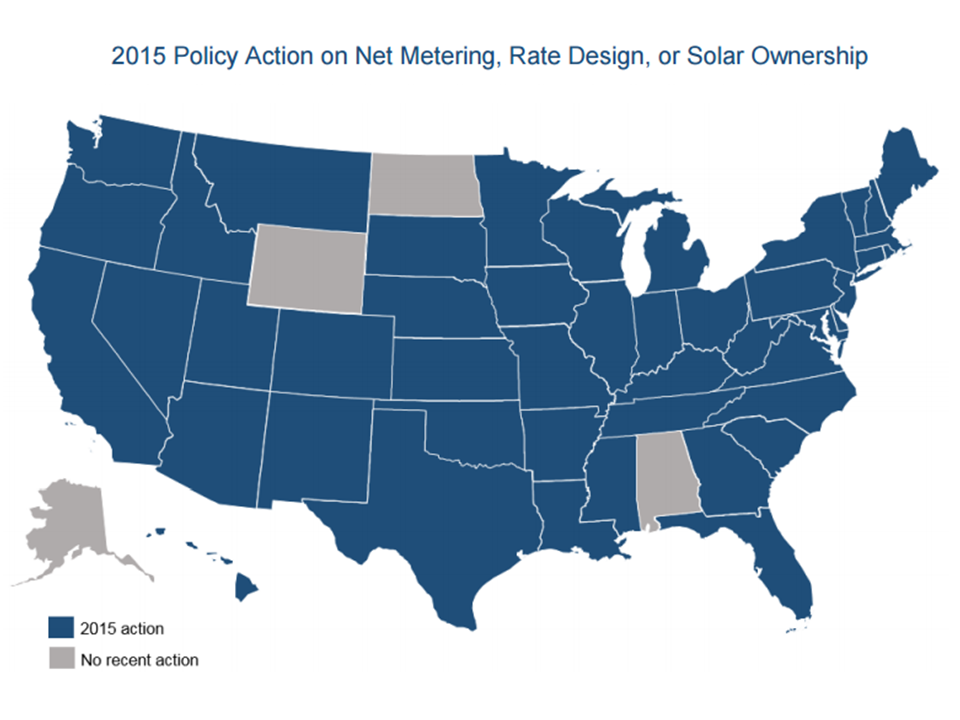
Sometimes one stat is all it takes: 46 of the 50 states had solar policy debates going on in 2015. That makes solar literally the talk of the nation.
Only residents in Alaska, North Dakota, Wyoming and Alabama were spared from solar policy last year. Everywhere else, regulators, utilities, solar providers and the like have been wrestling to find the proper valuation, aggregation and ownership models for the fast-growing renewable resource, according to a new report from the North Carolina Clean Energy Technology Center (NC CETC).
“It has created an uproar in different places and it is hard to say what has affected the regulators’ thinking because each commission is different and each is persuaded by different evidence,” said NC CETC Sr. Policy Analyst Autumn Proudlove, co-author of “The 50 States of Solar; 2015 Policy Review.”
The extensive policy review is the product of ongoing research by NC CETC and Meister Consultants Group. In the report, the analysts break down the year's developments into five key categories:
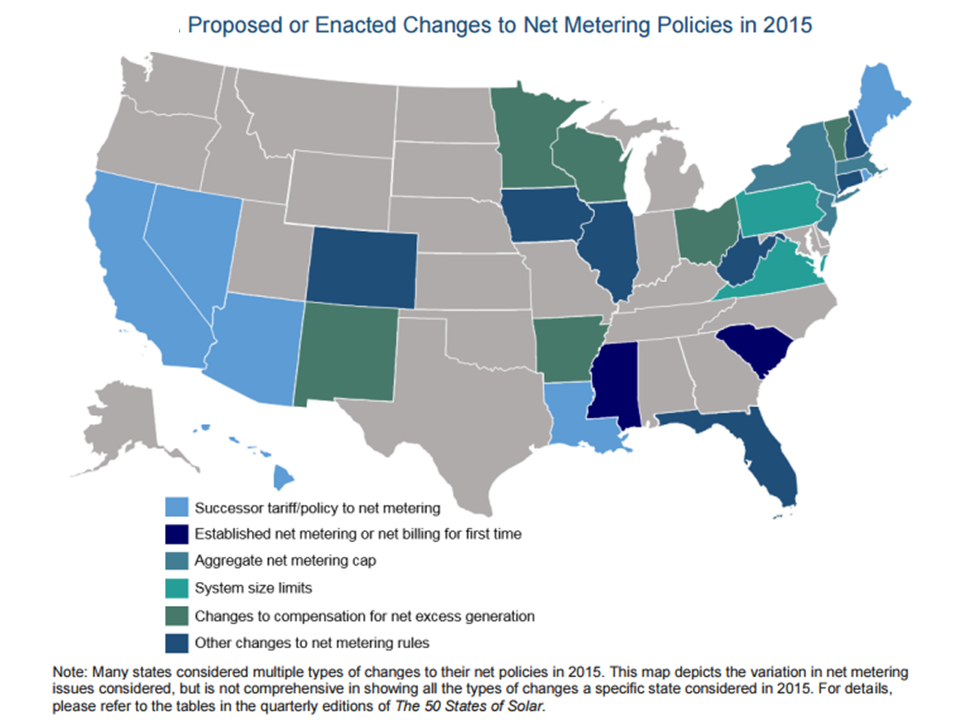
Net Metering: 27 states considered changes to how solar owners are compensated for energy their systems send back to the grid.
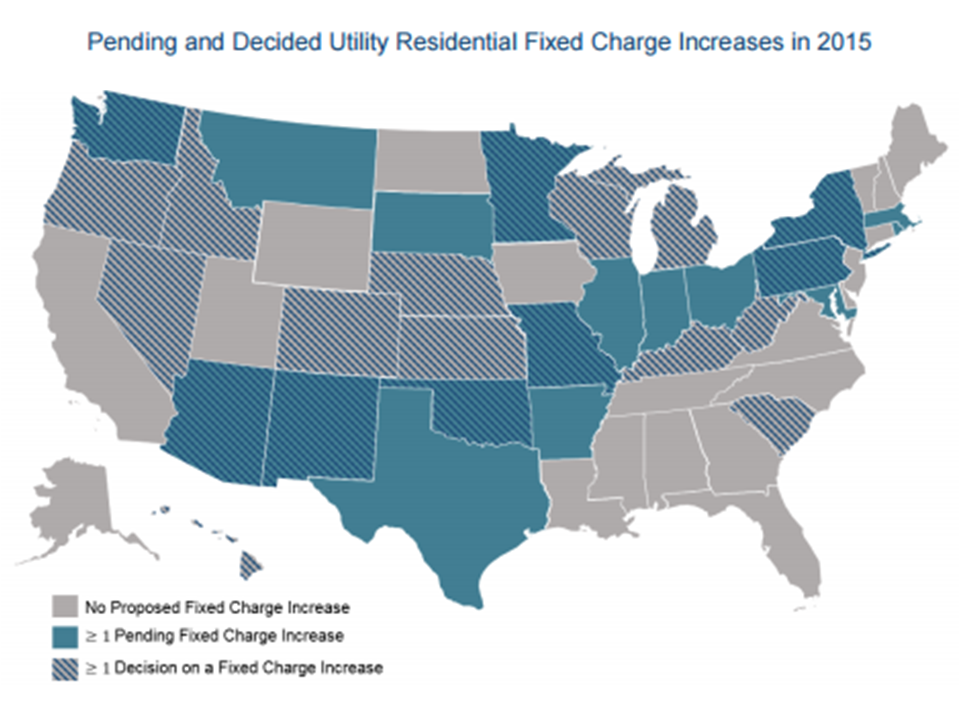
Fixed Charges: 61 utilities in 30 states proposed monthly fixed charge increases, and 21 utilities in 13 states propose new or increased existing charges specific to rooftop solar customers.
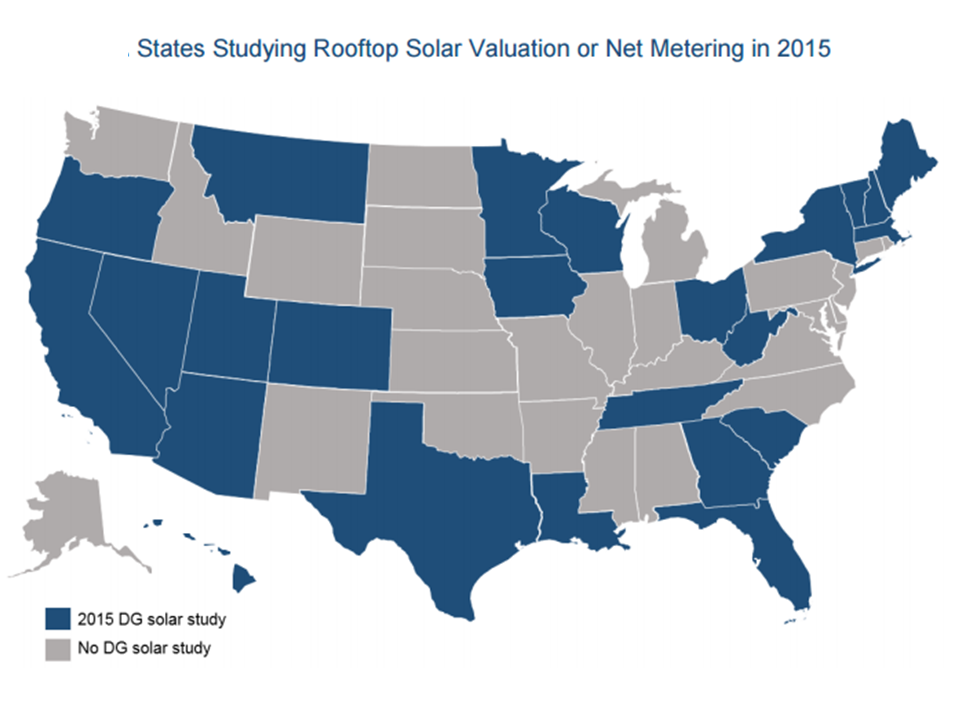
Value of Solar: 24 states undertook studies to better define the value of solar and other distributed energy resources (DERs), expected to influence the future of NEM and the design of successor tariffs.
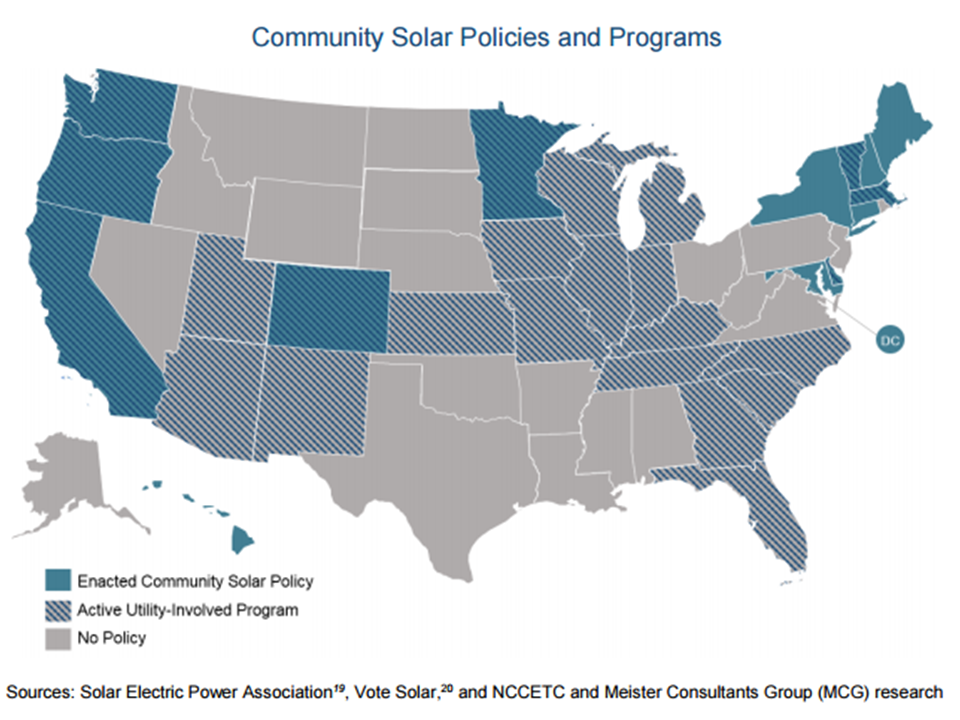
Community solar: 7 states advanced policies on community solar, including the resolution of Xcel Energy's concerns over a Minnesota program with a current queue of 1,500 applications representing over 1,400 MW of new capacity
Solar Ownership: 5 states considered utility ownership of rooftop solar and 6 faced debates on third-party ownership (TPO), including legislation making Georgia the first southeastern state to allow the practice.
Only four states did not have solar policy debates of some kind in 2015.
“One of the biggest things we saw in this edition was net metering successor tariffs,” Proudlove said. “Nevada and Hawaii re-evaluated net metering altogether and came up with very different policies. Now similar changes are being considered in other states. It is a turn toward something other than traditional net metering, something new and different. We call it net billing.”
Regulators in Hawaii and Nevada were the first in the U.S. last year to change the value of credits solar owners receive for electricity they export back to the grid, lowering them to the utility’s avoided cost or wholesale rate, the review reports.
The changes being considered in California’s NEM 2.0 proceeding are another example of a successor tariff, though that commission decided to delay changing retail rate NEM until 2019 in a January decision. Mississippi’s “avoided cost with a temporary adder” credit to solar owners for their exported generation is another successor tariff, Proudlove said.
Louisiana is preparing an avoided cost “net billing” successor tariff while Maine and Vermont are developing successor tariffs not based on avoided cost, she added.
“Maine’s alternative policy could range from $0.10/kWh to $0.185/kWh,” Proudlove said. “Vermont is considering something still called net metering but it would effectively be more of a buy-all, sell-all agreement.”
Not all places are doing away with traditional net metering. The South Carolina retail rate credit implemented last March is a departure from the trend away from NEM, the review reports.
“There is a lot of uncertainty to solar customers with these new policies because they may end up reducing the financial value of solar,” Proudlove said. “They could increase it but we don’t know what many of the final values will be yet.”
The fixed charge, “also called a “customer charge” or a “basic service charge,” is a per-month charge that applies to every customer,” according to the review. Fixed charges, typically for $5 to $10 per residential customer, cover “customer-specific costs associated with one additional residential customer.”
Faced with stagnant load growth and the proliferation of distributed generation, utilities across the nation have made a trend of pushing for higher fixed charges to cover “grid infrastructure, maintenance on generation assets, and other costs that do not vary in the short term with the amount of electricity sold,” the review reports.
Of the 61 utilities that proposed fixed charge increases across 30 states last year, the median increase requested was 62%, according to the report. The trend is a troubling one for solar installers, whose value proposition to customers can be seriously compromised when charges rise. A $5 monthly fixed charge increase is “equivalent to an extra $1,500 in charges over a 25-year PV system lifetime," according to the report.
Proposals for high fixed charge increases have been met with skepticism from regulators in many states, the review reports. A rate design that uses fixed charges instead of customer-specific costs “deviates from long-established rate design principles,” the review explains, referencing a recent Regulatory Assistance Project study.
That may help explain why in 16 of the 37 regulatory decisions on fixed charges in 2015, regulators dismissed the request completely. Of those approved, the median approved fixed charge was $10.85.
Of the 21 examples in 13 states of utilities proposing extra charges or fees specifically on solar, distributed generation, or net metering customers in 2015, the most common was a monthly demand charge. The median requested charge was $4.80 per kW per month.
Only a few IOUs, including Alabama Power and Dominion Virginia Power, have implemented such charges. But proposals are becoming more common as fixed charge increases get turned away or reduced by regulators.
Because they attempt to turn solar owners into a separate rate class, “proposals generally faced organized opposition and few have been approved by regulators,” the review reports.
In 2013 and 2014, “state regulators rejected, or utilities withdrew, solar charges proposed by Idaho Power, Black Hills Power, Rocky Mountain Power, Central Maine Power, and Georgia Power,” it adds. A We Energies charge was approved by state regulators but was overruled in Wisconsin District Court as inadequately justified by the utility.
Demand charges have been allowed for some electric cooperatives, municipal utilities, public utility districts, and state-owned utilities, probably because they did not require the approval of state regulators, the review notes.
NV Energy was the only U.S. IOU that was granted a solar-specific demand charge in 2015. It came in a proceeding in which regulators had become so hostile to solar advocates that their decisions were described as “punitive.”
“In some places utilities have moved from requesting fixed charges to requesting a demand charge for solar customers as a different instrument,” Proudlove said. “We may therefore see more. It is still a relatively new concept and we still have to see what will happen.”
Demand charges are significantly easier to work with than fixed charges, according to GTM Research Sr. Solar Analyst Cory Honeyman. In conjunction with time of use (TOU) rates, demand charges “allow more opportunities for customers to adapt their habits.”
TOU rates “are an important part of this conversation and it is something we want to look more closely at in the future,” Proudlove agreed.
The other major policy activity in 2015 was the beginning of examination, in at least 24 states, of “some element of the value of distributed generation,” the review reports. That could add significantly to the only 10 completed valuation studies at the end of 2015.
The studies were undertaken as part of regulatory proceedings ranging “from direct rate design or net metering policy changes, to informing and refining approaches to DG valuation, to general education of decision-makers and the public,” the review adds. “The ultimate policy significance of these studies is highly variable because they have arisen for state-specific needs and motivations.”
Hawaii and New York studies have been part of wider regulatory reforms. Florida and Ohio studies were taken on to educate the commissions. Georgia and Tennessee ordered studies to improve integrated resource planning. Oregon, South Carolina, and West Virginia ordered studies as part of NEM proceedings. Utah, Minnesota, and Texas did so as part of a study of solar-specific rate designs.
Stakeholder groups undertook studies in South Carolina, Tennessee, Georgia, Vermont, Maine, and other states.
“Although the stated end goal of many of these inquiries and studies is to come to a more thoughtful, data-driven understanding and policy direction for distributed generation, it is still largely unclear what, if any, trends will emerge,” the review concludes. “The inquiries themselves demonstrate a pathway towards deriving solar policy outcomes through participation by multiple stakeholder groups.”
The problem is that the studies “tend to be all over the place.” Proudlove said.
“It is hard to say what is right and wrong about them," she explained. "The solution might be standardizing methodologies so their conclusions could be compared. But that doesn’t seem very practical because there are state specific factors that have to be included.”
Working through the issues in a stakeholder group “can lead to a result with much less controversy in the process,” Proudlove added. “It allows states to be pro-active and avoid the debates we have seen in some other states.”
As solar adoption has increased throughout the nation, much of the growth has come through third-party ownership models, but the practice remains outlawed in many states.
More than 72% of residential systems were TPO-financed in 2014 and 63% of 2015’s systems were expected to be TPO-financed, the review reports. TPO is allowed in at least 26 states, the District of Columbia, and Puerto Rico. Eight states prohibit it and its legal status in unclear in 16 states, the review adds. There were six policy actions on TPO in 2015. Only Georgia’s proposal was enacted.
When Georgia's legislation made it the first southeastern state to legalize TPO, it was hailed as a success for the stakeholder process as well as for solar.
There was a lot of “set-up” in passing the Georgia legislation, including stakeholder talks with Georgia Power, Proudlove observed.
In other southeastern states, TPO proposals produced fights. Solar advocates’ 2016 ballot measure legalizing TPO in Florida lost to utility-backed opposition. Efforts to pass TPO-enabling legislation in North Carolina without Duke Energy’s backing failed.
Utility ownership of rooftop solar is a business model that is still emerging and there was policy action on it in only five states last year, the review reports. The question is how regulated utilities can participate in the highly competitive rooftop solar marketplace.
While 59% of utility executives surveyed by Utility Dive at the beginning of 2016 thought their utility should build a business model around owning and operating DERs and rate-basing these investments, only 29% thought it should be done through a regulated subsidiary and only 5% thought their utility should not have a business model around DERs.
But national solar installers have been vocal in their opposition to regulated entities in the marketplace. The “market context and program design” will be determinative, the review notes.
Arizona Public Service and Tucson Electric Power led with regulator-approved pilots of utility-owned rooftop solar. They are just now being implemented. Georgia Power and New York’s Consolidated Edison are developing trial programs through unregulated affiliates. CPS Energy, the San Antonio municipal utility, is in the process of implementing utility-led rooftop solar and community solar programs.
“Utilities in four states implemented or announced plans to develop programs for utility ownership of customer-sited rooftop solar systems, and regulators in New Mexico are weighing the pros and cons of utility-ownership of distributed generation more broadly,” the review reports.
“Not a lot of utilities looking at it right now,” Proudlove acknowledged.
“There doesn’t seem to be any controversy or special challenge,” Proudlove said. “There just seem to be other priorities.”
There are about 75 community solar projects representing about 100 MW of capacity across the country but only 14 states and D.C. have enacted legislation. That means the vast majority of households and businesses without solar-suitable circumstances still do not have access to community solar.
Enabling legislation is necessary to remove regulatory barriers. It can, for instance, require utilities to provide participating customers on-bill credits for electricity generated by an off-site installation. There is also utility-sponsored community solar in about six states without enabling legislation
In 2015, Oregon and Maryland enacted key enabling legislation. New York and Hawaii directed utilities to file enabling tariffs. California moved ahead with its 600 MW Green Tariff Shared Renewables program.
After months of debate, Xcel Energy resolved much of its opposition to Minnesota’s community solar policy. It is preparing to move ahead on implementing “one of the most ambitious community solar solicitations in the country,” the review reports. Though only one project had been completed by January 2016, it adds, there are “over 1,500 additional applications in the queue, totaling more than 1,400 MW.”
There were four surprises in the year’s policy activity, Proudlove found. First, given the buildup about community solar, it surprised her that “there wasn’t more happening at the state policy level.”
It was also surprising that the final decision from Mississippi’s Public Service Commission sharply reduced the proposed net billing credit. Something happened between the draft and the final rule, she said.
“I don’t think many people considered that possibility,” Proudlove said. But it set a precedent that could lead to similar decisions elsewhere. “Louisiana’s proposed rule, which is far from being final, does not include a grandfathering provision.”
The spread in the valuation of solar, ranging from a very low avoided cost rate to as high as $0.33/kWh in Maine “is the most surprising piece of that topic,” she observed. “It indicates the methodologies must be very different.”
It did not surprise the CTEC analyst that regulators so consistently rejected fixed fee proposals because they were being used outside historical patterns. But, Proudlove said, it does anticipate a shift toward debates about demand charges and TOU rates going forward.
Utility-sponsored community solar gardens offer real benefits to the grid, especially when the utility has a say in where to site the project, because they can be sited where they are most needed, even closer to load on the grid than polluting natural gas plants.
Utilities are ideally positioned to expand community solar. Because of their regulated and guaranteed rate of return, the market sees that they are less risky investments. So they can generally borrow at lower rates than solar developers. And solar prices are becoming competitive with fossil energy at wholesale.
Sidestepping the conflict with utilities over net energy metering, Arizona-based First Solar is partnering with developer Clean Energy Collective (CEC), and working with several utilities in supplying modules for community-solar projects in Colorado and Texas.
"One of the reasons that we got into this market is that we saw the opportunity to serve the growing interest in community generation, but do it in a way that aligns with how we operate, which has always been about forming utility partnerships,” Rebecca Campbell, community solar market development manager at First Solar, said. "We see an opportunity to partner with utilities that we have already formed relationships with, and do it in a way that's not in conflict with their business model."
Built By a Survivor of Solar Wars
As the solar developer that leads the 100+ MW utility-scale solar space in the U.S., First Solar is almost the only thin-film firm left standing. The sector had been left for dead on the brutal solar battlefield that ruthlessly killed off solar companies during the Solyndra era, but First Solar has shown its CdTe thin film technology can be cheaper and more efficient than standard silicone-based solar.
First Solar is vertically integrated. They manufacture the modules and the balance of system (BOS) themselves, and develop and construct their own projects.
In general however, smaller projects are not as cost-effective to build as utility-scale ones at 100 MW and up (though they are cheaper than rooftop solar customized for one customer at a time).
First Solar does not typically develop or construct community-solar projects itself, but instead, supplies the modules to its community-solar partner CEC, which markets and administers the subscriptions and develops and constructs the projects.
Community gardens are a way to go solar for the 50 percent who are not able to go solar themselves, whether because they rent, have unsuitable or shaded rooftops, don't meet the credit requirements of solar leasing companies or second mortgages (over 650 FICO), or because their city doesn't make PACE financing available to all homeowners.
Community Solar Protects Against Net-Metering Reversals
Although community solar gardens have always been seen as the solution for those who can't go solar; with the new threat of rollbacks in net metering, even those who can go solar themselves might take a second look. Contracts with utilities are better protected against the kind of rate rollbacks that solar homeowners experienced in Nevada.
"Where rooftop differs is that the contract is between a third party and its customer,” Campbell explained. “You could argue that the utility had nothing to do with what's in that contract. They didn't agree to pay a net-metering rate that is fixed indefinitely.”
To avoid complicated SEC rules regarding investments, community solar gardens allow subscriptions only up to 100 percent of a subscriber's average annual use. Campbell said that most programs are structured with a cap so customers in large homes with high demand don’t monopolize a project.
“The cap might be either 100 percent of your average demand, or up to 10 kW," she said.
In California, Pacific Gas & Electric (PG&E) has been permitted by regulators to build up to 272 MW of its Solar Choice solar gardens. Ratepayers can check a box on their PG&E bill to receive all of their electricity from a solar garden, either by buying into one directly that a developer builds independently, or one PG&E develops.
PG&E has little risk from possible under subscription, as any surplus capacity is counted towards their next RPS, according to PG&E program manager Molly Hoyt. PG&E is well-embarked on California's RPS, having just announced it is already now 30 percent renewable, surpassing the 2015 target of 25 percent. The 2030 target is 50 percent.
Subscribers pay a little extra per kilowatt hour to participate.
“This ensures non-subscribers aren't subsidizing a subscriber's choice to go solar,” Hoyt said.
What Is a Fair Price?
Until recently, solar was the most expensive electricity option; however, now solar prices are dropping fast.
Generally, solar costs the least when built at utility-scale (100 MW and up). First Solar broke records last year with its 100-MW solar project in Nevada at a starting PPA rate of 3.87 cents per kWh (escalating 3 percent annually).
But even for smaller projects like community solar gardens, which range up to 20 MW, prices like this are becoming a new reality. The City of Palo Alto recently signed a 26 MW solar PPA at under 4 cents per kW.
Community solar projects range from half a megawatt to about 20 MW.
"We're getting to a point where the utilities are actually saving money on these kinds of programs," Nancy LaPlaca, principal of LaPlaca Associates, said. LaPlaca is former policy advisor to a Democratic Commissioner at the Arizona Corporation Commission overseeing utilities.
"I remember in Colorado, many years ago, they had this program called Windsource, with green power pricing where you pay some premium. But even though gas is dirt cheap, wind is cheaper,” LaPlaca said. “Yet the utility still charges a premium for subscribing to that wind program.”
Xcel still offers Windsource subscriptions for an extra 2 cents per kWh — even though wind is now so cheap in Colorado that wind actually displaces gas.
Susan Kraemer reports on renewable energy for CSP Today, Wind Energy Update, PV Insider and Renewable Energy World, and has written about renewables for Cleantechnica, Green Prophet and other sites.
By Mauricio Espinoza, Ohio State University Extension
A growing number of farms are turning to solar energy to meet some of their electricity needs. Solar energy can save farms and other farm-related businesses money thanks to increasingly lower installation costs and the availability of government grants and other incentives.
To help farmers and other agribusiness people find out if solar energy is right for them, experts with the College of Food, Agricultural, and Environmental Sciences at The Ohio State University have put together a series of fact sheets that cover all key aspects of on-farm solar energy development—from an explanation of how solar energy works to financial considerations.
Eric Romich, an Ohio State University Extension field specialist in energy development and leader of OSU Extension’s Energize Ohio signature program, said the fact sheets were created to helps farmers and others looking into renewable energy alternatives make informed decisions about these technologies.
OSU Extension is the statewide outreach arm of the college.
“The agriculture sector was an early adopter of off-grid photovoltaic solar systems as a remote energy source,” Romich said. “High costs used to be a limiting factor in the widespread adoption of PV solar systems on farms. But in recent years, PV solar cost reductions have been stimulated by a decrease in the cost of solar modules, technology advancements and the scale of market development.”
The fact sheet series is available at energizeohio.osu.edu/farm-solar-energy-development. It includes “An Introduction to On-Farm Solar Electric Systems,” “On-Farm Solar Site Assessment,” “Estimating the Size of Your Solar Electric System,” “Financial Considerations of On-Farm Renewable Energy” and “On-Farm Solar Electric System Safety.”
The website also includes a fact sheet from the U.S. Department of Agriculture’s Rural Energy for America Program. Through a competitive application process, this program provides guaranteed loan financing and grant funding to agricultural producers and rural small businesses to purchase or install renewable energy systems or to make energy efficiency improvements.
In addition to fact sheets, the site offers short videos showing what solar energy systems look like, agricultural facilities using these systems and information about solar stock water systems.
“In general, PV solar systems are very compatible with agricultural operations, as farmers have access to open land and often have high electricity demands,” Romich said. “Additionally, many farmers support PV solar because it reduces uncertainty of future energy costs, has low maintenance costs and positive environmental attributes, and once the initial capital investment is recovered, the fuel is free.”
The college also offers workshops and other educational opportunities related to on-farm renewable energy generation throughout the year. In early March, the Ohio Agricultural Research and Development Center in Wooster hosted a packed Solar Energy Workshop for Agricultural Producers, featuring university experts, commercial solar energy installers and growers who are using PV systems on their farms.
OARDC is the research arm of the college.
On-site renewable energy production is part of a larger trend called distributed energy, which involves the generation of power through small, modular, decentralized energy systems located in or near the place where the energy will be used.
Expansion of distributed energy generation systems in Ohio is driven by the alternative energy portfolio standards, net-metering policies, and incentive programs including the Federal Business Energy Investment Tax Credit, bonus depreciation and REAP, Romich said.
“These policies and incentives encourage Ohio farms, businesses and others to invest in on-site electricity generation projects. However, solar projects require a significant upfront capital investment with cash flow paybacks that are often eight years or more,” he said.
“If you are considering an investment in solar, I encourage you to get multiple quotes, carefully evaluate the system costs (without incentives), understand the value of energy savings and review the assumptions with your utility provider.”
To learn more about on-farm solar energy generation and upcoming educational opportunities, contact Romich at romich.2@osu.edu or 419-294-4931.



 James Bruggers, @jbruggers