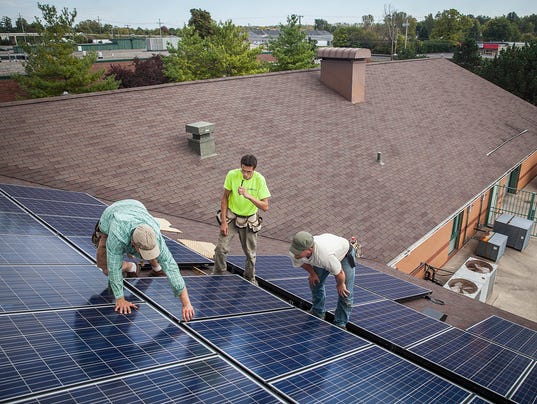
Workers with Indianapolis based company Rectify Solar LLC install solar panels on top of the Youth Opportunity Center on Kilgore Avenue Wednesday Oct. 7, 2015.
(Photo: Jordan Kartholl/The Star Press, Jordan Kartholl/The Star Press)
Seth Slabaugh, seths@muncie.gannett.com4:22 p.m. EDT October 12, 2015
MUNCIE — A solar energy construction spree is in progress throughout the city to cut utility bills, educate the public and fight climate change.
Installation of solar panels is under way at the Youth Opportunity Center, to be followed by more projects at Kennedy Library, an ecoREHAB house in the Old West End, the Unitarian Universalist Church on the northwest side and Shaffer Chapel AME Church in Whitely.
"This sort of project can really bring in a lot of diverse people," said Chris Randolph, pastor at Shaffer Chapel, a predominantly African-American denomination. "Solar energy crosses all boundaries. There is no one that doesn't want to have better energy and pay less. If we can do it at the church, then we can do it at homes."
ecoREHAB, a nonprofit organization that collaborates with Ball State University and the city, is installing eight solar panels — each measuring about 3 feet by 7 feet and weighing 50 pounds — on the roof of a house that it rehabilitated at 522 S.Gharkey St.
"We are hoping that will be enough solar panels to bring the house down to net zero electricity consumption, so we are using as much as we produce or producing as much as we use," said ecoREHAB's Craig Graybeal.
The house is heated with gas but air-conditioned with electricity, which also runs the appliances, lights and plug loads.
When you factor in tax credits, electricity savings and feeding power back into the grid, the payback period (how long until you break even) for a residential solar project like ecoREHAB's is eight or nine years, Graybeal said. Because it's a nonprofit, ecoREHAB is ineligible for tax credits, but it did receive a grant to cover half of the project's $8,500 cost.
The library, the Unitarian church, ecoREHAB and the Youth Opportunity Center received a combined $88,250 in SUN (Solar Uniting Neighbors) grants available as the result of a legal settlement between the U.S. Environmental Protection Agency, Indiana Michigan Power and other parties.
The Unitarian church applied for solar funding as a faith response to climate change and the need to care for creation, said Holly Hanauer, a board member. Producing electricity with solar emits no pollution, produces no greenhouse gases, and uses no finite fossil fuel resources.
Another motive was to save money over the long haul.
"We wouldn't be able to get tax credits that homeowners can get, so the grant was an important incentive for us," Hanauer said. "We expect the payback time in our system to be between seven and nine years, and after that whatever energy we generate on the roof will be free."
She urged citizens to contact their representatives in Congress to extend the federal solar investment tax credit on residential/commercial properties. The credit is scheduled to expire on Jan. 1, 2017.
"Otherwise, we're going to lose momentum on this," Hanauer said.
She also recommends that citizens contact their representatives at the Statehouse to defend against utility industry attempts to cut the amount that power companies must pay when they buy excess energy generated by home systems, as well as attempts by industry to charge a "user fee" to solar customers to help utilities cover the costs of the power grid.
"There was a big fight six months ago to keep net metering in this state, and it's going to come up again," Hanauer said. "The utilities want to get rid of it."
Kennedy Library is using its $30,000 grant to help pay the estimated $88,000 cost of a 10-car solar carport with 80 panels on the roof.
"It will not save us a huge amount of money," library Director Ginny Nilles said. "It's more of an educational venture. We're mostly excited about the educational programming aspect. That's why we want to have this (solar energy) fair in April, to educate people."
The Unitarian church's solar panels won't be visible from the ground, but the church will monitor all 80 panels on its roof and show on a monitor in the foyer how much energy they are collecting.
Shaffer Chapel obtained its $10,000 solar grant through Hoosier Interfaith Power & Light (HIPL) with the same I&M legal settlement funds as the other grant recipients.
"Each congregation that gets a solar grant makes a commitment to reduce their energy use and also makes a commitment for the people in their congregation to lower energy use in their own lives," said HIPL's Mike Oles. "It's a holistic effort.
If all Indiana churches went solar, they could save $26 million a year that could "go to ministry and community work, not just the power companies," he said. "There are also huge savings out there for individuals who make their lives more energy efficient."
LANSING — Since Michigan's energy law was adopted in 2008, billions of dollars have been spent in the state's emerging renewable energy industry — building infrastructure, adding jobs and lowering costs.
With the help of the state's two largest utilities, which are required under state law to generate electricity from renewable sources, nearly $3 billion has been invested on wind, solar, biomass and other clean power sources across the state.
Now, the utilities want state lawmakers to end the standards that contributed to those results — mandates that governed the amount of electricity they produce from renewable sources.
Detroit's DTE Energy Co. and Jackson-based Consumers Energy say they don't need mandates to expand their investment in solar and wind power. Rather, they believe new rules from the federal Environmental Protection Agency requiring utilities to reduce their carbon emissions by 32 percent by 2030 will ensure further investments in alternative energy.
Their position has changed in seven years: Both companies supported including renewable standards when the Legislature approved the first energy law.
"There are some who believe that we won't do it unless we're forced to do it. I don't agree," said Irene Dimitry, DTE's business planning and development vice president. "It's the right thing to do."
Not everyone is convinced. Groups from the Sierra Club to some large industrial corporations — led by Benton Harbor-based appliance maker Whirlpool Corp. — say Senate bills that would eliminate Michigan's renewable energy standard and a companion mandate requiring programs to reduce energy use would cause the utilities to scale back their efforts in pursuit of higher profits.
"Investor-owned energy companies have little incentive to sell less energy and reap less profit," the Sierra Club's Michigan chapter said in recent Senate testimony, "but as regulated monopolies they can and should be required to help their customers reduce energy waste."
Gov. Rick Snyder also has advocated for upping Michigan's renewable targets — as much as 24 percent of a utility's electric portfolio by 2025, he said in March. And, he added, Michigan should aim for a combined renewable and efficiency target of 30 percent to 40 percent within a decade, based on costs. But the governor has stopped short of saying that should be mandated.
The Senate's Energy and Technology Committee has held hearings this summer and fall on a two-bill package that would update the 2008 law. Included in the bills is a provision to repeal a mandate that utilities generate a portion of their electricity from renewable sources.
Utilities were required to produce 10 percent of their electricity from renewable sources by 2015. DTE and Consumers both say they have met that target.
Revisions to the Senate bills, sponsored by Republican Sens. Mike Nofs, of Battle Creek, and John Proos, of St. Joseph, could be introduced next month based on testimony gathered at the hearings, said Greg Moore, Nofs' legislative director and energy policy adviser.
Nofs has received $122,995 in political contributions from people and groups connected with electric utilities, according to the nonpartisan National Institute on Money in State Politics. More than $98,000 of that amount has come since 2010, the year Nofs was tapped as chairman of the Energy and Technology Committee. Proos has received $71,170 from the electric utility sector, with most of that coming since 2014.
The legislation as drafted would replace the mandates with a process known as integrated resource planning, which would be used to set rates. DTE and Consumers say the IRP process is more flexible and transparent and allows utilities to consider all energy sources to find the best value for customers, rather than building their electric portfolios around renewable targets.
This scenario is playing out in states across the country, where lawmakers are attempting to roll back, if not repeal, renewable standards. Mandates have been targeted in states from Colorado to Kansas to Ohio.
Proponents of eliminating the standards say they were necessary when the renewable industry was in infancy, but the solar and wind markets now are large enough that they don't need incentives.
"It's time for that industry to sink or swim on its own," Moore said. "What is the most cost-effective resource for our ratepayers? Not having the Legislature pick winners or losers based on the hot technology of the day."
Less costly
The emphasis on renewables has had noticeable effects on the industry, particularly on price. The cost of installation has fallen as the market has gained traction across the state.
In a February report, the Michigan Public Service Commission, the state's energy regulatory agency, said the most recent wind contracts it approved cost in the range of $50 per megawatt hour to build. That was about 10 percent lower than the cheapest contracts approved in 2011 and half as expensive as those from 2009 and 2010.
The standard also spurred nearly $3 billion in investment in renewable energy through 2014, based on an assumption that installation cost $2,000 per kilowatt hour, the MPSC said. It also is estimated to support roughly 8,200 jobs.
"The renewable energy standard is resulting in the development of new renewable capacity and can be credited with over 1,450 megawatt hours of new renewable energy projects becoming commercially operational since the (2008 law) took effect," according to the MPSC's report.
The utilities themselves offered similar data: Dimitry said the company's first wind project cost $115 per megawatt hour, while the price of its most recent had dropped to $50.
Lower prices for installation are one reason why proponents of repeal say it's time to abolish mandates.
Another reason is aging coal. Consumers plans to retire seven coal-generation units by next year; DTE another two. Valerie Brader, whom Snyder appointed to lead the new Michigan Agency for Energy, testified recently before the Senate energy committee that a total of 25 coal-fired units are expected to come offline by 2020.
"When we think about the pending EPA regulations, the Clean Power Plan, that will put even more pressure on Midwestern coal plants and will drive even more transformation," said Dan Bishop, a Consumers spokesman. "In our mind, there is little question that inevitably there's going to be more investment in renewable energy and energy efficiency."
Duplicating efforts
Utilities say they view the Clean Power Plan as a federal mandate they'll have to meet, so continuing Michigan's standards would be duplicative. They want flexibility to consider all electricity generation sources, including renewables and natural gas, and say there are no plans to uproot the wind turbines or solar panels they already have installed.
DTE says it has more wind and solar projects in the works. It recently received bids for a solar project that would generate 5 to 50 megawatt hours of electricity, Dimitry said.
Consumers recently announced plans to buy electricity from a new 100-megawatt wind farm in Huron County.
"We're buying wind power from seven different facilities. We own two wind parks ourselves," Bishop said. "There's been a tremendous amount of work done in this space, and we just see that continuing."
Since there's evidence the mandate has worked, "some have said, 'Why don't you just keep it in the books?' " said Moore, Nofs' energy policy adviser. "We don't want mandates. We don't believe they are necessary."
The issue isn't limited to the large players.
The Michigan Municipal Electric Association, which represents 40 municipally owned electric utilities, said decisions about pursuing energy efficiency and renewable sources are best left to local leaders.
"It would be our preference to be allowed to do so without the burden of rigid state mandates," Jim Weeks, the association's executive director, wrote in submitted testimony. "History tells us that a one-size-fits-all approach to energy policy cannot compete with a process that leaves these important decisions in the hands of our local governing bodies."
Preserve standards
Yet Michigan is among more than two dozen states and Washington, D.C., that have adopted renewable standards, according to a March 2014 report from the Union of Concerned Scientists, a Cambridge, Mass.-based organization that performs science-based analysis of policy issues such as clean energy, global warming and agriculture.
Of those states, 17 require at least 20 percent of a utility's electric portfolio come from renewable sources, according to the UCS report. Still more, including California and New York, require at least 30 percent.
Michigan could support boosting its standard to 32.5 percent by 2030, UCS analysts estimated. The group modeled various scenarios, including assuming no changes to Michigan's current standard.
If the renewable requirement was increased to 32.5 percent, retail prices for customers would rise by about 3.5 percent by 2020 before leveling off by 2030, the group predicted, and investment could reach $9.5 billion. UCS analysts also said it's the best option to diversify utilities' power portfolios and lessen the reliance on fossil fuels.
Environmental groups also say a shift toward more renewable resources will mean improved health benefits to Michigan residents.
"When the evidence is so clear that renewables and efficiency carry with them significant benefits to the people of Michigan, I believe it is critical to preserve these standards rather than replace them with a less-robust and more-complex mechanism," Sam Gomberg, UCS' lead Midwest energy analyst, testified before the Senate committee.
"We know we want to continue developing these resources, so let's maintain the standards and make sure that happens."
Editor's note: This story has been updated with political contribution data.
Cheap natural gas, falling costs for wind, solar already have power companies on low-carbon path
Lynn Good, Duke’s chief executive, is undecided about the EPA’s carbon-dioxide emissions plan.
PHOTO: GETTY IMAGES
By REBECCA SMITH, Oct. 11, 2015 7:33 p.m. ET, 60 COMMENTS
U.S. coal companies and at least 16 state governments are working on challenges to the Obama administration’s new rule limiting carbon emissions from power plants. Most electric utilities have a different strategy: They are embracing it.
From Dominion Resources Inc. in Virginia to Dynegy Inc. in Houston to Ohio’sFirstEnergy Corp., electricity producers say they plan to comply rather than contest the regulation.
The main reason, executives and experts say, is that economic forces are pushing the power industry inexorably toward a lower-carbon future.
“Everybody is moving in this direction anyway,” said Dominion Chief Executive Tom Farrell.
The new regulations just add certainty to companies’ plans to move away from relying on coal to generate electricity, turning instead toward cheap natural gas as well as renewable energy, which is available at increasingly lower cost.
“Price is a larger force in electricity markets today than what Washington is doing with regulations,” said Todd Carter, president of Panda Power Funds, a private-equity investor and generating-plant developer based in Dallas.
Panda Power Funds is building a huge gas-fired power station in central Pennsylvania, adjacent to a 65-year-old coal plant that closed down last year. Building near the old facility means Panda can reuse existing infrastructure like transmission lines and an electrical substation to save money.
Switching from an old coal plant to a modern natural-gas one can cut carbon-dioxide emissions by between 50% and 60% for each megawatt hour of electricity produced, according to the Environmental Protection Agency.
And although coal also remains a relatively cheap fuel, natural-gas plants can produce power at lower prices and are often much more profitable for the companies that own them.
“Our coal assets are still running but they’re not making any money,” said Bob Flexon,CEO of Dynegy, an independent supplier whose generating capacity is about 45% coal and 55% gas. “All the earnings are coming from our gas portfolio.”
That is partly because of the way electricity markets work. In much of the U.S., grid operators take bids from generators every day, tapping the lowest-cost resources first—often natural-gas plants.
But the market price is set by the last producer needed to meet that day’s electricity demand, which tends to be a coal plant. So natural-gas plants can often offer electricity at prices lower than coal plants but collect the higher price set by coal units.
In the wake of the U.S. shale boom, natural gas has become so abundant and so inexpensive—and forecasters expect it to remain so for years—that the EPA’s new carbon rule has provisions that prevent utilities from relying too much on a single fuel. Instead, the EPA regulation encourages development of renewable-energy projects.
Coal consumption by utilities fell so much in the first four months of the year that it may be headed toward a 25-year low, according to data released in August by the U.S. Energy Information Administration.
“The bulk of utilities have already started to make the transition away from coal,” said Jeremy Fago, PricewaterhouseCoopers LLP’s power and utilities deals leader. He said the rule’s emphasis on green electricity means “it effectively creates a national renewable-energy policy.”
To be sure, not every utility has agreed to go along with the EPA’s 15-year plan to cut carbon dioxide emissions from the power industry by 32% compared with 2005. Implementation is being left to the states, which must come up with plans to comply or face direct regulation from Washington.
So far, at least 16 states have expressed opposition to the regulation, and some are likely to file a formal suit once the EPA publishes the carbon rule in the Federal Register, which is expected to happen this month.
Some companies are testing the political winds in their states or are still analyzing the potential impact on customer bills and company earnings. Edison Electric Institute, which represents shareholder-owned utilities, is staying out of legal contests while working with utilities and states to plot a path forward.
North Carolina-based Duke Energy Corp., with utilities in the Midwest and Carolinas, is undecided. Lynn Good, Duke’s chief executive, recently told investors that her experts continue to analyze the plan, though she noted, “I think there’s flexibility there.”
Some utilities are hedging their bets. Ohio-based American Electric Power Co. is urging the 11 states in which it operates utilities to draft carbon-reduction plans. But it is also participating in the Utility Air Regulatory Group, a loose federation of energy companies that has challenged the low-carbon rule in the past and may do so again.
Renewable energy is becoming more financially attractive for utilities. A recent survey by the Energy Department found that utilities paid 66% less for wind power purchased under long-term contracts in 2014 than 2009, making it extremely competitive with electricity from the latest gas-fired plants.
Southern Power, a unit of Atlanta-based Southern Co., recently installed its first wind turbine at a 299-megawatt project in Kay County, Okla. It also announced the purchase in August of controlling interest in the 200-megawatt Tranquility solar facility in Fresno County, Calif., from Recurrent Energy, a unit of Canadian Solar Inc.
When combined with other existing and announced projects, these developments will boost Southern Power’s green portfolio to a production amount equivalent to three big fossil-fuel plants, though production will be less because the wind doesn’t always blow and the sun doesn’t always shine.
The company made more electricity using natural gas than coal in the second quarter, something so unusual it was highlighted in an earnings call. Nevertheless, Southern said it is still studying the rule and deciding what its next steps will be.
Think Al Gore, but a lot more charismatic, and a lot more Republican, and female — with curling, platinum blond hair, plenty of bling, and a honey-sweet South Carolina drawl. That gives you a rough sketch of Michele Combs, founder and chair of Young Conservatives for Energy Reform, and possibly the most impassioned and unexpected messenger on clean energy and climate change the GOP has ever seen.
“I love Al Gore,” says Combs, “but he’s the wrong messenger for us. And he’ll admit that. He made this issue polarized. And that’s what we have to tackle every day.”
The daughter of Christian Coalition President Roberta Combs, Michele jumped into politics at age 21 when she became state chair of the South Carolina Young Republicans and a protégé of Lee Atwater, campaign manager for George H.W. Bush. She later built a special-events company that produced hundreds of events for members of Congress, the White House, and the Republican National Convention. Along the way, she befriended many high-level party members.
Michele Combs
That proved to be a big help in 2012 when she founded Young Conservatives, which is now building grassroots campaigns on energy reform and climate change in every state in the country, and working to convince environment-minded Republican senators to craft a comprehensive energy bill. She’s also working on the state level to help pass clean-energy legislation, like bills to set up net-metering systems that make it easy for homeowners with solar panels to sell their excess electricity into the grid.
We spoke with Combs recently to find out why she’s taking on this issue and what it will take to engage Republicans — young and old, moderate and right-wing — on climate change.
——
Q.What first got you fired up about energy reform?
A. It started when I was pregnant with my son — he’s now 14. You know how the doctors say, “Don’t eat fish.” So I asked my doctor why, and she said because of the mercury. Well, I said, “Mercury? Where is it coming from?” I began to research it on my own, and found that it came from coal-fired power plants. I was shocked. I thought, “This is something I need to get involved with.” But then I thought, ”Ahh! No, Michele, this is a liberal issue.” Then I thought, “A liberal issue? No! It’s a conservative issue, it’s a family issue — we need to protect our fetuses from mercury. It’s an American issue — we need to protect ourselves, our children, we need to protect everybody from mercury. Mercury’s a really bad thing.”
Q.How did that translate into political action on energy and climate?
A. I started on a mission to find out what was going on with our air, and why there is such a disconnect with the Republicans and the Democrats on this issue. So I got invited to this trans-partisan energy forum in Colorado in a real hippie town right outside of Boulder. There were a few conservatives there, but it was mostly liberals, about 30 of us, and we sat around this lake, and there was this gong, and they meditated, and I was thinking, “What the heck am I doing here?” One of people there was Al Gore. I was like, “Oh my Gosh, I am just in the throes of environmentalism!” But he was so kind to me, and while we’re very different, we became very close. I didn’t look at him as this liberal-monger Al Gore, I just looked at him as a person, and I learned a lot from him.
He introduced me to Larry Schweiger, who at that time was the president of the National Wildlife Federation. Larry said he’d been wanting to meet Republican senators and congressmen, and would I like to consult? I said, “Yes, of course,” because I really like him, and he’s a great Christian. I introduced him to my mother, and it ended up that the Christian Coalition started partnering with NWF. We were one of the ones that got [South Carolina Sen.] Lindsey Graham involved in the climate and energy issues, because Lindsey Graham and my mother are very, very close.
Q.How did you transition your focus from mercury to climate change?
A. The climate issue is not the defining issue for our organization at all, but, if we have clean air, it’s going take care of climate change. So if you don’t agree [with climate science], that’s fine, because we all agree on clean air. Clean energy is the next moonwalk, it’s the next frontier, and this country is the best country in the world. It’s so innovative and we can do anything, we can lead the world in this issue. I see it bringing jobs, and more importantly, clean air! I mean, who doesn’t want clean air?
Q.Tell me how your mom has influenced your work as an activist.
A. My mom is one of my biggest inspirations. She was a very successful businesswoman who became involved in politics and then she joined up with the Christian Coalition. The No. 1 thing the Bible talks about is to take care of the elderly, the widows, the environment, and so forth, so that tradition informs the Christian Coalition. My mom has taken a lot of heat for going after some of these issues, but she believes in her heart that this is what she needs to do. I took my thinking and my values from her example, with the idea that I would expand on it.
Q.So you see your environmental work as an extension of the Christian Coalition’s mission?
A. Yes, yes. Definitely. This is all about supporting the health and security of American families.
Q.Don’t Christians disagree about whether the Bible says God wants people to protect the Earth and its resources, or whether God has given us those natural resources to exploit and extract?
A. I don’t really deal with the Christian community. The Christian Coalition members are Christians, but they are Christians who are politically active. We focus less on faith and scripture and more on family advocacy. Our deal is all about education, about reframing the message. I love Al Gore, but he’s the wrong messenger for us. And he’ll admit that. He made this issue polarized. And that’s what we have to tackle every day. We have to educate conservatives — we’re the actual conservationists. That’s where the word conservative comes from — fromconservation, from Teddy Roosevelt.
There are Christians spreading a message about “Creation Care,” but they seem to be more liberal and moderate Christians, maybe Episcopalian or Lutheran. We don’t really use the “creation” language, we focus on clean air, jobs, family issues.
Q.Let’s get specific about your policy goals.
A. Our ultimate policy goal is a comprehensive, bipartisan energy reform bill that would give us clean energy, improve energy efficiency, and also help small businesses. The House always goes faster than the Senate, so we are starting with the Senate, and working through Republican senators like Lindsey Graham and Rob Portman [Ohio] and Kelly Ayotte [N.H.] and Cory Gardner [Colo.]. We’re meeting with senators and building up the grassroots support in the states where the senators live. Right now, for instance, I’m in Ohio.
Q.What kind of grassroots work are you doing in Ohio and elsewhere?
A. We helped Portman last year on his efficiency bill, which passed. We’re doing events for young conservatives in Ohio and getting a lot of media attention. I’m writing op-eds for papers like the Cleveland Plain Dealer. Elsewhere, we’re working on net-metering legislation in Indiana, Florida, and Georgia, for example, and wind energy legislation in Iowa, Kansas, and Texas. We understand, overall, that we’ve got to have the grassroots before we can go anywhere with the [national] energy bill.
Q.You have voiced your opposition to oil industry subsidies — would that be in the bill?
A. Yes, I think the oil subsidies are ridiculous. I don’t know how companies that make billions of dollars still get subsidies. They’re just there, and no one has managed to change that. But I don’t want to get too specific about the bill we want just yet — it’s too early to do that, and we risk not getting our foot in the door. Some senator may come out to say, “I don’t like that,” and shut us out.
Q.What’s your position on a carbon tax?
A. I’ve seen it [proposed] and I think it looks good, but I don’t think it’s something we’re going to come out on right now.
Q.What’s your timeline for the bill?
A. After the [2016] election. I just don’t see that anyone’s going to touch this issue now, especially the Republicans. And I don’t see a big shakeup happening [in Congress] in 2016 — if anything, there might be more Republicans. In the meantime, we’re going to really build the grassroots so we can provide cover, so we can keep the senators safe, so that when they do vote on the bill, they don’t get a lot of feedback from the other side. So they don’t get voted out of office.
Q.When you speak to senators and to the grassroots, do you have to be careful to avoid the issue of climate change?
A. We’re not going to go to ultra-right older Republicans and start talking about climate change, because if we do, they’re gonna shut us down. But if we talk about energy independence, clean air, homeowner energy, and American innovation, we have a chance to get them. Now, with younger Republicans, we can say, “Clean air is gonna help climate change,” and they’re like, “Yes it is!” They grew up with recycling, they grew up with renewables, they didn’t live through the whole Al Gore era, they have no barriers. But with older Republicans, you have to be more careful.
Q.What’s the hardest moment you’ve had, the biggest barrier you’ve faced, since you began your political work on energy and climate?
A. Going to one senator’s office, when we first started. I’m not going to tell you who it was because we’re still working on him, but he’s from out west. He told us off for taking on this issue, and it was kind of like, “You guys shouldn’t be here,” and it got uncomfortable.
Q.That sounds like the attitude of many of the current Republican presidential candidates toward the issue of climate change. Does it upset you to see how poorly energy and climate are playing among the conservative candidates? How do you think progressives and environmentalists should react?
A. They are playing to the base, which is very conservative. I know we will see more of [the energy and climate issues] closer to the general election. I’m optimistic. It’s politics, and politics can change fast. We just have to educate, educate, educate.
As for environmentalists, they have learn to compromise, and to not overreact. The fact is, we’re all Americans, and everybody wants a better future for their children. Climate activists can’t come in and say, “It’s our way or the highway, and we’re gonna die tomorrow because of climate change.” That’s not the way to sell it. Of course we’re not going to die tomorrow. Maybe 20, 30 years from now, but not tomorrow. [Laughs.]
You know the biggest thing to keep in mind? That it can’t be all or nothing. This is not about right versus wrong, good versus evil. It’s about educating, compromise, and baby steps. That’s the best advice I can give to anyone who wants to make a difference on this issue. It’s not whether you’re dunked or you’re sprinkled. It’s not a religion.
MANDATE MAN: Gov. John Kasich wants to ratchet up Ohio’s green energy mandates
Ohio lawmakers looking to extend a freeze on state “green energy” mandates will have to find a way past Gov. John Kasich.
Kasich immediately shot down as “unacceptable” a legislative study committee’s Wednesday recommendation the state extend its current two-year mandate freeze indefinitely.
The governor’s public opposition to an extended freeze isn’t the only sign he’ll fight for increased mandates. Kasich reportedly threatened to veto a version of SB 310 that would have locked the mandates at 2014 levels.
And the same day the Energy Mandates Study Committee published its recommendations, a new coalition of Kasich backers calling itself Ohio Conservative Energy Forum popped up to promote steeper mandates.
Ohio Right to Life President Mike Gonidakis — a Kasich appointee to the state medical board — is a member of Ohio CEF’s leadership council. So is retired Air Force Col. Tom Moe, formerly Kasich’s appointed director of the Ohio Department of Veterans Services.
Other leaders of the group demanding tougher mandates as a matter of “conservative support for a common-sense, all-of-the-above state energy policy” include Kasich campaign enthusiasts from Ohio Young Republicans and Ohio Federation of College Republicans.
News stories from Gannett and The Columbus Dispatch have already quoted Hartley and Ohio CEF as “conservative” advocates of higher mandates without acknowledging Hartley’s ties to the governor’s presidential campaign.
Dispatch reporter Dan Gearino described Hartley as “president of a political consulting firm,” and Gannett reporter Jessie Balmert described Hartley simply as a “conservative who thinks an indefinite freeze is a bad idea.”
Ohio Watchdog contacted Ohio CEF to ask whether Hartley is still being paid by Kasich’s campaign, but an inquiry sent to the address listed on Ohio CEF’s website was returned as undeliverable and Ohio CEF did not respond to questions submitted through a web contact form.
Both of Ohio’s free-market think tanks remain critical of the green energy mandates Kasich wants to expand.
“I’m bewildered by Gov. John Kasich’s leftish stance on energy issues,” Opportunity Ohio president Matt Mayer told Ohio Watchdog.
“From his tax hike attack on the oil and gas industry to pro-renewable mandate support, Kasich frankly isn’t much different than a Democratic governor would be,” Mayer sad. “Unfortunately, his anti-free market energy positions will increase costs on businesses and consumers in Ohio and lead to job losses.”
The mandates Kasich wants to expand were approved in 2008 by a Republican-controlled Ohio General Assembly and signed into law by former governor Ted Strickland, a Democrat.
“We shouldn’t return to the policy mistakes of the Strickland administration by embracing another costly government mandate,” Buckeye Institute president Robert Alt said in a press release.
The Ohio chapter of conservative activist group Americans For Prosperity praised the Energy Mandates Study Committee for recommending an indefinite freeze.
“We’re thrilled that Ohio is continuing to lead the way in rethinking these harmful energy mandates,” AFP-Ohio state director Baylor Myers said in a statement.
The governor’s office did not respond to questions from Ohio Watchdog.
Before Kasich signaled he wouldn’t stand for a freeze of Ohio’s green energy mandates, there were signs of progress in the General Assembly towards rolling back the energy efficiency and electricity generation requirements.