Bill concealing legislative records from public scrapped
Niki Kelly, The Journal Gazette
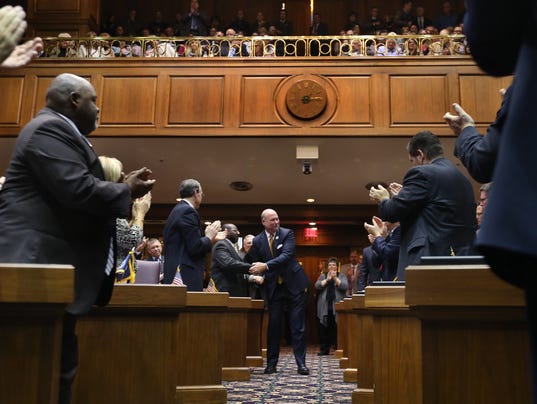
INDIANAPOLIS - A last-second attempt to conceal legislative records from the public hit a wall Tuesday morning.
A conference committee hearing had been called for Senate Bill 528 - a bill about public records. Legislative leaders were considering adding language to officially exempt legislative calls and emails.
The move is related to a recent lawsuit filed against the Indiana House, and multiple opinions by the Indiana Public Access Counselor that the General Assembly must follow the state public records law.
But the Tuesday meeting was scrapped.
"Ultimately I thought it was inadvisable to put legislation together at the last second despite the appropriateness of it and the need for it," said Republican House Speaker Brian Bosma. "Probably best not to do it."
Citizens Action Coalition, Common Cause Indiana and the Energy and Policy Institute filed a lawsuit earlier this month in Marion County against the Indiana House Republican Caucus and State Rep. Eric Koch, R-Bedford, for violating the Indiana Access to Public Records Act.
According to a press release, the groups are asking the court to declare that Koch and the caucus are subject to the state open records law, which the GOP legislators have denied, and to order disclosure of correspondence between Rep. Koch and utility companies regarding solar energy issues.
Both the House and Senate have long held that they aren't subject to the public records law though there isn't a specific exemption in the law. Judges have been hesitant in the past to step into legislative affairs due to the separation of powers.
"As Indiana Public Access Counselor, I humbly and respectfully request the caucus reconsider its position on the blanket inapplicability of the Access to Public Records Act and treat public records requests in a manner consistent with the spirit of transparency and openness," the April PAC ruling said.
He said the caucus could define their own work product as an exception to the law.
"I implore the General Assembly to be judicious in deciding what to withhold and what to release," the ruling said. "It indeed requires a delicate balance, but the scales should favor transparency.
Effort to withhold state legislative records stalls
Tom LoBianco, tom.lobianco@indystar.com 1:57 p.m. EDT April 28, 2015
A last-minute push to protect state lawmakers from having to disclose public records, including their emails and other documents, has stalled, but is likely to resurface next year.
Senate and House lawmakers had scheduled a conference committee for Tuesday morning to consider a measure that would have specifically exempted their exchanges from public disclosure. But the meeting was cancelled at the last minute Tuesday morning.
House Speaker Brian Bosma, whose lawyers are fighting off a challenge from a Washington-based environmental group, said the protection is needed, but will probably have to wait.
"Ultimately I thought it was inadvisable for us to put legislation together at the last second, despite the appropriateness of it and the need for it," he said Tuesday.
Lawmakers are a little more than 24 hours from wrapping up work on their 2015 legislative session. The issue of access to public records arose earlier in the session when the Energy and Policy Institute sought emails between House Energy Chairman Eric Koch, R-Bedford, and Duke Energy regarding solar energy legislation.
Bosma's staff flatly refused the request, citing a 1993 court case that allegedly exempted all state lawmakers from the state's public records laws. But Indiana's public access counselor, who is appointed by the governor to interpret state open records laws, determined at the time that lawmakers, along with other public agencies, are still subject to the law.
"It is the opinion of the public access counselor the Indiana General Assembly is subject to the Access to Public Records Act," Public Access Counselor Luke Britt wrote in the conclusion of his March 6 opinion.
But because the opinion's are only advisory, and not enforceable, Bosma's staff replied that they would still not release the emails. Specifically, Bosma's chief counsel, Jill Carnell, argued that a pair of Indiana Supreme Court cases left the decision solely up to the General Assembly, as to whether disclose.
"For all of these reasons, the Indiana Access to Public Records (in the Indiana Code 5-14-3) does not apply to the Indiana General Assembly," Carnell wrote in a March 16 reply.
A month later, the Energy Policy Institute and a pair of local liberal watchdog groups -- Common Cause of Indiana and The Citizen Action Coalition -- filed suit against the Indiana House in Marion County Superior Court.
The National Renewable Energy Laboratory (NREL) has published a report on the Value of Solar: Program Design and Implementation Considerations. The report is designed for regulators, utilities, and stakeholders who are interested in issues related to value of solar (VOS) program design and implementation. It discusses and addresses program design options and considers how a VOS rate may impact future development of distributed PV projects. “The study assesses the current cost competitiveness of residential solar projects in each U.S. state, under several hypothetical VOS tariff and incentive levels.” The six authors are staff members of NREL and the Solar Electric Power Association.
Eco-friendliness and personal finance are essentially cousins. Not only are our environmental and financial necessities aligned – providing ourselves with sustainable clean drinking water and nutritious sustenance, for example – but we also spend money on both the household and government levels in support of environmental security.
Then there’s climate change. We’ve already seen a rise in powerful land-bearing storm systems and extreme droughts, with New York and New Jersey recently spending $71.4 billion to rebuild from Hurricane Sandy. But that’s just the beginning, as storm surges and other bad weather are expected to cause more than $500 billion in property damage by the year 2100. Climate change will also have a direct impact on our military-industrial complex, as nearly all of our East Coast air and naval installations are vulnerable to sea-level rise.
In the meantime, we can all try to do our part to save the world for our kids, grandkids and future generations. In order to help highlight this important issue as well as all states taking steps to care for the environment and call out those doing a poor job, WalletHub compared each of the 50 states in terms of 14 key metrics designed to illustrate each place’s environmental quality and the eco-friendliness of its policies.
Jeff Swiatek, jeff.swiatek@indystar.com7:56 a.m. EDT April 26, 2015
Credit the ice ages for making Indiana a good place to turn wind into electricity. All that glacial action scoured flat the northern half of the state and sculpted the perfect terrain for wind turbines.
A few million years later, the Environmental Protection Agency is about to use regulatory fiat to make the state even more attractive to industrial windmills.
New EPA rules coming down the pike will cut carbon emissions from coal and gas power plants for the first time and boost demand for clean power such as wind. One result: Indiana could see two or three times as many wind farms as it has now.
In its latest projection of U.S. wind energy needs, the federal Department of Energy says only five other states are in line to boost their wind power sectors as much as or more than Indiana.
Indiana has a good shot at tripling its wind power capacity in the next decade or so, from the current 1,744 megawatts to 5,000 or more, says Sean Brady, Midwest policy manager for the wind power advocacy group Wind on the Wires.
That would require erecting 2,000 wind turbines to join the 1,031 that now dot the state's landscape north of Indianapolis. "Indiana has quite a large upside. It has a great opportunity for wind development," Brady said.
If growth of that magnitude occurs, investment in the state's wind farms would have to soar from $3.7 billion to more than $10 billion, making wind farms one of the most expensive industrial installations in state history.
Whether wind power actually has that kind of upside, however, depends on a few cards being played just so.
For one thing, not everyone in the public policy arena thinks that wind is the way to go. It is, after all, a variable power source that you can't rely on to generate the juice when needed. (Indiana's four-season winds are especially fickle, with a fivefold difference in breeziness between the least windy month, August, and the windiest, November. Regional power grid operator MISO tracks wind power use by the hour and posts it online.)
Wind power, in addition, is expensive to install ($2 million or more per turbine) and controlled to a great extent by foreign companies, which doesn't bode well for winning a lot of public support.
Also, demand for wind energy depends on Congress renewing the federal tax credit that wind developers rely on to be price-competitive with other forms of energy. The credit expired at the end of last year and renewal isn't a given.
And one last thing: The proposed EPA CO2 rules are fraught with sticky issues, gray areas and unknowns that could tip in favor of wind or against it, depending on how they're finally written.
"So much is up in the air," said Joan Soller, director of resource planning at Indianapolis Power & Light Co.
One particularly sticky issue: EPA's proposed "clean power plan" rules don't give a utility any credit, under the CO2-lowering mandates, for using green energy in its generation portfolio if it buys wind power from outside its home state.
If that proviso stands, Indiana's wind industry could be hurt because it currently sells the bulk of its power to non-Indiana utilities. They would be newly motivated to drop their Indiana contracts and buy their green energy from wind farms in their own states.
Utilities and other interests are lobbying the EPA to drop the rule giving credit only to home-state-bought green energy. The final EPA rules are expected out this summer. States also will have a say in the matter, so they'll have to be lobbied, too. (Some states also are fighting the CO2 rules in court.)
Whatever happens, Indiana likely won't lose its standing as a big player in wind energy. It's just too good a place to site wind farms.
The northern reaches of the state not only are prairie-flat, but they're close to Chicago, Indianapolis and other big population centers that gobble megawatts of electricity. The state also overlaps the territories of two electrical system operators that distribute power from Canada to Louisiana and points east and west.
And, of course, it's windy.
Wind farm developers in Indiana are already scouting out locations for new farms as the new EPA mandates march closer.
"We're actively marketing sites to ... gauge interest" from power users, said Ryan Brown, an executive vice president at EDP Renewables. "Expansion is definitely possible."
Spanish-owned EDP already controls about 40 percent of the state's wind turbines through its Meadow Lake wind farm in White County and its newly opened Headwaters farm in Randolph County.
Most of Indiana's turbines were erected from 2008 to 2012. Growth has since slowed. Last year, Headwaters was the only major wind farm to open.
A proposed project in Benton County and another in and around Rush County are seen as leading contenders to be built next. Those projects would have about 70 turbines each.
In Indiana, "the easiest-to-develop projects have been developed," and much of the best available ground for catching steady wind is taken, said Tristan Vance, director of the Indiana Office of Energy Development. "But I think we will see future projects here. We've been fairly open for wind development."
Though the best sites for wind farms might indeed be snapped up, technological improvements have given the industry taller turbines with larger and lighter blades that capture more wind at higher altitudes than older, smaller turbines.
That should allow wind developers to continue to profit from Indiana's wind at new sites with new turbines, said Brown of EDP.
At its Headwaters farm, EDP installed new turbines 312 feet tall from ground to gearhouse, with blades 180 feet long. Turbines at EDP's older farm in White County along I-65 are 262 feet tall with blade lengths of 134 to 144 feet.
Because the bigger machines can catch more wind, they generate electricity about 40 percent of time, compared with about 33 percent of the time for the shorter turbines, Brown said.
(Turbines likely won't get any taller. The Federal Aviation Administration requires special, harder-to-get approvals for turbines that exceed 500 feet from their base to the tip of an upright blade. The new turbines at Headwaters are just about at that 500-foot limit.)
With the bigger turbines, "Indiana is looking very attractive" for wind farm development down the road, said Michael Goggin, senior director of research for the American Wind Energy Association, a trade group for the wind industry. "At that height, (wind) is a very attractive resource in Indiana. It's like being in the plains at that altitude."
Any growth in wind farms also would put more money in the hands of farmland owners, who rent the land needed for the turbines. Average rents in Indiana now run about $5,000 a year per turbine, which amounts to about $5 million a year in statewide turbine rent payments.
For those who can get it, wind turbine rent "is pretty significant, especially if you have multiple turbines on a farm," said Justin Schneider, senior policy adviser and counsel at Indiana Farm Bureau. "It can take off some of the risk of crop production if you have a bad year."
Schneider said he thinks most Indiana farmland owners would be eager to rent their land for any new wind farm proposals that pop up.
Still, pushback to wind persists at policymaking levels. And that opposition could harden as wind energy use spreads and utilities are forced to spend billions of dollars nationally building transmission lines to handle the increased flow of power from new wind farms, said Tom Tanton, director of science and technology assessment at the Energy & Environment Legal Institute in Washington, D.C. The group has done studies suggesting federal subsidies to wind energy don't make economic sense.
Tanton said wind farm developers are able to push "hidden costs" of wind energy onto utilities and ratepayers. Those costs include gas turbine plants required to back up wind power and balance its fluctuating energy flows caused by intermittent wind, he said.
Existing backup power sources can handle the fluctuations of wind energy now, since it supplies only about 4.5 percent of U.S. electrical use, Tanton said. But if wind energy boosts its share of the market much beyond that, a fleet of costly new backup gas turbine plants that can turn on and off with short notice will be required, he said.
IPL's director of project development, Richard Benedict, said it's tough for a utility to even calculate the true cost of electricity from wind energy because of the need for backup capacity.
Wind-generated electricity is so variable it almost doesn't count as power in a conventional sense. IPL, for instance, has long-term contracts to buy 300 megawatts of electricity from wind farms in Indiana and out-of-state. But the Indianapolis utility can't count those megawatts when calculating its official electrical capacity because they're not reliably available, Benedict said.
"We (only) get it when the wind blows," he said.
Still, the coming of the CO2 rules might force IPL to buy much more wind-generated electricity in the future. Under its pending rules, the EPA won't allow IPL to claim CO2-lowering credits for the 66 percent of wind energy it now buys out-of-state, or for converting its coal-fired Martinsville plant to natural gas (because the conversion won't happen by the deadline set in the rules).
If IPL can't get credit for those green energy moves, it might have to turn to buying in-state wind energy in a big way.
IPL officials are trying to get their minds around the fact that they might have to buy as much as 1,000 megawatts of wind energy to meet the coming carbon-lowering standards. That move alone would create the demand for a 60 percent build-out, of about 600 turbines, in Indiana's wind farms.
Call Star reporter Jeff Swiatek at (317) 444-6483. Follow him on Twitter: @JeffSwiatek.
Wind power in Indiana
(2014 data)
Turbines: 1,031 on six wind farms.
Electrical capacity: 1,744 megawatts.
Electrical output: 3,495 thousand MWh (0.4% increase from 2013).
Share of U.S. wind energy produced: 3% (enough to power 321,000 houses).
Largest month for production: November (507 thousand MWh).
Smallest month for production: August (101 thousand MWh).
Largest Indiana wind farm: Fowler Ridge (355 turbines in Benton County, operated by BP Wind).
Annual land rent paid by wind farms: More than $5 million (typical rent is $5,000 per turbine).
Wind energy employment: About 1,500 jobs.
Investment in wind farms: $3.7 billion.
Proposed new wind farms: 200 megawatts (Wayne, Henry counties by EDP Renewables); 150 MW (Benton County) by Amazon and partners; 140 MW (Fayette, Rush, Henry counties) by NextEnergy Resources. If built, they would increase Indiana's wind farm generating capacity by 28 percent.
Forty-five years after the first Earth Day launched the modern environmental movement, economics are proving to be the catalyst bringing more people online with clean energy.
Kathy Luther, director of environmental management at the Northwestern Indiana Regional Planning Commission, said the agency and those like it are working to lower the costs of solar energy to encourage more people to install systems at their homes or businesses.
NIRPC has partnered with Dyer, Gary, Hobart and Valparaiso to bring Solarize Northwest Indiana online by cutting through the zoning bureaucracy of placing rooftop or freestanding solar modules on their property and reducing the costs of the systems through volume purchasing.
Through June 30, residents and businesses can sign up to see if a solar system can be installed on their property, how it would financially benefit them and just how much it will cost to take the plunge. NIRPC also selected an installer through a competitive proposal process, Midwest Wind and Solar LLC of Griffith to help streamline the process.
"Some of the top barriers for people to solar energy is the cost and the paperwork," Luther said.
Partnering with the towns and cities tackles one of those barriers. A federal grant that helps reduce the cost per solar module based on the number of participants helps tackle the second barrier.
"It's like a Groupon for solar," Luther said. The more businesses and homeowners participate, the lower the cost of the solar modules for all of the participants. That combined with a federal tax credit of 30 percent of the cost of installing a system through 2016 could reduce the cost of a typical system to as low as about $12,500.
Kevin Moore, president of Midwest Wind and Solar, said the falling prices of solar panels and the shortened time for a return on investment are bringing people from all walks of life to green energy. The Solarize Northwest Indiana program makes the systems even more economical.
When he first started the business, Moore said, all the metrics showed his clients would be young, environmentally conscious men. But, eight years in, he has learned that his client base is more diverse than he ever expected.
"One thing we have found that is very interesting is people who are looking at retirement in the not too near future, say 10 years away, they are investing in solar," Moore said.
One concern as people look to retire is determining how they will live on a fixed income. Solar energy stabilizes a homeowners' or businesses' energy costs and provides a level of predictability, he said.
Moore said solar first became popular in the areas where electric rates were the highest such as California and Hawaii, but as the cost for the systems go down, they are popping up throughout the Midwest. More said he has between $4 million and $5 million in installations in his territory of Indiana, Illinois, Michigan and Wisconsin.
"It really all comes down to a financial calculation as to whether people do it or not," Moore said.
A typical homeowner can see a return on their investment in as little as four to five years depending on the size of the system installed, he said. Currently, cost for electricity is about 12 cents a kilowatt hour. Producing your own solar energy reduces that cost to about 5 cents per kilowatt hour, he said.
The process begins with a phone consultation where technicians look at the site using Google Earth and Streetview to see if the property has a site that would work for an installation.
Technicians are looking for a shade-free south, east or west facing surface. Moore has seen applications mounted on barns, garages, residents, businesses and even ground mounts. Size of the systems is determined by the kilowatt hours the customer uses each month and just how much money they have to invest in the system.
An average 2,000-square-foot home could use a system of about 20 3-by-5-foot solar modules.
"It would get rid of about eight months worth of electric bills a year," Moore said.
The consultation results in a proposal that details the costs, the savings and projected return on investment. It also includes a bevy of statistics that help drive home the impact switching to solar, such as a simple residential installation is equivalent to planting 4,000 trees or reducing driving by 25,000 miles per year.
"I think what draws the general population to renewable energy first and foremost is financial …The rest, I think that's icing on the cake. They go, 'Wow'," Moore said.
Carrie Napoleon is a freelance reporter.
Learn more:
Informational sessions have been scheduled from 9-11 a.m. May 9 at the Plum Creek Center in Dyer and at 6 p.m. May 18 in the Community Center in Hobart. Dates and times for session in Gary and Valparaiso are to be determined.
Kevin Moore, president of Midwest Wind and Solar is a member of IndianaDG. Congratulations Kevin!



 Tom LoBianco, tom.lobianco@indystar.com
 Jeff Swiatek