

SunEdison ready to sign solar PV 25-year PPA for 150 MWs “just below” 5 cents/kWh with Austin Energy

Posted by Laura Arnold  /   March 16, 2014  /   Posted in solar, Uncategorized  /   No Comments

Cheapest Solar Ever? Austin Energy Buys PV From SunEdison at 5 Cents per Kilowatt-Hour

Cheapest Solar Ever? Austin Energy Buys PV From SunEdison at 5 Cents per Kilowatt-Hour

An unprecedentedly low price for a large solar project

Eric Wesoff
March 10, 2014

Texas utility Austin Energy is going to be paying 5 cents per kilowatt-hour for solar power, and it could mean lower customer rates.

City-owned Austin Energy is about to sign a 25-year PPA with Sun Edison for 150 megawatts of solar power at "just below" 5 cents per kilowatt-hour. The power will come from two West Texas solar facilities, according to reports in the Austin American-Statesman. According to reports, around 30 proposals were at prices near SunEdison’s. Austin Energy has suggested that the PV deal will slightly lower rates for customers.

This is one of the lowest, if not the lowest, reported prices for contracted solar that we have seen. Last year, First Solar (FSLR) entered a 25-year PPA in New Mexico for 50 megawatts of solar power at 5.79 cents per kilowatt-hour. That number included a significant PTC from the state. The Macho Springs project, the Austin project and most solar projects of this nature rely on the 30 percent federal Investment Tax Credit.

Austin Energy's net sub-five cent price does not include any state PTC, according to Monty Humble of energy development firm Brightman EnergyLLC. He said that the utility was "to be commended" for this solicitation. Humble added, "Based on our analysis, it can be done. There's not a whole lot of profit in it, but it's not a loss leader. It's a legitimate bid."

GTM Solar Analyst Cory Honeyman points out that "new PPAs signed in North Carolina fetched prices between 4.5 and 5 cents per kilowatt-hour." Like Macho Springs, those projects could also take advantage of an in-state tax credit to make the economics work. Honeyman said that none of the projects in Georgia or North Carolina were larger than 20 megawatts, so 5 cents does seem like "an unprecedented low for large-scale projects."

Bret Kadison, COO of Austin-based Brazos Resources, an energy investment firm, said this was "a highly competitive solicitation." Although historically, "Texas hasn't been a hotbed of solar, you're starting to see that change. ERCOT needs the generation."

He expects to see more solar activity "not just as a green source of energy, but as an affordable source of energy. Texas is seeing economic growth, but the power grid has not kept pace." Kadison added, "When you think about the volatility of natural gas, a 25-year PPA starts to look pretty attractive."

Kadison notes, "This is below the all-in cost of natural gas generation, even with low fuel prices and before factoring in commodity volatility and cost overruns." He also points out that the original RFP was for 50 megawatts, but the utility ended up buying 150 megawatts "in a red state where hydrocarbons dominate the political landscape." Kadison suggests that "one of the biggest cost reduction drivers that allowed solar to reach this parity came from the massive reduction in financing costs."

The 5-cent price falls below Austin Energy's estimates for natural gas at 7 cents, coal at 10 cents and nuclear at 13 cents. The utility points out that it approved a 16.5-cent price for the Webberville solar plant in 2009.

Austin Energy has a 35 percent renewable energy resource goal by 2016 and a solar goal of 200 megawatts by 2020. The utility is currently at about 25 percent, much of it made up by its 850 megawatts of wind.

Humble of Brightman Energy said, "I expect that this will force a lot of players to reexamine their approach and get far more aggressive. Because of the size of the ERCOT market and the size of the state, Texas is potentially the largest solar market in the country." According to GTM Research's 2013 U.S. SMI report, Texas ranked 8th in the nation with 75 megawatts installed in 2013.

GTM's Honeyman notes, "This is the second major announcement in which a utility has stated plans to procure more than 100 megawatts of solar PV based on its cost-competitiveness with natural gas, as opposed to RPS-driven demand."

If developers continue to bid in at these prices -- it won't be the last.


Lazard's estimates of unsubsidized levelized cost of energy (click to enlarge)

TAGS: cdteel paso electricfirst solarfslrmacho springsnew mexicoppa

GTM: 73% of U.S. Homeowners willing to buy solar energy from third-party energy service providers; Are you willing?

Posted by Laura Arnold  /   March 14, 2014  /   Posted in Uncategorized  /   No Comments

Poll: 75% of US Homeowners Say Utilities Shouldn’t Block Solar

Poll: 75% of US Homeowners Say Utilities Shouldn’t Block Solar

Consumers want more choice. And they’re open to buying solar power from the utility or a third party.

Herman K. Trabish
March 12, 2014

U.S. homeowners are concerned about the cost of solar, but want it as an option, according to a recent survey conducted by Zogby Analytics and commissioned by Clean Edge and SolarCity.

The survey found that 75 percent of U.S. homeowners opposed utilities limiting their access to alternative sources of electricity. It also showed that 73 percent of homeowners will buy solar from utilities that sell it -- but they will buy it from other energy providers as well.

Source: U.S. Homeowners on Clean Energy: A National Survey

“This is the first poll, as far as I know, to deal with the issue of choice, and it shows utilities are at risk if they think there isn’t public opinion around...homeowners’ desire, whether through a utility, a third party, or on their own, to install systems that provide energy, energy storage and other utility services,” said Clean Edge Managing Director Ron Pernick.

Over three-fourths of homeowners are at least satisfied with their utilities, Pernick said. But 88 percent favor renewable energy, and 62 percent are interested in solar -- and they will buy it elsewhere if the utility won’t offer it.

The survey shows that support for renewables is widespread across political party lines, but that dimension has been polled before, Pernick said. “This poll shows homeowners, whether self-defined as Republican, Democrat, or independent, want choice. And that is strongest, at 83 percent, among conservatives. Independents are at 73 percent. Liberals, at 57 percent, will accept the market being a little less open.”

Source: U.S. Homeowners on Clean Energy: A National Survey

“Many of the same free-market consumers who want the choice to not have a smart meter also want to protect their right to install their own distributed energy and storage systems,” the survey report notes in describing the Green Tea Coalition of Tea Party Republicans and Sierra Club environmentalists that allied to preserve solar incentives in Georgia.

Some utilities and energy services providers, like NRG, Next Era, and MidAmerican, get this, Pernick said. But there is a process of disintermediation happening at the grid edge that points to a major shift, and many utilities and regulators need to do a much better job of understanding it.

In addition to the two key insights that homeowners strongly support renewables and want energy choices, the survey turned up two other central conclusions.

Source: U.S. Homeowners on Clean Energy: A National Survey

The first is that homeowners take environmental impacts into consideration, but ultimately, economics determine their choices. Environmental impacts are important to 70 percent of homeowners, some 57 percent more than expressed such concerns three years ago. But economic considerations drive most purchasing decisions. Zero upfront costs and ongoing cost savings are the top two reasons homeowners are interested in solar.

The poll’s last overarching conclusion is that though renewables are becoming mainstream, perceived price barriers persist. Only 45 percent of the surveyed homeowners expressed awareness that solar power is now more affordable than it was three years ago because of the 50 percent drop in solar module prices in that time, as well as the fact that the cost of solar electricity now beats utility rates in many places.

From U.S. Homeowners on Clean Energy: A National Survey

The survey also found that the purchase of LED light bulbs is the leading anticipated clean-energy purchase by homeowners, with 37 percent of respondents describing themselves as likely to make such a purchase. That is followed by smart thermostats, at 11 percent, double- or triple-pane windows, at 10 percent, hybrid cars and Energy Star-rated hot water heaters, at 9 percent, and electric vehicles, at 7 percent.

Half of U.S. homeowners are interested in backup power, either because they have experienced a power outage or want to be ready for one. Three-fourths of those respondents say the cost of energy storage is the biggest factor in the decision about whether to make such a purchase, and 73 percent say the biggest factor is reliability.

“The survey, done in January of this year, is the first to ask many of these kinds of questions,” Pernick said.  “We’re going to do it yearly and track these attitudes over time.”

Source: U.S. Homeowners on Clean Energy: A National Survey

TAGS: backup powerenergy service providersgrid edgesolarsolarcitysurveyutilities

Herman K. Trabish

2014 U.S. Homeowner Survey on Clean Energy

National Poll Results and Clean Energy Growth Trends

SolarCity and Clean Edge commissioned a survey of more than 1,400 U.S. homeowners by polling firm Zogby Analytics. The first of its kind, the purpose of the survey was to learn what homeowners know and think about clean‐energy products and services, electric utilities, third‐party energy service providers, and consumer choice. Respondents were randomly selected to answer questions about renewables, energy efficiency, clean transportation, energy storage, and other related topics.

2014 U.S. Homeowner Survey on Clean Energy:

National Poll Results and Clean Energy Growth Trends
Click here to download report

Fate of Indiana energy efficiency programs now in the hands of Governor Pence

Posted by Laura Arnold  /   March 14, 2014  /   Posted in 2014 Indiana General Assembly, Office of Utility Consumer Counselor (OUCC), Uncategorized  /   No Comments

http://www.eenews.net/energywire/2014/03/12/stories/1059995965

Indiana governor to decide fate of energy efficiency standard

Jeffrey Tomich, E&E reporter

Published: Wednesday, March 12, 2014

The future of Indiana's 2-year-old energy savings mandate is in the hands of Republican Gov. Mike Pence after the state Senate overwhelmingly voted yesterday to end the program on Dec. 31.

The Senate voted 37-8 in favor of S.B. 340, which would eliminate a requirement for Indiana investor-owned utilities to reduce retail electricity sales by 2 percent by 2019.

More than half of all states have implemented energy efficiency standards -- an effort to reduce energy demand, lower utility bills and cut power plant emissions. The mandates, which require utilities to reduce kilowatt-hour sales and allow them to recover program costs, are credited with helping shrink power use across the Midwest (EnergyWire, Feb. 18).

In most cases, the standards were approved by state legislatures. But the Energizing Indiana program was authorized in 2009 by the Indiana Utility Regulatory Commission, which determined utilities weren't doing enough on their own to reduce energy use.

The program took effect in 2012 with the support of then-Gov. Mitch Daniels (R) and has so far saved consumers 979.3 million kWh -- the equivalent energy usage of 78,000 homes -- according to a running ticker on the Energizing Indiana website.

The measure that threatens to end the efficiency mandate began as a bill that would have allowed industrial energy users to opt out of utility programs on the premise that they have plenty of incentive to cut out energy waste.

That bill was passed by the Indiana Senate, but when it reached the House it morphed into broader legislation that threatens to end the efficiency mandate entirely.

The original sponsor of the bill, longtime state Sen. Jim Merritt (R), issued a statement Monday saying the bill would pause the program while the utility commission analyzed the benefits. The IURC is required to produce a report for the General Assembly by Aug. 15.

Merritt said the program, created without legislative input, has cost ratepayers $500 million since 2009 and would cost an additional $1.9 billion by the end of 2019.

"We need to be sure this expensive program, funded by ratepayers, is a worthwhile and valuable investment," he said. "While Energizing Indiana was able to generate energy savings in its initial years of operation, experts indicate the program is struggling to find additional ways to save ratepayers' costs."

Energize Indiana supporters say the bill would do more than pause the state's efficiency mandate.

"The reality is it kills efficiency in the state of Indiana," said Kerwin Olson of the Citizens Action Coalition, a consumer and environmental advocacy group. "This bill is just a dramatic overreach. The programs are working, and they're effective."

As amended, the bill would prohibit the utility commission from setting energy-saving targets or goals, or using a third-party administrator. It would, however, allow utilities to recover costs of efficiency programs as they do now under the standard.

On the fence

It generally takes several days for a bill passed by the Legislature to make its way to the governor's desk, after which he has seven days to veto it. The bill becomes law if Pence doesn't act.

Olson believes there's a fifty-fifty chance the governor will veto it. Environmental groups and consumer advocates are keeping up a full-court press to influence Pence's decision.

And it's not just activists making the case. A coalition of companies, including General Electric Co., Honeywell International Inc. and Siemens AG, sent a letter to Pence on Friday urging him to veto the bill if the Senate approves it. The companies said the legislation would hurt manufacturers that produce heating and air conditioning equipment as well as the small contractors that sell related services, costing the state 1,600 direct and indirect jobs.

So far, Pence hasn't indicated how he'll come down on the issue.

"The governor recognizes the important role energy efficiency has to play in Indiana's energy portfolio," spokeswoman Kara Brooks said in an emailed statement. "SB340 proposes a departure from Indiana's current program and the governor is carefully weighing whether this is best for Indiana."

Edwin Simcox, head of the Indiana Energy Association, a group of investor-owned utilities, said utilities' concerns are about the program's cost and the effect on rates. Utilities agreed with the decision to "press the pause button," he said, but the group didn't go to the Legislature with the idea to kill the efficiency standard.

"This is a very costly program to the ratepayer," he said. But "this was not an industry bill."

The Indiana Energy Association also has concerns about the ability of Energizing Indiana to be cost-effective in future years.

"The low-hanging fruit is gone," Simcox said. "Meeting these metrics going forward will be more difficult to achieve."

'Giant step backward'

Energizing Indiana costs residential consumers about $2 to $3 a month, though large electricity users can pay millions of dollars -- a reason they lobbied for the ability to opt out. It provides five "core" services, including rebates for energy-efficient light bulbs, weatherization upgrades for low-income consumers and incentives for businesses that install more efficient equipment or appliances.

While the program fell short of its energy savings goals in the first year, and required utilities to issue refunds, the program more than met its goals for cost-effectiveness, supporters said.

In testimony to the Indiana Legislature earlier this year, Indiana Office of Utility Consumer Counselor David Stippler said the efficiency program generally has been successful. But he urged flexibility in making any needed changes based on evolving energy markets and the economy.

"Energy savings have been achieved and, for the most part, have been cost-effective as compared to the cost of building new power plants," Stippler said at the time. "However, as we move beyond 2013, we become more concerned about future costs to Indiana ratepayers with regard to the level of energy saving mandates previously established in light of the changing regulatory landscape and other considerations."

The future of energy efficiency in Indiana has implications not just for customer bills but also for utilities' need to add electric generation in coming years.

A December analysis by the State Utility Forecasting Group at Purdue University showed energy efficiency and demand response programs were expected to reduce total electricity demand in the state by 1,800 megawatts over the next 20 years. The same report projects Indiana consumers face a 32 percent increase in electricity rates over the next decade.

Robert Kelter, senior attorney with Environmental Law & Policy Center, a group that advocates for energy efficiency throughout the region, said energy efficiency is the best way to hold down electricity bills, and the Indiana measure runs counter to what many of the state's neighbors are doing when it comes to energy policy.

"This is a giant step backward for Indiana," he said. "While Iowa, Michigan, Illinois and Ohio move forward, Indiana residents are going to pay more than they should for electricity."

Twitter: @jefftomich | Email: jtomich@eenews.net


Conference Committee on HB 1234 Tuesday, March, 11, 2014 @ 11:00AM in Room 404, State House

Posted by Laura Arnold  /   March 10, 2014  /   Posted in 2014 Indiana General Assembly  /   No Comments

The conference committee meeting on HB 1234 has been scheduled as follows:

Tuesday, March, 11, 2014 @ 11:00 AM in Room 404, State House

HB 1234 Thompson, Clere, Ober
Conferees
Senate: Miller Pete, Hume
House:Thompson, Kersey
Advisors
Senate: Holdman, Rogers, Hershman
House: Ober, Clere, GiaQuinta

Isn’t Duke Energy Indiana’s Edwardsport IGCC plant such a great deal for consumers? NOT!

Posted by Laura Arnold  /   March 09, 2014  /   Posted in Edwardsport IGCC Plant, Uncategorized  /   No Comments

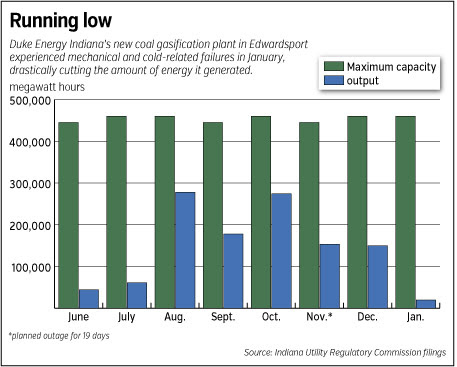
Mechanical problems caused Duke Energy Indiana’s $3.5 billion power plant in Edwardsport to generate a mere 4 percent of its maximum capacity in January, according to company officials and regulatory filings.

The plant’s electricity output was by far the lowest since Duke declared the facility commercially operational in June.

edwardsport duke plant 15col
Construction of Duke's Edwardsport coal gasification plant was beset by massive cost overruns. (File photo)

Edwardsport generated 19,644 megawatt hours of electricity, enough to power about 20,000 homes, in one of the most frigid months on record, according to a Feb. 28 filing with the Indiana Utility Regulatory Commission.

The new plant, at its maximum capacity, could have generated almost 460,000 megawatt hours in January.

The most electricity the plant has generated in a single month to date was about 278,000 megawatt hours, or about 60 percent of capacity, in August. That was in line with what Duke expected as the plant ramps up to full service over the 15 months following its debut.

The plant suffered a variety of mechanical failures in January, said Duke spokeswoman Angeline Protogere. They included leaks in a few systems—the lock hopper flush valve, which is part of a system that handles mineral slag, and the performance heater boiler feed water system, which heats the synthesized gas and optimizes fuel burn in combustion turbines.

The plant also went offline once in January when outdoor equipment froze in frigid temperatures.

“While the problems weren't major, they did limit our generation,” Protogere said. “We believe we have addressed those issues.”

However, the slowdown continued into February, she acknowledged.

With machinery down in February, Duke decided to bump up a maintenance shutdown scheduled for March. That kept Edwardsport offline longer than it would otherwise have been in February.

Duke won’t report the plant’s February performance until the end of March.

Protogere said that Duke has not yet assessed whether the work would fall under the heading of a design problem, in which case it would be covered by shareholders, or whether it was regular maintenance and repairs, the cost of which could be passed onto customers. All costs are subject to regulatory review, she added.

One critic blasted the Edwardsport plant’s technical woes, saying the facility is proving that fears about its viability were valid.

“I hate to paint this thing with a broad, 40,000-foot brush, but this goes back to everything we've been saying since 2006,” said Kerwin Olson, executive director of the Citizens Action Coalition, an Indianapolis lobby for utility consumers.

The project, originally billed in 2006 as an efficient way to generate electricity by converting coal to gas, has struggled with billion-dollar cost overruns and ethical breaches that resulted in high-profile firings at both Duke and the IURC. The plant's original cost estimate was $1.9 billion.

In late 2012, state utility regulators capped the amount Duke could collect from ratepayers for construction at about $2.6 billion, with Duke having to cover about $900 million itself.

Duke edwardsport plant online

Olson said this week that Citizens Action Coalition soon would file a complaint with the state about the January troubles. He would not reveal what the filing would say.

Duke Energy Indiana provides electricity to about 790,000 homes and businesses in Indiana. The company has said ratepayers can expect a 14-percent to 16-percent increase in their monthly bills for construction of the Edwardsport plant through 2015.

Parent firm Duke Energy Corp., based in Charlotte, N.C., operates dozens of power plants and serves 7.2 million electric retail customers in six states in the Southeast and Midwest.

Copyright 2013 IndianaDG