


Author Archives Laura Arnold

Brevini Wind division to close in Delaware Co. (IN)
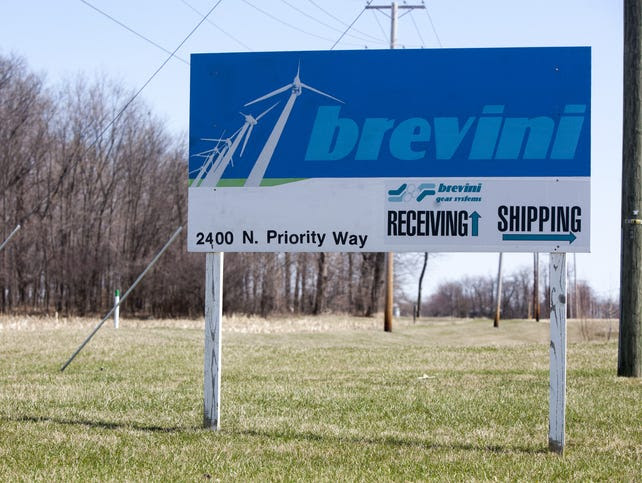
A Brevini sign at Park One in western Delaware County. The gearbox maker built two buildings but failed to hire 450 people. less
 Jeff Ward, jward@muncie.gannett.com;
 MUNCIE — Struggling Brevini Wind Division, a maker of large gearboxes, will cease operations in Delaware County at the end of August, company President Brian Richardson announced.
About 20 Brevini Wind employees, mostly machinists, CNC operators and quality control, will lose their jobs.
"While Brevini Wind may be ceasing operations in the United States, Brevini USA will remain, and we will work in a highly responsible manner to help mitigate the impact to our employees and the local community," Richardson said in a press release.
The Brevini USA subsidiary of Brevini Group's Power Transmission business unit, located in Park One/332 business park next to Brevini Wind's facility, employs more than 40 workers and will continue there, operating under a consolidated "One Brevini" corporate structure.
Richardson said the company will honor its obligations to the county and repay money for failing to create jobs. The company was originally to create 450 jobs, and paid $375,000 in penalties last year for failing to meet numbers. Richardson said the county will receive an $800,000 payment next spring, for a total of about $1.2 million to be returned to the county.
The workers who are losing their jobs will receive severance packages. Brevini Wind will work with other manufacturers and WorkOne to help displaced workers find other jobs.
Richardson said Brevini is seeking a new company to purchase the property and building where Brevini Wind's U.S. operations are located.
"We are actively working with commercial real-estate companies and will work with the local economic development board to help attract a new manufacturer to the property," Richardson said.
Brevini's Delaware County facility opened in 2010 to great fanfare, as the market for gearboxes for wind turbines was expected to take off. That did not happen because of market and regulatory forces, and the company was never able to generate predicted employment figures.
Contact Rep. Todd Young to Extend Clean Energy Technology Tax Incentives
Posted by Laura Arnold / June 23, 2016 / Posted in cogeneration/CHP, Federal energy legislation, geothermal, Uncategorized / No Comments



Please find below a suggested sample letter to send to Congressman Todd Young. Even if Young is not your Member of Congress, please consider sending him a message since he is now also the Indiana Republican candidate for the U.S. Senate.
Here is a link to his Congressional offices: https://toddyoung.house.gov/office-locations-and-hours/
Dear Congressman Todd Young:
I am writing to request your support for legislation extending the Sec. 48 and 25D tax incentives for clean energy technologies and to ask that you work to include these provisions in the next possible legislative vehicle.
H.R. 2029, the Consolidated Appropriations Act, 2016, extended and gradually ramped down the Sec. 48 business investment tax credit (ITC) and Sec. 25D residential tax incentive for solar while also allowing projects to qualify so long as they have commenced construction before the deadline. While these changes are important, we are concerned that other technologies that currently access these credits—such as: combined heat and power (CHP), microturbines, fuel cells, small wind, and geothermal—will be disadvantaged if not provided equitable long-term certainty regarding tax incentives.
- Please consider cosponsoring H.R. 5167, the Technologies for Energy Security Act, bipartisan legislation recently introduced by Representatives Tom Reed (R-NY), Mike Thompson (D-CA), Pat Meehan (R-PA), and Earl Blumenauer (D-OR). This bill would extend Sec. 48 and 25D for all technologies left out of H.R. 2029, and gradually ramp down the incentives for those technologies that are eligible for a credit of 30 percent of the capital costs of equipment.
- In addition, as a member of the House Ways and Means Committee, please do everything possible to include an extension of the ITC in the next available tax vehicle.
- Finally, I hope you will support clarifying the existing ITC to add waste heat to power as a qualifying technology. Waste heat to power (WHP) captures exhaust from industrial processes and uses it to generate electricity with no additional combustion and no additional The Senate Finance Committee approved bipartisan legislation last year (S. 913) that would add WHP as a qualifying technology to the ITC; however, this provision was left out of the final agreement in December.
All clean and efficient energy technologies should be treated fairly. A deal that includes an across-the-board ITC extension needs to come together soon in order to give businesses the certainty needed to begin planning projects that take years to complete.
Thank you in advance for your consideration.
Sincerely,
SNL: Corporates still hunting for renewable energy deals
Corporates still hunting for renewable energy deals
Corporate buyers are expected to remain a source of demand for renewable electricity as companies install solar panels and sign power purchase agreements in order to meet sustainability goals, generate return on investment and limit exposure to changing energy prices, according to PwC.
A survey of 63 "major" U.S. corporations active in renewable energy markets found 72% of respondents are pursuing deals to buy more renewables, PwC said June 20, with the vast majority identifying solar as the "most important" renewable energy technology to their organization. Respondents included information, communication and technology companies, retail and consumer firms, manufacturers and financial services companies, among others.
"One of the biggest developments in the renewable energy marketplace in the last 12-24 months has been the rapid growth in corporate renewables purchases," PwC said in a report on the survey. "Their share of renewables is growing, their demands of providers are rising, and their approaches to energy procurement are becoming more sophisticated."
Onsite PPAs remain the most popular purchasing option. However, of those companies actively pursuing deals, 58% said they intend to sign more traditional offsite PPAs, with 30% planning to pursue virtual PPAs — long-term, fixed-price energy contracts in which electricity is sold into the market rather than used directly by the customer.
More than 90% of respondents said they will try to buy power directly from project developers, while half said they will try to work through a utility.
Last year, nonutility buyers accounted for more than half of all contracted wind power, up from 23% in 2014 and 5% in 2013, according to the American Wind Energy Association.
The top reasons companies gave for not pursuing renewable energy purchases were lack of corporate mandates, unattractive return on investment and contract durations.
Respondents to the PwC survey ranked advanced meters, energy management software and energy storage as the most important ancillary technologies for measuring and monitoring corporate energy use.