Author Archives Laura Arnold

Midwest utilities retire more than 2,000 MW of coal-fired generation

Posted by Laura Arnold  /   April 18, 2016  /   Posted in Uncategorized  /   No Comments

Midwest utilities retire more than 2,000 MW of coal-fired generation

Louisville, Kentucky (Platts)--15 Apr 2016 652 pm EDT/2252 GMT

Friday (4/15/16) marked the retirement of another 2,000 MW of older coal-fired generation in the Midwest.

Though not unexpected, the coal retirements continued a trend in a region that for decades has relied heavily on coal to produce electricity. Coal still comprises a sizable share of the generation portfolio, but it is slowly being replaced by renewables, particularly wind, and natural gas.

The latest retirements were concentrated in Indiana and Michigan.

In Indiana, Indianapolis Power & Light (IPL) shuttered its 341-MW Eagle Valley plant 67 years after it began operating. Eagle Valley is being replaced by a new 671-MW combined-cycle gas plant, whose construction is more than one-third complete and is targeted for commercial operation in spring 2017.

IPL also halted coal burning in February at its roughly 700-MW Harding Street plant in downtown Indianapolis.

Duke Energy Indiana, the state's largest electric utility and a subsidiary of Charlotte, North Carolina-based Duke Energy, closed Units 2, 3, 4, 5 and 6 at its 668-MW Wabash River station. Duke expects to decide by the end of 2016 whether to convert 318-MW Unit 6 to burn natural gas, according to company spokesman Lew Middleton.

In Michigan, Consumers Energy planned to pull the final switches on its "Classic Seven" coal units totaling 950 MW by midnight Friday, spokesman Dan Bishop said. The next major generation project the CMS Energy subsidiary pursues is expected to be the 700-MW Thetford combined-cycle gas plant that was deferred two years ago.

The Holland Board of Public Works also stopped burning coal in its 62-MW James De Young plant, constructed in 1940. Holland is replacing it with Holland Energy Park, a 125-MW gas-fired facility, said Ashley Kimble, spokeswoman for the Michigan muni.

The retiring coal plants for years burned several million short tons of thermal coal annually, both from low-sulfur Powder River Basin and higher-sulfur Eastern sources.

Iowa's MidAmerican Energy, meanwhile, announced plans Thursday to install up to 2,000 MW of new wind capacity by the end of 2019 as part of a $3.6 billion project.

By the end of 2016, wind is projected to represent 47% of the utility's generation portfolio. Coal still accounts for 31% and company spokeswoman Ashton Newman said Friday there are no plans to retire any coal generation.

--Bob Matyi, newsdesk@platts.com
--Edited by Jason Lindquist, jason.lindquist@platts.com

Solar farm fuels interest in bigger Ky projects; KY vs. IN solar policies

Posted by Laura Arnold  /   April 18, 2016  /   Posted in Uncategorized  /   No Comments

Solar farm fuels interest in bigger Ky projects

Mark Mahan, Special to The CJ
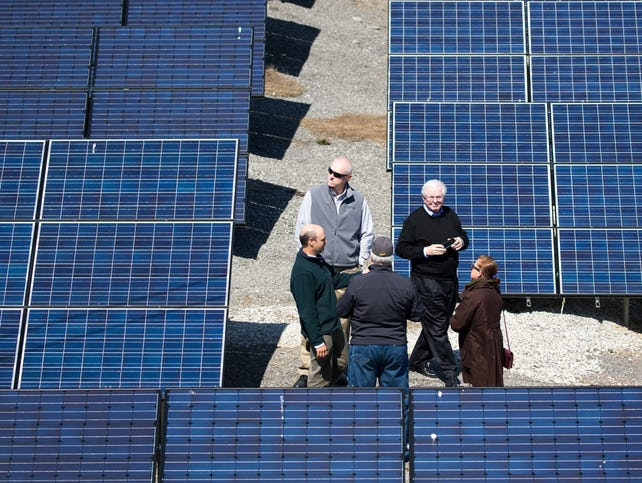
A group from Solar Over Louisville toured the Berea community solar array on March 23, 2016, in Berea, Ky. less

, @jbruggers10:18 a.m. EDT April 18, 2016

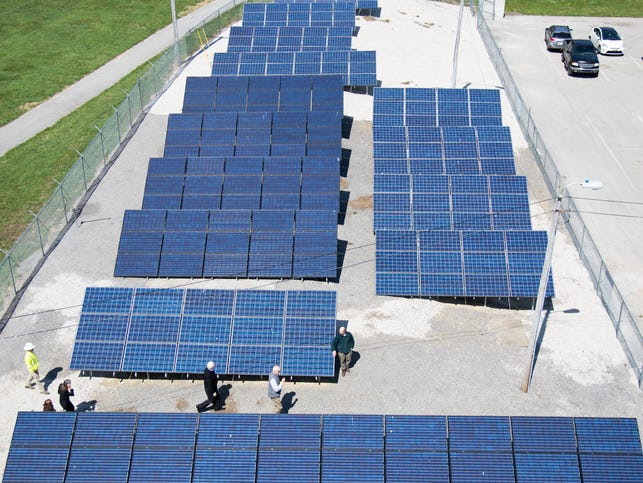
BEREA, Ky. – The 4-year-old solar farm here isn't modest. It's tiny. Just 246 panels. Enough to power six or seven homes.

But it was the first in Kentucky of what insiders call "community shared solar" – solar-electric systems that provide power or financial benefits to their members or participants. They're especially useful to people who cannot or do not want to put solar panels on their roofs but still want to offset their energy use with clean power from the sun.

More than 150 people have leased the solar panels in Berea. They paid a one-time leasing fee of $750 at an array built and run by Berea Municipal Utilities. In turn, the customers get a few bucks off their electricity bills each month for 25 years. Their return on investment will take two decades. But that wasn't really the point.

"People were interested in doing something toward an energy transformation in Kentucky," recalled retired Berea College mathematics professor Steve Boyce, a driving force behind the project. Participation was, he said, "out of an urge to be able to do something when we were not getting any leadership on sustainability nationally nor in Kentucky."

Kentucky still ranks near the bottom of all states – 45th out of 50 – for all renewable energy production, at 2.4 percent, and solar is barely noticeable at less than 1 percent of all electricity consumed, according to the U.S. Department of Energy. Indiana ranks much better for renewable energy production – 29th – but most of that is from biomass energy including ethanol production.

Cheap electricity rates from burning coal and now even cheaper natural gas – and state energy policy – still make it hard in states like Kentucky and Indiana for solar to compete on the bottom line. But that seems to be changing as the cost of solar falls and is expected to decline up to 12 percent per year through 2020, according to the Energy Department.

Despite its small size, the Berea example is stirring the imagination of the organizers of the new Solar Over Louisville push backed by Mayor Greg Fischer. It calls for 2 megawatts of solar capacity to be installed in Louisville this year. Community solar is one option those organizers are examining.

"It opens the doorway to what we could have," said Nancy Givens, a Solar Over Louisville volunteer, on a tour of the Berea facility in March. "We're looking at how we can take baby steps. We still don't have policies in place, but we have a lot of interest."

Indiana touts its sunshine, and Indianapolis was recently ranked second in the nation for solar panel capacity per capita behind Honolulu in the Environment America 2016 Shining Cities report. By contrast, Louisville was dubbed a "solar beginner."

Kentucky's 2008 energy plan found that the Bluegrass state has ample amounts of sun for solar power.

Joshua Bills, energy expert with the Mountain Association for Community Economic Development, pointed to the solar inverters during a tour of the Berea community solar array on March 23, 2016, in Berea, Ky. (Photo: Mark Mahan, Special to The CJ)

"People think we don't have enough sun, but we do," said Joshua Bills, an energy expert with the Mountain Association for Community Economic Development in Berea.

In states long dominated by coal, even utilities are starting to notice the sun.

Utilities explore solar

As grassroots solar power advocates press for state legislation to loosen utilities' grip on energy production and encourage more solar power including community solar farms, two big Kentucky Public Service Commission-regulated utilities are planning ways to join Berea and offer community solar options for their customers.

They are part of a national trend, according to a recent report by the Deloitte Center for Energy Solutions. Deloitte found that there was one such solar project in 2010 in the United States.

Now, 77 utilities administer 11 projects in 26 states, offering a combined capacity of 106 megawatts, the study found.

"Utilities are finding that shared solar allows them to grow their solar generation portfolios, developers are seizing the opportunity to expand their business offerings, and more customers have the chance to buy solar power," the study says. "By unlocking value in each segment of the supply chain, community solar is evolving into a growth engine for distributed solar resources."

East Kentucky Power Cooperative has 16 member-owned distribution co-ops with 527,000 customers in 87 counties. It plans to take a proposal for community solar to the PSC this spring. The idea is to construct an 8.5-megawatt solar farm on 60 acres near its headquarters in Winchester, then license solar panels to the cooperatives' members, who would then get credit on their bills for energy produced by the sun.

Important details such as how much the licenses would cost and how participation would affect members' bills are still being worked out, said Nick Comer, East Kentucky Power spokesman.
Mark Mahan, Special to The CJ

A group from Solar Over Louisville toured the Berea community solar array on March 23, 2016 in Berea, Ky.

The solar farm would generate enough electricity to power about 1,000 homes, he said.

"We have members who are interested in doing this," Comer added.

Louisville-based LG&E and KU Energy officials said their customers have asked for something similar, so they are developing their own community solar vision. They believe customers are ready to help them invest in that vision.

Those solar panels could be "on the lot next door or 50 miles away," or located on buildings or in parking lots, said John Malloy, vice president of customer service for LG&E and KU Energy.

In a program they also hope to get through the PCS this year, customers would pay a sign-up fee and subscription fees to help cover costs for the construction and operation of what they also call community solar.

LG&E's David Huff, director of customer energy efficiency, said participants would then get a pro-rated share of the electricity produced, similar to net-metering arrangements for customers who install their own solar panels on their homes or businesses.

Net metering credits customers owning solar panels with the electricity they add to the grid.

It's doubtful that the arrangement would result in smaller electricity bills at today's energy pricing, Huff said. Solar is still more expensive than coal or natural gas, LG&E officials said. But customers could find their investment a hedge against future rate increases, Huff added.

It's not community solar, but LG&E and KU Energy is preparing to dedicate its first solar array on April 19, just in time for Earth Day on April 22.

Crews have been erecting 45,000 solar panels on 50 acres in Mercer County adjacent to the company's E.W. Brown power plant. Those 10 megawatts should generate enough electricity for about 1,750 homes.

"It was put in at that size so we can get better experiences how solar is going to work in our company," said Scott Straight, LG&E and KU Energy's director of project engineering. He said it's expected to cost about 10 percent less than the budgeted $35 million, in part because the cost of solar panels fell rapidly during the project.

Electricity generated from that array will flow into the grid, just as at any other of the company's power plants.

LG&E and KU Energy is also this year developing a new program for large-scale industrial or commercial businesses that want to tap the sun while ensuring those costs won't be subsidized by other customers, Malloy said.

The Indiana Utility Regulatory Commission last year approved Duke Energy’s 20-year agreements with two solar developers to purchase up to 20 megawatts of solar power for its Indiana customers. In January, Duke also proposed to construct a 17-megawatt solar facility at Naval Support Activity Crane, a Naval installation southwest of Bloomington.

Community solar obstacles

Indiana has a handful of utility-run community solar projects largely run by electric cooperatives, but the concept has not taken off because of legislative obstacles in Indiana similar to those in Kentucky, said solar advocate Laura Arnold, president of the Indiana Distributed Energy Alliance.

When she and other solar advocates discuss community solar, they describe an entirely different model from one put forward by LG&E and East Kentucky Power, where the utility is at the center.

They see regulated utilities' efforts to create more community-based solar projects as an alternative to supporting better, more open net metering policies and to keep control, Arnold said. That utilities have adopted the community solar name for their efforts even bothers some, said Bills.

Arnold said that different vision places a neighborhood at the center. Residents, businesses and churches come together to establish their own solar installation. And using net metering, the electricity it generates offsets each participant's bills.

But neither Indiana nor Kentucky allows what's called virtual or remote net metering, where customers share benefits of electricity output from a single solar power project.

And to really encourage community solar, Kentucky lawmakers would also need to raise the individual system size cap to require net metering above 30 kilowatt systems, so more than only a few efficient homes could be on one system, Bills added.

Indiana's net metering limit is larger, set at 1 MW systems.

Nationally, there's been tension between solar advocates and utilities, with utilities fighting to make sure all their fixed administration and power line maintenance costs are shared among all their customers, as many customers seek to lower their bills by generating solar power. That played out in a rate increase dispute last year with LG&E and KU.

Berea Municipal Utilities has more freedom because, as a city-owned utility, it doesn't fall under the regulation of the PSC. But it also has limits on its solar generation because of terms of its contract with Kentucky Utilities, said Ed Fortner Jr., the city's utilities director.

Still, he said, the small array has "got a lot of publicity. But this is the future – renewables, along with energy efficiency."

Reach reporter James Bruggers at (502) 582-4645 and at jbruggers@courier-journal.com.

Duke Energy Seeks $120,000 Sanction against Critics in NC Church-Solar Test Case

Posted by Laura Arnold  /   April 16, 2016  /   Posted in solar  /   No Comments

Duke Energy Seeks $120,000 Sanction against Critics in Church-Solar Test Case

As legal battle begins over nonprofit’s solar sales to church partner, national solar companies, NC industry and faith groups join case over monopoly control of rooftops

As a legal battle begins over whether only Duke Energy can sell electricity in its captive territories, the nation’s largest electric corporation is calling for massive financial punishment of its long-time critic, nonprofit NC WARN, for selling solar power to a community church in Greensboro.

Duke Energy told the NC Utilities Commission in a Friday filing that the regulators should penalize NC WARN up to $1,000 for every day since late June, when the group began selling solar power to Faith Community Church after contracting to have a 5.2 kilowatt photovoltaic system installed on its roof.

Duke Energy is clearly trying to punish and silence one of its most persistent critics.  After joining the Koch brothers in beating down bipartisan legislation that would have allowed solar competition – and which had broad public, business and military support – this attempt to sanction NC WARN shows how intensely Duke will fight to disallow third-party financing for solar power.

Duke’s position is particularly egregious because NC WARN and Rev. Nelson Johnson very publicly announced the unprecedented solar installation as a test case to clarify state policy, and it was accompanied by an NC WARN legal request for a declaratory ruling by the NC Utilities Commission.

We have cited precedents from in-state cases and those in other states, and maintain that the funding arrangement is consistent with state energy policy and with the constitutional ban of monopolies, and that it should be encouraged across North Carolina.  Since that time, numerous other churches have expressed interest in solar power via third party – or “no money down” – solar financing in order to save money and further their Earth stewardship.

Duke Energy is entitled to disagree with us, but seeking to financially hammer this 27 year-old nonprofit is more proof that Goliath wants neither competition, criticism, nor scrutiny.

This case has been joined by the nation’s largest solar company, SolarCity and others interested in offering “no money down” installation of solar on churches, businesses, homes and other customers.  Nonprofit NC Interfaith Power & Light is also an intervener, represented by Southern Environmental Law Center, and supports our position.

North Carolina is one of only four states where third party sales are thought to be disallowed – three of them are Duke states.  Georgia recently joined the rest of the country where either regulators or courts have allowed solar companies to sell power directly to customers from systems on those customers’ property. Until now, no one has tested it in North Carolina.

How can Duke possibly justify a $120,000 penalty based on losing a few hundred bucks in sales to the Faith Community Church?

NC WARN has been openly and persistently critical of Duke Energy’ executives’ climate-wrecking, customer-gouging practices over many years.  That includes its “build plants, raise rates, control government” business model, its coal ash injustices, its distortions about carbon emissions and solar power, and its Koch collaboration to limit solar.  Most recently, we have petitioned Attorney General Cooper to alter Duke’s corporate charter, and are challenging Duke’s incredible stumbling toward a fracking gas future despite its disastrous methane emissions and high-risk financial future.

All these efforts continue to the present day, and it seems clear that Duke is now retaliating, seeking to cast a chilling effect over NC WARN and other critics.  Our long-running criticisms have remained truthful and factual, and directed not toward the many Duke’s workers who do their jobs well.  Our complaints are with the executives who make so many decisions that are incompatible with the physical and economic well-being of the people of North Carolina.

NC WARN will continue seeking to foster honest public debate about Duke Energy’s practices and the need to join the clean energy revolution.  We have offered to the executives many times – and hereby repeat again – that we to would like very much to find ways to stop fighting Duke, and to work together to address the planetary emergency posed by climate change.

As Rev. Johnson stated at the ribbon cutting ceremony in June:  “The time is right for the People of North Carolina to come together around our common goals of stewardship, pollution, and the protection of low-income customers against the rising power bills they face under Duke Energy’s current plans.”

Third party solar could be helping all electricity customers avoid rate hikes for more power plants – if companies offering third party sales are allowed to compete in this state.

Ohio Bill continuing ‘freeze’ on clean energy expected soon

Posted by Laura Arnold  /   April 14, 2016  /   Posted in solar, wind  /   No Comments

Bill continuing 'freeze' on clean energy expected soon

By Dan GearinoThe Columbus Dispatch  •  Wednesday April 13, 2016 5:06 PM

Legislative Republicans are close to proposing an extension of a freeze on state standards for energy efficiency and renewable energy, an idea that Gov. John Kasich has said he opposes.

Sen. Bill Seitz, R-Cincinnati, has been circulating a draft of a three-year extension of the freeze and could introduce it as a bill as soon as next week, according to lawmakers and lobbyists who are closely following it. The bill would seek to implement some of the recommendations of the Energy Mandates Study Committee, a joint House-Senate panel that issued a final report in September.

Seitz, a key player in passing the original freeze in 2014, was not available for comment on Wednesday.

Senate President Keith Faber, R-Celina, said he is generally supportive of extending the freeze, particularly while waiting for the U.S. Supreme Court to rule on the Obama administration's proposed regulations on carbon emissions.

The Sierra Club has reviewed the draft of the bill and says it is "unacceptable."

"Other members of our legislature should not be aligning with this misguided piece of legislation, and it's time for Gov. Kasich to take leadership in developing a reasonable clean-energy standard for our state," said Samantha Allen, conservation program director for the environmental group.

Other groups also are gearing up for a fight.

"The legislature has a clear choice," said Ted Ford, president and CEO of Ohio Advanced Energy Economy. "It can create a business-friendly environment to attract investment in advanced energy or Ohio can keep the door shut on billions of dollars of benefits."

Meanwhile, Sen. Troy Balderson, R-Zanesville, co-chairman of the study committee, says the panel's recommendations should be debated.

"It's something that needs to be done," he said.

The two-year freeze took effect in 2014 and is about to conclude. It covers state rules that require utilities to meet annual benchmarks for investment in energy efficiency and renewable energy.

The freeze was a compromise, as some majority Republicans lawmakers wanted to repeal the rules, arguing that the costs of compliance are greater than the benefits. Opponents said the rules are good for the environment and the economy.

At the time of the study committee report, Kasich's office said the governor opposes an extension freeze, and Kasich has repeated that view while campaigning for president. Kasich spokesman Joe Andrews had no comment on Wednesday.

dgearino@dispatch.com

@dangearino


Clifton (Louisville, KY) solar panels OK’d, with conditions

Posted by Laura Arnold  /   April 14, 2016  /   Posted in solar, Uncategorized  /   No Comments

Clifton solar panels OK'd, with conditions

A solar panel case in Clifton that attracted heated attention was largely resolved Wednesday  when a city architectural review committee approved the installation of the panels after-the-fact.

Clifton is a local preservation district, and homeowner Mark Frazar had been cited by the city for installing the panels in December 2014 without applying for a certificate of appropriateness that's required.

He must still obtain a building permit for the installation and was asked to fill in a gap by the chimney where the red roof showed through. Frazar, who works as a project manager for a local architectural office, said he didn't realize he needed approval for the panels.

Many people spoke in support of Frazar at an evening meeting of the Metro Landmarks and Preservation Districts Commission's Clifton Architectural Review Committee, which voted to issue the certificate -- meaning Frazar didn't have to remove or move the panels. Frazar said he was satisfied with the outcome and hoped it would "help people work together" more.

The audience applauded when neighborhood leader Mike O'Leary urged approval.

Committee leader Jay Stottman said it was not a choice between preservation or solar installation but about the importance of finding solutions through the review process.  After-the-fact reviews risk "putting the whole process in jeopardy," he said.

Frazar had said the panels needed to have southeast exposure to work, and Develop Louisville head Jim Mims said the panels were "not offensive, not in-your-face."

David Coyte, a Clifton Community Council leader, praised Frazar for his energy conservation efforts.

"That's they way we need to go," said David Doll, a facilities manager at St. James Church in Tyler Park, which is considering solar panels for its school.

But Phil Samuels, who worked on the 62-page list of guidelines for the district, said people needed to take more responsibility for being aware of the guidelines.

"He should have known," Samuels said. Frazer received staff approval for a new roof he also had put on, and a $100 fine he was issued was waived after he applied last fall for the certificate.

Reporter Martha Elson can be reached at 502-582-7061 and melson@courier-journal.com.  Follow her on Twitter at @MarthaElson_cj.

Comment

Steve Riggs Representative

This article on the "solar panel civil war" in Clifton is very informative. On Day #1 I contacted the Mayor to plead for reasonable intervention on behalf of those who want solar panels. City bureaucrats shouldn't issue fines in cases like this. It's up to them to properly advise citizens about this overreaching review process and its existence. A normal citizen can't be expected to be expert in something so shadowy as this. City leaders want more solar panels and the old-time bureaucrats need to re-focus their efforts to be more modern and flexible with our energy policies.

Copyright 2013 IndianaDG

