

Author Archives Laura Arnold

Hoosiers, you gotta fight for your right to net meter

Posted by Laura Arnold  /   February 13, 2017  /   Posted in 2017 Indiana General Assembly, solar, Uncategorized  /   No Comments

IndianaDG Editor's Note: I am sharing this Guest Editorial with IndianaDG Readers, however, I am also including corrections and clarifications. This will be noted in [red italics].

Hoosiers, you gotta fight for your right to net meter

State now boasts over 1,600 high-paying solar jobs

By Mike Keen and Timothy Powers Guest columnists

Did you know Indiana has experienced a boon in solar power recently? The market is projected to enjoy incredible growth in the coming years. Unfortunately, this progress could be stopped by Senate Bill 309, heard by the House [Senate] Utilities Committee on Thursday. New-era photovoltaic installations for cities, schools, companies, places of worship and homes currently total over 175 megawatts, or roughly 612.5 acres of sun-soaking crystalline silicon. That’s enough to power 18,000 homes! Barring a change in incentives, this output is expected to triple in the next five years, producing the same amount of power as a small coal-fired plant. Indiana, a state better known for its basketball and corn, now boasts over 1,600 high-paying solar jobs that cannot be outsourced.

Indiana’s emergence onto the solar scene reflects national trends, where solar jobs outpace the national job growth rate by a factor of 12. In 2016, 1 in every 50 new U.S. jobs came from solar. Indiana is home to 82 solar companies that install residential, commercial and utility-scale projects across the state and around nation.

The benefits of solar are numerous. These panels can cut their owner’s electricity bill by more than half while reducing environmental impact. Saint Anthony’s de Padua Catholic school in South Bend, which sports a solar array on its gym, practices environmental stewardship strongly encouraged by Pope Francis while saving money they would much rather spend on their student’s education. Kokomo recently turned on its 21-acre solar farm, installed on a toxic brownfield site where a steel plant once stood. [The Kokomo solar farm installed on the former Continental Steel brownfield site does not use net metering and will not be impacted by the net metering provisions of SB 309. This project has a long term purchase power agreement with Duke Energy. Indiana's current net metering rule only applies to customer owned solar and wind systems less than 1 MW.]


A variety of federal and state incentives help reduce solar system costs for Indiana. One of the most critical of these is net metering, the law granting anyone producing renewable energy (solar, wind, biofuel) the right to sell their extra power back to the grid at market rates. [The notion that solar customers sell their net excess electricity back to the grid is a common misnomer. Net metering customers receive a kWh for kWh CREDIT. When the solar customer's meter runs backwards they reduce the electricity they receive from their utility which is priced at the lowest price since most Indiana utilities still employ declining block rate structures where the more electricity a customer uses the less they pay per kWh.] Indiana and 41 other states currently allow their citizens to net meter.

Unfortunately, SB 309, threatens to significantly undermine this incentive. [Unfortunately, the notion that net metering is an incentive or a subsidy is another misnomer  propagated by Indiana's electric utilities. There has been no Indiana net metering cost study using data from Indiana's electric utilities. There have been numerous cost studies doe in other states which instead indicate that net metering is a NET BENEFIT to all customers. See http://www.indianadg.net/solar-cost-benefit-studies/ and in particular a 2016 report by the Brookings Institute which summarizes the results of numerous state studies. See  

]  This bill is bad for Hoosiers on numerous levels. It directly affects anyone with solar by prohibiting them from using their own power produced by their panels. Instead, by 2027, and in some cases earlier, people would have to sell their solar power to the grid for as little as 25 percent of the retail value, and then pay a full price for all the power on their electricity bill.

Supporters of the bill claim this will make solar owners pay their fair share to support the costs of maintaining the grid. However, anyone who receives an electricity bill, no matter the size, will notice they already pay a transmission and distribution fee.

This about so much more than a few thousand people with solar on their roofs. [Please note that according to the most recent Report on net metering prepared by the Indiana Utility Regulatory Commission (IURC) can be found at http://www.in.gov/iurc/files/2015_Net_Metering_Required_Reporting_Summary.pdf. This is the most current information on net metering for the investor owned electric utilities that would be impacted by SB 309 as it was amended 2/9/17. This report shows there were 866 net metering customers NOT a few thousand. The next IURC Net Metering report documenting net metering as of the end of 2016 should be available in March 2017.] It is about modernizing Indiana’s power grid through distributed generation. Most states are doing this, including Michigan, Ohio and Illinois, all of whom have recently overhauled their energy policy to support the rise in renewable energy. A few states such as Nevada, who have passed bills similar to SB 309, have seen over a thousand solar jobs flee the state. 

[The action in Nevada on net metering was at the Nevada Public Utilities Commission (PUCN) and not the Nevada state legislature. Please see these two recent articles further explaining the NV PUC's reversal of their recent net metering decisions.

Nevada Regulators Restore Net Metering for Existing Solar Customers, Sept. 16, 2016; and

Nevada Regulators Restore Retail-Rate Net Metering in Sierra Pacific Territory, Dec. 22, 2016 "The Public Utilities Commission of Nevada (PUCN) has voted to restore favorable rates for residential solar customers in NV Energy’s Sierra Pacific Power Company’s service territory -- exactly one year after the commission passed a controversial fee increase that brought the state’s residential solar market to a halt."

It is not just solar this bill will hurt. Currently, 43 percent of Fortune 500 companies have pledged to make renewable energy a significant part, if not all, of their energy consumption by a certain date. General Motors plans to be 100 percent renewable by 2050, while Salesforce, with 800 employees in Indianapolis, has pledged to do the same. We will not attract more of these companies to Indiana if our energy laws make it unfeasible to meet their energy goals.

If you own solar, are interested in one day owning solar, or simply want to see fellow Hoosiers breathing cleaner air, I encourage you to contact your state [Senator and later your state] Representatives about SB 309. This is hardly a partisan issue; 80 percent of the country is in favor of renewable energy. In Indiana it is critical we retain net metering in its current form. Let’s be a leader in renewable energy, not a straggler.

Mike Keen is Professor Principal Thrive Michiana LLC and Emeritus at IU South Bend. Timothy Powers is a graduate student at the Center for a Sustainable Future at IU South Bend.

Big utilities try to tilt solar energy market in their favor

Posted by Laura Arnold  /   February 09, 2017  /   Posted in 2017 Indiana General Assembly, Indiana Michigan Power Company (I&M), solar, Uncategorized  /   No Comments

Solar Energy Indiana

Solar farm at Indianapolis airport.

Big utilities try to tilt solar energy market in their favor

NDIANAPOLIS (AP) — Indiana's energy utilities want state lawmakers to pass a law that critics say would muscle out smaller companies from the emerging solar energy market.

Solar power provides only about 1 percent of the country's energy, but it is growing rapidly, with U.S. Energy Department figures showing solar industry employment grew 125 percent since 2010.

Much of the growth has come from homeowners or businesses taking advantage of its bill-lowering potential. That could eventually eat away at the business of the big utilities — in Indiana Duke Energy, Vectren and Indiana Michigan Power — which have a powerful voice and donate handsomely to political campaigns.

Indiana legislators started debate Thursday on a proposed law that in five years would eliminate much of the financial benefit Indiana homeowners, businesses, schools and even some churches reap harvesting the sun's rays.

Republican state Sen. Brandt Hershman's bill would overhaul a practice called "net metering," which allows solar panel owners to feed excess energy into the power grid in exchange for a credit on their power bill.

Hershman's bill would lock in a substantially lower rate of reimbursement than what is currently guaranteed — a move that solar advocates say would make it difficult to break even during the useful life of a solar panel.

"I have nothing against solar. I'm simply trying to reset the marketplace," said Hershman, who says solar panel owners are reimbursed at too-generous of a rate.

But the measure comes as investor-owned utilities across the U.S. are also looking to take advantage of plunging costs for sun-generated power and carve out a share of the market. And critics say the bill amounts to utilities muscling out small companies, threatening the 1,500 jobs the Solar Foundation estimated in 2015 the industry had created in Indiana.

Utilities are also promoting an alternative to installing home solar panels called "community solar" that involves customers agreeing to buy or lease panels from the utilities on large panel farms.

"Utilities like solar if they can control those assets," said Ryan Zaricki, who owns Whole Sun Designs, a solar panel installation company headquartered in Evansville. Zaricki, who employs five workers during busy months, said that if the bill passes "it means that, in the long term, I won't have a business."

Duke Energy Corp., the largest electricity company in the nation, this year plans to launch a "community solar" program in South Carolina and seek regulatory permission to do so in North Carolina, Florida, Kentucky and Ohio, as well as Indiana, utility vice president Melisa Johns said.

Indiana is not the first state to consider a solar industry overhaul. Michigan, Illinois and Iowa are phasing out net metering at a gentler pace, according to advocates. In Maine, Republican Gov. Paul LePage last year vetoed a bill that would have overhauled the state's approach. Montana also is considering policy changes, according to The National Conference of State Legislatures.

Utilities say the current Indiana compensation system is unfair because it requires them to pay solar panel owners for power at retail cost — which is more than it would cost them to produce the energy. They also stress that they own the infrastructure solar panel owners rely on to feed their excess power onto the grid and should be compensated.

"The simple logic for us is if you're using it, you should pay for it," said Mark Maassel, president of the Indiana Energy Association, which represents the largest power utilities.

The solar measure is the latest pushed by Republicans in Indiana, who dominate the Statehouse, which would corner a market, or benefit longtime political allies and campaign donors.

A bill last week that would have effectively blocked electric car maker Tesla from selling in Indiana was overhauled after opposition. Last year lawmakers passed vaping industry regulations that created a monopoly for one security firm that became the sole gatekeeper of who could manufacture the nicotine-laced liquid consumed through vaping. GOP leaders pledged to "fix" the law this year after the FBI launched a probe.

Over the past three years Duke energy and its affiliated political committees funneled $76,000 to state Senate members of both parties.

Hershman has collected $9,000 from the company since 2010, according to state campaign finance records.

The utilities also donated more than $1 million to the Indiana Economic Development Corporation, which helped finance trade missions former Gov. Mike Pence led to several foreign countries in 2014 and 2015, according to data obtained through a public records request. The corporation is a quasi-governmental agency that regularly uses private donations to fund VIP trips for state officials.

___

Associated Press business writer Emery P. Dalesio contributed to this report.

Indiana legislators throw shade on solar, wind energy with net metering bill

Posted by Laura Arnold  /   February 08, 2017  /   Posted in 2017 Indiana General Assembly, solar  /   No Comments

screen_shot_2017-02-08_at_9.32.56_am.png

Indiana legislators throw shade on solar, wind energy with net metering bill 

On Thursday, February 9, the State Senate Utilities committee is set to hear Senate Bill 309, which deals with the issue of the distributed generation of power in this state.

On the surface it may seem like a bill full of technical mumbo jumbo that shouldn't concern the general public. But the public should be concerned about the details of the bill and many are, especially residents, businesses and industries that are concerned about and invested in clean renewable energy.

The bill, authored by Sen. Brandt Hershman, would require public utilities to end the net metering tariff for customers by 2027 or "until the first calendar year after the aggregate amount of net metering facility nameplate capacity under the tariff equals at least 1 percent of the electricity supplier's most recent summer peak load," whichever comes first.

And according to industry watchers, that timeline could be moved up to three or four years.

While that may sound confusing — believe me, it is —the bottom line is that the bill seeks to reverse some of the provisions put in place by the Daniels Administration and the 2011 state legislature to help create an investment climate for business and industry interested in wind and solar power.

And, for an administration like that of Gov. Eric Holcomb, who has made economic investment and creating a business-friendly environment in Indiana — well, let's just say that the bill is bad for business.

Net metering allows utility customers who generate their own power to essentially "sell" any power they don't use back to the public utility at a retail price — which in turn results in a discount of sorts on their bill for power they do get from the utility company. Customers essentially get to use the power they have generated themselves, through wind or solar, at a later date for no additional cost.

For example, a typical 10 kW-h home solar installation will produce 55 kW-h of electricity on a sunny day. The average home uses about 40 kW-h each day. So on those sunny days the customer sells the extra 15 kW-h of electricity back to their public utility. When they use power from the utility on a cloudy day, 15kW-h of electricity is discounted from their bill. That's net metering.

So, what happens when net metering ends? The customer sells the 15kW-h of electricity to the utility at wholesale, but then has to pay the retail price when it is used at a later date. That's like selling a scarf you knitted yourself for $5 only to turn around and buy it back for $10.

thinkstockphotos-637341558.jpg

Net metering doesn't just affect residential homes and small businesses with rooftop solar panels. The 2011 legislation also increased the total service kW-h from 10 to 1000kW-h, opening up the opportunities for large businesses, commercial properties and industries to create their own power as well. And the results have been prosperous for the state.

There are numerous large corporations and industries that have made renewable energy sources part of their strategic plan and look for strong investment climates when deciding where to locate. For example, Amazon has a specific plan for 100 percent sustainability for the company with a long-term step-by-step plan of how to get there. According to the company's website, Amazon was on track to exceed its goal of generating 40 percent of its own power by the end of 2016 and has a goal of 50 percent for 2017. To achieve this goal, the company as created several wind and solar farms in the same states where its warehouses are located. Amazon operates four fulfillment centers in Indiana — Indianapolis, Plainfield, Whitestown and Jeffersonville — which created much-needed jobs. Amazon also built a wind farm in Benton County, Ind. outside of Fowler. The 65 wind turbines generate power that is supplied to Amazon data centers that is the equivalent of powering 46,000 homes per year.

Amazon currently has a 13-year purchase agreement to supply power from its wind farm to its data centers. Could the terms of SB 309 put that agreement and the future of Amazon's business and jobs in Indiana in jeopardy? Anything's possible, especially when other states are competing for that business and are creating better climates for investment.

"The trend that is happening in other states is that this is a promising industry and we've got to figure out, how do we make our climate better for this technology," Hoosier Environmental Council executive director Jesse Kharbanda says. "So they have gone beyond one percent and gone to two, three maybe even five percent. And they have gone from maybe a one-megawatt (1000 kilowatts) limit to essentially an unlimited commitment. "

Businesses with interests in the investment climate of Indiana are prepared to testify at the committee hearing. Hoosier Interfaith Power and Light is rallying its membership to attend the hearing to voice concerns for the bill and champion renewable energy in the state. The hearing is scheduled for 9 a. m. Thursday in the Senate chambers.

Letter: Strengthen solar industry, Legislature; Reject SB 309; Support SB 500 and HB 1624

Posted by Laura Arnold  /   February 08, 2017  /   Posted in 2017 Indiana General Assembly, solar  /   No Comments

Image result for chris rohaly green alternatives

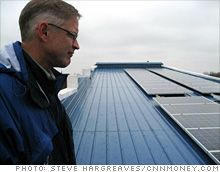
Chris Rohaly next to the newly installed solar panels on his office roof.

Letter: Strengthen solar industry, Legislature

The 2017 Indiana legislative session is underway, and this session includes three different bills dealing with distributed energy generation (most typically in the form of rooftop solar). These bills offer Indiana very different choices for our energy future.

Most publicized so far is Senate Bill 309, which would end net metering (the interconnection policy that allows bi-directional connection to the grid). Net-metered energy flows in either direction through the meter. When you produce more than you are using, that energy flows out through the meter and builds a “credit.” When your demand increases, energy is drawn back through the meter and draws down your credit.

Rather than engage in serious investigation and debate, this bill outlaws net metering, replacing it with a requirement to sell all energy from your system to the utility at wholesale rate and purchase it back at retail rate. It would be illegal for you to use any of the energy generated by the system you invested in. In addition, the door is left open for monthly fixed fees to be added to the bills of system owners.

Illinois and Ohio have both reconsidered their net metering policies in the recent months. Both states have chosen to not only maintain but expand their programs to encourage development of a distributed energy industry in their states.

SB 309 would have a poisonous effect on the solar industry in Indiana, killing many current and future jobs that cannot be shipped abroad. It stands in contrast to the other two bills under consideration.

SB 500 defines limits on the power of a homeowners’ association to forbid the installation of rooftop solar. This bill is modeled after a Texas law and removes restrictions on personal choice. HB 1624 would allow school systems to purchase renewable energy systems through a third-party ownership financing. This would allow schools to benefit from the federal renewable energy tax credit, not possible today. This financing structure has been used in neighboring states to help school systems significantly lower operating costs as budgets shrink.

Our neighboring states have chosen to strengthen their growing solar industries. Indiana has a great opportunity to do likewise. Or we can choose the exact opposite with just one vote. I encourage our Legislature to keep strong renewable energy growth as a priority, reject SB 309, and support SB 500 and HB 1624.

Christopher Rohaly

Kokomo

Wal-Mart, other companies back Missouri bill to allow power-purchase agreements

Posted by Laura Arnold  /   February 07, 2017  /   Posted in Uncategorized  /   No Comments

Advocates say attracting new data centers, like this Google facility in South Carolina, should be a strong motivator for utilities to support power purchase agreements.

Wal-Mart, other companies back Missouri bill to allow power-purchase agreements

A bill to permit large electricity customers to bypass their utility and purchase power directly from a renewable generator is before the Missouri General Assembly for the third consecutive year. And the support among corporations for such a law is growing, according to one of the bill’s authors.

Power-purchase agreements, as such arrangements are known, are “becoming more and more necessary because of corporate demand” for renewable energy, said P.J. Wilson, director of Renew Missouri, which is pushing this year for the legalization of power-purchase agreements.

“There are a whole lot of companies that would be interested in Missouri if not for the inability to get renewable energy” here, he said.

Major corporations nationwide have adopted policies to ramp up their use of renewable energy. Many of them are aiming, eventually, to use only renewable energy. Seven of them – Procter & Gamble, Wal-Mart, Unilever, General Mills, Target, General Motors and Nestle – have signed a letter supporting the PPA bill this session. Wilson expects more of them to sign onto the letter, which he is now circulating among the legislators.

The Missouri Energy Consumers Group, an alliance of large electricity customers, also backs the bill. However, the group’s legislative representative, David Woodsmall, would not specify the names – or the number – of supporters.

“At some point, if this comes up for a hearing, I will be there supporting it because certain of my members have made renewable commitments, and this better allows them to meet those commitments,” Woodsmall said.

The bill has not yet been assigned to a committee, an early step in the legislative process.

‘The utilities shouldn’t lose any money’

The PPA bills of the past two years didn’t go far in the Missouri legislature, but Wilson said “we feel this year’s language is a lot better thought-out and workable.”

The current bill differs in a couple of significant respects from last year’s bill, differences that Wilson believes will bring more legislators on board. Most importantly, it calls for a pause when the total rated generating capacity of renewable-energy contracts reaches 3 percent of the utility’s single-hour peak load.

At that point, the utility is to file a report with the Public Service Commission – or other governing body in the case of rural electric cooperatives and municipal utilities – that describes the impact of the power-purchase agreements on its operations. The governing body would then assess any potential cost shifts between rate classes and would address those by modifying the tariff.

The bill would allow utilities to seek compensation for moving electricity from the renewable generator to the contract customer. It states that utilities may charge a fee based on the cost of providing transmission, distribution, monthly capacity, administrative services and any actual power needed in excess of that provided by the renewable generator.

“The utilities shouldn’t lose any money as a result,” Wilson said. “Whatever costs they incur, we want them to be made whole.”

Missouri’s utility industry is approaching the bill with caution, according to Trey Davis, president of the Missouri Energy Development Association (MEDA).

In an e-mail, he wrote, “We are unsure of the need. Some of MEDA’s electric members are moving forward with community solar and solar partnership programs, even without this legislation, that accomplish the goals of the bill.

“Also, the legislation appears to create an opportunity for large customers to acquire power from other regions without necessarily paying their fair share for the costs of the grid needed to serve them, which would unfairly increase prices on all of the other customers in the service territory.”

The bill applies to electricity customers with a demand peak of at least 1 megawatt. Although corporations have been driving this sort of legislation in Missouri and elsewhere, Wilson said that other customers could qualify. The bill stipulates that demand can be calculated using multiple meters. That means that a large customer with many meters – say a university campus or school district – likely could meet the threshold of 1 megawatt.

In fact, he said he thinks even homeowners could qualify, as long as together their yearly demand was at least one megawatt. One hundred homeowners with at least 10 kilowatts of demand could meet the minimum threshold for size, he said.

The bill also specifically allows large customers to buy power directly from a third party generating electricity on the customer’s property.

Public support

Wilson said Renew Missouri decided to target its legislative efforts on legalizing power-purchase agreements because of the issue’s apparent resonance when the non-profit hired a firm to conduct a statewide survey in September, 2015.

“It was the most popular of the things we polled,” Wilson said. “Seventy-five percent of Missourians who answered said, ‘Yeah, Missourians should have the right to contract for renewable energy.’

“We didn’t have to talk to companies to get them interested. They have their own sustainability plans. We were just looking at where the momentum is and saying, ‘There is momentum to this nationwide. Why not just copy what works?’ ”

At least 26 states – including Illinois, Iowa, Michigan and Ohio – allow electricity customers to obtain power from an entity other than their local utility through a power-purchase agreement.

Although utilities might stand to lose revenues if existing customers use power-purchase agreements to turn to renewable sources, one clean-energy consultant said it’s important for utilities to look at what they stand to gain if renewable power from some other power generator becomes more accessible.

The only significant source of electric load growth in the nation is data centers, said Ryan Hodum, an advocate of power-purchase agreements and vice president of David Gardiner and Associates, a clean-energy strategy consulting firm. And because operators of large data centers like Facebook and Google have made it clear that they are in the market for clean energy, Hodum said states wishing to create jobs and revenue should listen to that message.

“More options for renewable energy equals economic-development opportunities,” he said. “That’s particularly true for states that are seeking to attract the IT (information technology) industry. I’d look at this proposal as one that does two things: it could meet the needs of existing customers, and it could attract future customers.

“The question for utilities is: do you have a desire to attract Facebook and Google? If the answer is ‘yes,’ this conversation is about increasing options for renewable energy should be one where you’re at the table, engaging in proactive ways.”

Copyright 2013 IndianaDG