


Author Archives Laura Arnold

Cypress Creek accuses Duke Energy of illegally restricting NC solar power deals

Posted by Laura Arnold  /   January 30, 2017  /   Posted in Uncategorized  /   No Comments

Developer accuses Duke Energy of illegally restricting solar power deals

Cypress Creek Renewables says Duke Energy has abruptly decided to refuse long-term power-purchase agreements for larger, utility-scale solar projects in violation federal and state law.

The California-based solar company filed a formal complaint against Duke with the N.C. Utilities Commission Friday afternoon. In it, Cypress Creek accuses Duke of suddenly refusing to make power contracts for anything more than five years for projects larger than five megawatts as a gambit to promote its own proposal to state regulators for radically changing how N.C. solar projects are developed.
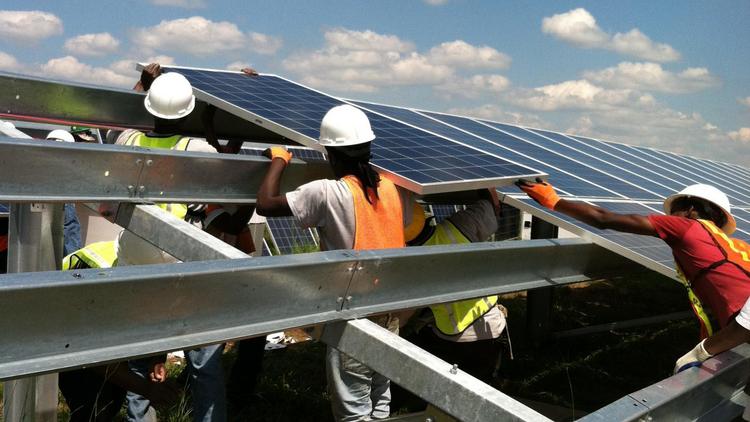
Duke contends that there is no precise definition of “long-term” for the power-purchase agreements at issue in the complaint. And it says it made its decision to go to five-year contracts to protect its customers.

The complaint is the latest round in an escalating battle between Charlotte-based Duke and the solar industry over the future what has been a surprisingly robust industry in North Carolina.

Escalating battle

Duke (NYSE: DUK) wants the commission to end solar development promoted under the federal Power Utility Regulatory Policies Act (PURPA) and replace it with annual bids for projects under the control of the utilities.

This latest turn takes aim squarely at the large-scale projects. Projects that size — commonly 20 to 80 megawatts — are increasingly favored by the largest developers active in North Carolina, such as Cypress Creek and Chapel Hill’s Strata Solar.

Cypress Creek already owns and operates 767 megawatts worth of solar projects in the state. It has almost 2,200 megawatts more in development.

At issue is Duke’s refusal to negotiate power-purchase agreements (PPAs) longer than five years for six Cypress Creek projects, totaling 402 megawatts of solar capacity. They range from Cypress Creek’s proposed 80-megawatt Slender Branch Solar near Lumberton to its proposed 22-megawatt Ruff Solar in Rutherford County west of Shelby.

Negotiable contracts

Cypress Creek spokesman Jeff McKay says Duke’s practice for years had been to negotiate 10- to 15-year contracts for projects larger than five megawatts but not larger than 80.

PURPA requires utilities to negotiate long-term power-purchase agreements to projects built in that size range, but there is not a required contract length.

But Cypress Creek’s complaint notes the Federal Energy Regulatory Commission has ruled that project developers are entitled to contracts “long enough to allow (developers of qualified projects) reasonable opportunities to attract capital from potential investors.”

Cypress Creek quotes N.C. law that asserts purchase agreements “shall be of sufficient length to stimulate development of solar energy.” And it notes that the commission echoes that language in its own rules and regulations that govern negotiations between utilities and developers for projects in that five- to 80-megawatt range.

Duke defense

The complaint says Cypress Creek is “unable to secure financing for construction of any of the QFs based on the five-year PPA term offered by Duke. Notwithstanding ..., Duke has rebuffed all attempts by Complainants to negotiate a term longer than five years.”

Cypress Creek argues that although there is no term length specified by PURPA or North Carolina for projects in the size range at issue, the five-year contract Duke proposes clearly does not meet the general standard set by either the state or federal government. It asks the commission to declare “that a five-year PPA term is insufficient to allow the Solar (developers) to obtain the financing necessary to construct their respective (projects).” And it calls on the commission to direct Duke to enter into contracts “of sufficient length to allow the (projects) to be financed and constructed.”

The company also asks for an expedited hearing in the matter.

Duke spokesman Randy Wheeless says the company has not had an opportunity to review the complaint, which was filed late Friday. But he generally defended Duke’s position.

“Since customers pay the cost of any solar agreement, we are negotiating in their best interest,” he says. “We have received the complaint and will make a formal response in due course.”

Policy changes

Duke has for some time complained that the accelerating growth of solar in the state is being allowed in too haphazard a fashion. It has proposed changes in state renewable-energy policies that solar developers have contended would slow the industry’s growth and increase its own control over development.

Last summer, Duke unilaterally imposed a new requirement on solar projects that seek connection to its distribution grid. Developers complain that the new requirement, called the “stiffness test,” has essentially blocked projects from connecting to any substations on the distribution grid.

This has been a particular problem for projects on the lower end of utility-scale construction, which typically seek connections to such substations. Late last year, Cornelius-based O2 EMC filed a complaint against Duke over the stiffness test on behalf of three of its projects. They were two five-megawatt projects and one 20-megawatt project.

Five-megawatt projects have for years been the bread and butter of the state’s solar industry. In North Carolina, utilities are required to offer such projects a standard contract, which in practice has been a 15-year power-purchase agreement at a specified price, called the utility’s “avoided cost,” set every two years by the commission.

Rapid rise

From 2008 to 2016, North Carolina rose quickly in the ranks of the nation’s most active solar states. Early last year, the state reached second place, behind only the massive solar market in California, in solar capacity installed on its power grid.

Now the industry here is moving to larger projects. The stiffness test does not impact those projects much since most — certainly those above 20 megawatts — are generally connected to Duke’s higher-voltage transmission grid, and developers build their own substations for those connections.

But the latest policy threatens those sorts of projects, too. Cypress Creek calls the five-year contract “a significant departure from past practice.” And the company says “no solar (project) in North Carolina has obtained financing under a five-year PPA term.”

Thus, recent policy changes from Duke appear to have put significant roadblocks up for smaller utility-scale projects with the stiffness test and larger, PURPA-qualified projects with the five-year policy.

Ultimate goal

The ultimate goal, Cypress Creek asserts, is relieving Duke of PURPA requirements to offer solar developers power-purchase agreements and grid connections.

“Duke’s unilateral and sudden refusal to enter into long-term PPAs reflects an effort to modify the current PURPA regulatory regime in North Carolina,” the complaint says.

Noting Duke’s preference for some kind of annual bidding process for new solar projects, Cypress Creek says the new policy was instituted to advance “any necessary approval of such modification and of a competitive solicitation model by this Commission, the North Carolina General Assembly (or) FERC.”

John Downey covers the energy industry and public companies for the Charlotte Business Journal.

Indiana senate bill targets net-metering for elimination

Posted by Laura Arnold  /   January 30, 2017  /   Posted in 2017 Indiana General Assembly, Indiana Michigan Power Company (I&M), solar  /   No Comments

2017-01-30 07_37_43-solar-panels-940x626.jpg and 18 more pages ‎- Microsoft Edge

Indiana senate bill targets net-metering for elimination

A bright idea; Resist urge to tie solar-energy producers’ hands

Posted by Laura Arnold  /   January 29, 2017  /   Posted in 2017 Indiana General Assembly, Indiana Michigan Power Company (I&M), solar  /   No Comments
  • Courtesy Renewable Energy Systems LLC
    These solar panels at Wible Lumber Inc. in South Milford were installed by Renewable Energy Systems, LLC, of Avilla. The million-megawatt system is NIPSCO’s largest net-metering customer.
 
Eric Hesher, Renewable Energy Systems (RES)-Midwest
January 27, 2017 1:01 AM

JG EDITORIALS

A bright idea

Resist urge to tie solar-energy producers' hands

The outlook should be sunny for Indiana companies such as Renewable Energy Systems, LLC.  But that’s only if Indiana Senate Bill 309, a plan that will change the playing field for those who use solar power in their homes, churches and businesses, is killed or modified.

As the legislature prepares once again to wrestle with what to do about solar-power generation, it’s important to remember places like Renewable Energy, which has its financial office in Avilla.

Eric Hesher was the sole employee when he founded the solar-engineering company more than nine years ago to serve commercial and residential customers in northeast Indiana, southern Michigan and the near edge of Ohio. Today, Renewable Energy has five full-time employees and several part-timers and often works through subcontractors. Business is booming, with more than $2 million in sales last year.

“Every year is better than the last,” Hesher said in an interview Tuesday. Early this year, the company’s operations are moving from a warehouse in Kendallville to one with twice the capacity in Avilla.

Hesher’s company isn’t alone. According to the Solar Energy Industries Association, Indiana has 72 companies involved in installing and servicing solar panels, employing 1,567 people.

Jesse Kharbanda, executive director of the Hoosier Environmental Council, said the state could attract many more jobs if its long-term policies are tailored to encourage the use of solar power.

But as it’s now written, solar advocates say, SB 309 is aimed not at nurturing the fledgling industry but eviscerating it.

Like a bill that died in the Indiana House two years ago, SB 309 targets net metering, the system that allows customers to generate and use solar power and send the excess to the utility for credit at retail rates.

Under SB 309, though, customers who generate solar power would only be able to use it for their own homes or businesses until 2027. After that, they would have to sell it to the utility wholesale and buy it back at retail rates.

Supporters say the bill is needed because solar producers depend on the utilities for backup electricity and use utilities’ transmission lines to sell their excess power.

“At the end of the day, our customers are paying for that,” said Brian Bergsma, director of corporate communications and governmental affairs for Indiana Michigan Power. “We support self-generation,” Bergsma said in an interview Monday.  But “self-generation must be done in a way that continues the reliability of the system for all customers.”

Advocates argue that solar generation actually reduces transmission costs and wear and tear on utility electrical systems. And, of course, wider reliance on solar power reduces pollution and its associated health costs.

As the legislature takes up SB 309, it also should remember companies like Hesher’s. As written, the bill is “going to tie the hands of a lot of businesses and customers in future years,” Hesher said. “Most states are promoting solar power. Why is Indiana doing what it is doing?”

Washington (IN) City Council asks for more info on net metering

Posted by Laura Arnold  /   January 28, 2017  /   Posted in Uncategorized  /   No Comments

Mayor Joe Wellman, City of Washington, IN

Council asks for more info on net metering

  • Lindsay Owens Times Herald

During its final meeting of the month, the Washington Council had a long discussion on an ordinance that could bring net energy metering to the city. but there are still a lot of questions some council members would like to have answered before giving final approval.

Mayor Joe Wellman said the possibility of net metering was brought up about a year ago.

“This tries to get ahead of the curve as more and more people want to put solar panels on their roof,” said Wellman of the ordinance the Indiana Municipal Power Agency or IMPA, the energy agency the city’s electricity is supplied by, recommended.

As the ordinance was presented, customers with solar panels or other alternative energy sources would pay a $50 per month fee which would compensate the city for having to maintain lines and poles running to the home or business. Customers could not generate more than 10 kilowatts of electricity in a month. Any electricity generated over the 10 kilowatts would be sold back to IMPA and the customer would receive a credit on his or her bill. IMPA said 10 kilowatts was typically enough electricity to run lights, the refrigerator and many other things but likely not enough to heat water and run the air conditioning.

While the ordinance has already been passed in several other communities IMPA serves, a couple of council members had reservations.

“I’m all for the concept of net metering but I’ve got to do some more research,” said Councilman Mike Singleton.

One of Singleton’s concerns was the $50 monthly fee.

“I’ve got a brother-in-law in Chicago who has solar panels and their monthly fee is $15,” he said.

City Utilities Manager Anita Ash said the price difference is likely based on the number of customers in an area.

Singleton said he felt like IMPA built the solar field just outside of Washington to protect the environment but now the company doesn’t want to lose money so it’s going to charge customers who choose to generate some of their own electricity.

“It’s like having an electric car. You can’t be charged road tax so they want to charge you $150 to make up for that,” he said.

The statement was something Councilman Blake Chambers said he kind of agreed with.

“I’m sort of with Mike on this. If people want to do this (have solar panels or other alternative forms of energy), they want to save money,” said Chambers. “The way this is set up, it’s going to be a wash. We need to find out what other towns are doing.”

Electric Superintendent Randy Emmons said he would check to see what other towns were doing. The ordinance will be up for adoption at the next meeting on Feb. 13.


Do you think adopting a $50/month fee for solar homeowners in Washington, IN is the wrong thing to do, please send a message to the City Council.

contact the Mayor:

Joe Wellman
Mayor
City of Washington

Office Hours:
Monday through Friday: 8:00 am to 4:30 pm

200 Harned Avenue
Washington, IN 47501

Phone (812)254-5575

 
Email: mayor@washingtonin.us
Email: dneukam@washingtonin.us Mayor's Executive Assistant


Senate Bill 309 Could Kill Indiana’s Rooftop Solar Sector

Posted by Laura Arnold  /   January 28, 2017  /   Posted in 2017 Indiana General Assembly, solar, Uncategorized  /   No Comments

Lawmakers in Indiana have introduced a new measure that could wipe out the state's net metering system within a decade and squash the state's burgeoning solar energy sector.

For the past 12 years, Indiana's net metering policy has credited homeowners and businesses with rooftop solar systems for the excess power their panels generate and send to the grid. However, Senate Bill 309 (SB309), authored by Republican State Senator Brandt Hershman, aims to eliminate this scheme by 2027 and replace it with a controversial "sell all, buy all" system.

"Mandatory 'buy-all/sell-all' approaches greatly infringe on customers' energy independence and this bill should be cause for great alarm for consumers in the state of Indiana," Sean Gallagher, vice president of state affairs for Solar Energy Industries Association (SEIA), told EcoWatch.

"Rooftop solar power that is exported from customers' homes or businesses to the grid is quickly absorbed by neighboring homes and businesses. Compensating that local power at average wholesale prices significantly undervalues the benefits of producing that power—such as avoiding the need to build new power lines—and ignores the fact that solar power is produced during daytime peak periods when wholesale energy prices are higher," Gallagher added. "Whether it's installing energy efficiency measures or consuming on-site generation, customers should always receive the full retail price value for behind-the-meter choices that reduce grid-supplied energy consumption, resulting in benefits for the entire community."

Laura Arnold, president of the Indiana Distributed Energy Alliance, explained to Midwest Energy News, that the measure is akin to confiscating private property.

"It's like saying, 'Yeah, you can have your solar panels but you really don't own them because you can't decide what to do with the electricity you're producing yourself,'" Arnold said.

While the bill aims to stop net metering in 10 years, as the Indiana Business Journal noted, the state could put an end to it even earlier:

Language in the measure stipulates that net metering would end no later than July 2027—which supporters say gives the solar industry plenty of time to adjust.

But it could happen sooner. According to current rules, a utility such as Indianapolis Power & Light Co. doesn't have to offer net metering to customers once it reaches a cap of providing net metering equal to 1 percent of its summer peak generation.

PV-Tech says the bill "has not yet been seen in other states and is a unique approach from the Indianan legislators."

Opponents of the bill say it would discourage homeowners and businesses from investing in solar systems, which can be costly to install.

"One of the fundamental reasons people put solar panels on their roofs is to reduce consumption from the grid—to be self-reliant, sustainable, efficient," Kerwin Olson, executive director of Citizens Action Coalition, told Indiana Business Journal. "That should be encouraged to the highest degree."

Additionally, the bill could have ramifications for Indiana's nascent solar sector. More than 72 solar companies operate in the state and employs about 1,567 people.

Incidentally, renewable energy is poised for massive growth in the U.S. The U.S. Department of Energy recently announced in a report that U.S. solar employs more workers than any other energy industry, including coal, oil and natural gas combined.

"SB 309's anti-American limitations on how consumers can use their own rooftops could significantly undermine the state's clean energy progress and, in turn, the well-paying jobs that solar now provides the state of Indiana," Gallagher said.

"Net metering creates a situation where customers with solar panels are being paid by customers without solar panels," Mark Maassel, president of the Indiana Energy Association, told Indiana Business Journal. "That's just not fair."

The legislation is set for a hearing before the Senate Utilities Committee on Feb. 2.

Indiana's net metering system actually survived an attack two years ago. In 2015, state representative Eric Koch (no relation to the Charles and David Koch) introduced a bill that would have reduced net metering payments and added fees to solar customers. That bill failed to advance.

So-called " solar wars" are waging in several states such as Nevada, Florida and Arizona. Reports have emerged of billionaire oil barons Charles and David Koch and their political allies trying to kill net metering as they see growth in renewable energy as a threat to their businesses.

An April 2016 report from the Center for Biological Diversity determined that Indiana was among the top 10 sunniest states in the country actively blocking rooftop solar development through overtly lacking and destructive policy landscapes.

Indiana, along with Alabama, Florida, Georgia,, Michigan, Oklahoma, Tennessee, Texas, Virginia and Wisconsin, account for more than 35 percent of the total rooftop-solar technical potential in the contiguous U.S., but only 6 percent of total installed capacity.

"Thanks to weak and nonexistent policies, the distributed-solar markets in these states have never been given a chance to shine," said Greer Ryan, sustainability research associate with the Center for Biological Diversity and author of the report. "There's room for improvement in solar policies across all 50 states, but it's especially shameful to see the sunniest states fail to lead the transition from fossil fuels to clean, renewable energy."

Copyright 2013 IndianaDG