

Author Archives Laura Arnold

New Survey Shows That Renewable Energy Polls Extremely Well Among Trump Voters

Posted by Laura Arnold  /   January 09, 2017  /   Posted in solar, Uncategorized  /   No Comments

New Survey Shows That Renewable Energy Polls Extremely Well Among Trump Voters

New Survey Shows That Renewable Energy Polls Extremely Well Among Trump Voters

As the press tries to understand Donald Trump's approach to energy and climate change policy, the focus is on his limited policy proposals, transition team appointments, and confusing, offhand quotes. But it's also helpful to look to the voters themselves.

Trump won the presidency partly because of his ability to speak directly to the angst of many voters. That was how he approached energy too. In numerous speeches during the campaign, Trump painted a dire picture for America's energy landscape -- a place where workers are losing jobs in droves and regulation is killing domestic production.

In reality, however, there are now more American solar jobs than jobs in oil and gas extraction, and the country is the world's leader in oil and natural-gas production. We're truly an "all-of-the-above" country -- and increasingly, more energy is being sourced from above the ground, rather than below it.

And if Trump listens to his own voters, he'll hear this genuinely positive story about the future of energy. Because his supporters really like renewables -- and they really want the government to prioritize them.

A new survey of 1,000 people conducted by the Republican polling firm Public Opinion Strategies illustrates this dynamic. According to the poll, 75 percent of Trump voters support "action to accelerate the deployment and use of clean energy" -- including solar, wind, energy efficiency, and community renewable projects.

This backs up what we already know. Renewables are generally not a partisan issue. Survey after survey demonstrates this fact.

Although many Americans believe their country has fundamentally changed after the election, the story on clean energy remains the same. People of all political persuasions want more of it.

Let's take a look at what voters are saying.

First to the broader electorate. Across the board -- from the most hardcore conservatives to the staunchest liberals -- Americans support "taking action" to support clean energy. (More on the "action" piece below.)

Voters also overwhelmingly support an "all-of-the-above" strategy, even across party lines. However, as strategist Glen Bolger points out, voters are generally less enthusiastic about coal. "There is majority support for less emphasis on coal," he writes in the report on the survey results.

Three-quarters of voters want to see more solar, 70 percent want more wind, 61 percent want more hydro, and 51 percent want less coal.

So how does this shake out when only Trump voters are factored in? The trend only gets stronger.

"Fully 75% of Trump voters support taking action to accelerate the development and use of clean energy in the United States. Trump voters support multiple specific policies to expand their state’s commitment to clean energy, including energy efficiency upgrades and community renewable projects," writes Bolger.
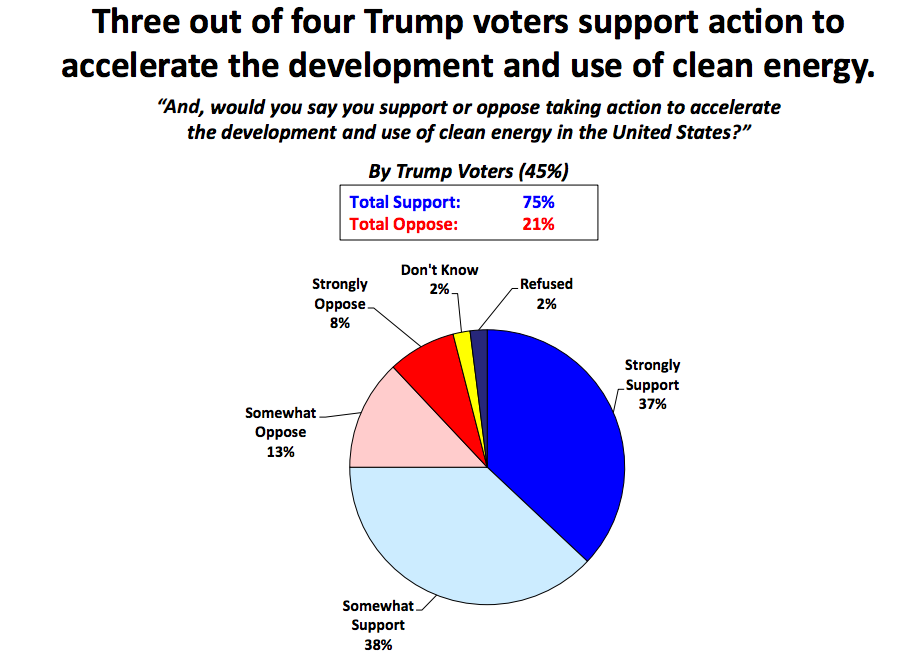
Broken down by technology, natural gas, wind, solar and hydropower all get majority support from Trump voters. Solar leads with 61 percent support -- a finding that won't come as a shock to anyone following the rise of the Green Tea Coalition.

"A majority of Trump voters want to see more emphasis on domestic energy in natural gas, wind, solar and hydropower. They are modestly supportive of coal, and mixed on nuclear. They also strongly support their state pursuing an all-of-the-above energy strategy that includes an increase in electricity generation from emerging technologies like renewable energy, as well as more energy efficiency," writes Bolger.

When asked what policies are most important, 46 percent of Trump voters say energy-efficiency upgrades, 41 percent say community renewable energy projects, and 36 percent say net metering policies.

Broadening out to all Republican voters, the survey also finds a similar pattern.

"When Republicans hear the phrase 'clean energy,' they think of solar and wind power. They say it is non-polluting and leads to clean air and renewable energy. There is some concern about the cost and government regulations, but that is outweighed by the positives," writes Bolger.

There is still opposition to state-level mandates among the most conservative Republicans. However, a majority of moderate conservatives do back renewable energy standards. (Unsurprisingly, 90 percent of liberals support the policy.) In total, two-thirds of voters support state targets for renewable energy.

"There is also strong support, except from base Republicans, for states to have a renewable portfolio standard requiring a minimum amount of electricity generated by a utility to come from renewable sources," concludes Bolger.


Public Opinion Strategies also asked voters if they'd be willing to pay a small premium for clean energy: “If accelerating the growth of clean energy meant that, in the short term, consumers would have to pay a little bit more for energy but in the long term would have more stable, cleaner, and cheaper energy, which would you choose?”

The responses break down along similar political lines. A majority of moderate conservatives and independents say "yes," while the most conservative Republicans say "no."

Altogether, 64 percent of voters say they'd pay more to support renewables.


Solar net metering also polls extremely well. When asked about their thoughts on giving homeowners "full retail credit for the extra energy their rooftop solar panels produce," 60 percent of all voters reacted favorably.

According to the results, 60 percent of voters agree with the following affirmative statement: "Some people say net metering is fair because it encourages the development of solar resources, and other customers benefit from the extra solar energy that goes onto the electricity grid."

Another 31 percent agree with the statement that net metering is a cross-subsidy: "Other people say net metering is unfair because solar customers use the electricity grid, too, and need to pay a fair rate for their use. They say that otherwise, solar customers’ use of the electricity grid becomes subsidized by non-solar customers."

However, no matter where voters sit on the political spectrum, a plurality or majority think that net metering is fair.


Finally, voters really do care about how candidates talk about energy. They want more clean energy -- and they want politicians to want more of it too.

"Voters overwhelmingly say it is important that a candidate for political office shares their opinion on energy issues," writes Bolger.


And messaging matters. The most important message for conservatives revolves around wealth creation.

This statement polls the best among "base" and "soft" conservatives: "We should accelerate the growth of clean energy to allow American innovation and entrepreneurs to drive economic growth and job creation."

In Trump's America, voter support for clean energy is alive and well. No election can change that.

Nevada PUC approves restoring retail net metering to Sierra Pacific customers

Posted by Laura Arnold  /   December 23, 2016  /   Posted in solar, Uncategorized  /   No Comments

Nevada PUC approves restoring retail net metering to Sierra Pacific customers

Dive Brief:

  • The Public Utilities Commission of Nevada unanimously approved a draft order to restore retail rate net metering to customers in Sierra Pacific Power's service territory. Any cost shift borne by ratepayers is "reasonable," the commission said in the draft order.
  • In the order, the PUCN would open up to 6 MW of installed capacity for rooftop solar systems in northern Nevada to fall under the original net metering rates on January 1, 2017. The decision, however, only serves about 1,500 customers.
  • The hearing comes as the PUCN prepares for testimony on Sierra Pacific's Integrated Resource Plan (IRP), which sets long-term forecasts for future investments.

Dive Insight:

In a hard-fought victory for the solar industry, the PUCN voted to reinstate full retail rate net metering for solar customers in northern Nevada after terminating it last year.

By opening up the capacity to 6 MW, regulators said it will "nearly double the growth of [net metering] participants in Sierra Pacific Power's territory over the past three years."

Net metering is a popular billing mechanism that credits residential solar customers—usually at the retail rate—for any excess energy exported to the grid. But increasingly, the policy has come under fire. Utilities say those customers don't pay their fair share for grid upkeep. On the other hand, solar customers argue utilities and regulators fail to quantify all the benefits distributed solar provides to the grid, including avoided costs in transmission and environmental impacts.

Regulators said in this instance, any cost-shift to non-solar ratepayers is "reasonable under the facts of this case."

"Under this order, the average Nevada ratepayer will see a decrease of $0.01 per month on monthly utility bills," they wrote.

Chairman Joe Reynolds called last year's decision a promise better left unkept.

"Abraham Lincoln once said that “[b]ad promises are better broken than kept...The PUCN’s prior decisions on NEM [Net Energy Metering], in several respects, may be best viewed as a promise better left unkept. The PUCN is free to apply a new approach...We look forward to pursuing that new approach together with all Nevadans.”

In the last year, Nevada's become a byword for acrimony in solar proceedings.

Last year, regulators chose to end the state's retail net metering program, replacing it with lower rates and higher fees. They also applied the new rates not just to new solar customers, but existing ones as well, an unprecedented move that sparked the most controversy.

After the decision, two leading solar developers exited the state and national wave of backlash slammed the decision, leading the governor to form an energy task force and choose not to reappoint two commissioners.

After the decision, the incumbent utility NV Energy collaborated with solar interests, including SolarCity, to come up with a grandfathering proposal. SolarCity, in conjunction with the Natural Resource Defense Council, also produced a study showing rooftop solar provides a net benefit of 1.6¢/kWh.

The decision aligns with SolarCity's head policy chief (and former FERC Chairman) Jon Wellinghoff's goal for restoring net metering throughout the state.

"I commend the Public Utilities Commission of Nevada for bringing full retail net metering back to Northern Nevada, and affirming that whether solar customers are providing clean solar energy for their own homes, or supplying it to their neighbors, the benefits of that local generation outweigh the costs," Wellinghoff said in a statement.

With this win, it appears the solar sector is on course to reclaim some of the financial ground it lost through the decision last year. However, the reinstatement is confined to less than 2,000 customers. It remains to be seen whether or not this decision will spread to the rest of Nevada. Gov. Brian Sandoval (R) through his New Energy Task Force wants retail rate net metering fully restored.

Arizona, conversely, ended its retail net metering program earlier this week after the conclusion of its value-of-solar docket. Instead, compensation schemes will be decided in pending rate cases.

Follow Krysti Shallenberger on Twitter

Pence could leave Indiana with no energy stds for buildings

Posted by Laura Arnold  /   December 21, 2016  /   Posted in Uncategorized  /   No Comments

rop-pence-4-042516-2col.jpg

Pence could leave state with no energy standards for buildings

December 21, 2016

Indiana could be without an energy code for up to two years after the Pence administration decided against extending the current one—a move that critics say could have negative results for Hoosiers’ energy bills and lead to a “slumlord’s dream” scenario.

The state’s energy conservation code—which covers commercial buildings and apartments and sets minimum energy standards—expires Dec. 31.

Groups including the American Institute of Architects hoped the Pence administration would extend the code for one year while it worked on updated rules. The current code is based on 2007 industry standards.

But state officials say that the Fire Prevention and Building Safety Commission “could not” readopt the former code after two groups requested changes. To make changes, an agency must launch a new rule-making process that can take up to two years.

Without renewing the rule in the meantime, the state will be without a code to dictate requirements for heating and air, insulation and lighting systems.

“The commission is pursuing energy code adoption, but the final product will take time to come to fruition,” said spokesman John Erickson of Indiana’s Department of Homeland Security.

But the groups say that is the opposite of what they wanted, and that they’re still hoping the Pence administration extends the code by the deadline.

Isaac Elnecave, senior policy manager for the Midwest Energy Efficiency Alliance, said he was shocked to hear that his group’s request to update the state’s energy standards could lead to a decision not to renew current ones.

“I have never heard of a state that suspends an actual code while an upgrading process is underway,” Elnecave said. “That was absolutely not the intention here, to put it bluntly. It actually is the opposite of what we asked for.”

And the result, which would impact new construction, could have negative consequences for middle- or lower-income Hoosiers, according to Jason Shelley, executive director of AIA Indiana.

“With no standards, the public is at the mercy of building owners,” Shelley said. “For example, an apartment dweller could find themselves in a structure with no or an under-insulated building. This would equal higher heating and cooling costs for each occupant and it increases the likelihood of mold, thus impacting the health, safety, and welfare of Hoosiers.”

Adequate energy standards also reduce pollution and increase grid reliability, according to AIA.

Not having a code “would set the state back 30 years,” Shelley said.

“Even the most modern buildings have some energy waste, however, architects, engineers and builders need to do our part to design and construct buildings to use less energy, which in turn puts less strain on the entire state’s utility grid,” Shelley said. “Without an energy code, some could build to lesser standards in order to save on construction costs, but in the long-term, it will increase costs and cause a strain on the utility grid.”

The commercial code at issue was adopted in 2010.

Shelley says he is concerned that allowing the commercial energy code to expire “sets a precedent to allow the systematic expiration of all building codes in Indiana”—particularly because the Pence administration put a moratorium on all new rules at the beginning of his administration.

Pence leaves office Jan. 9, the date Lt. Gov. Eric Holcomb will be sworn in as governor. That's too late to extend the current rules. Holcomb spokesman Pete Seat did not immediately return a call seeking comment.

However, the new Holcomb administration will face decisions about the residential building code, which expires in a year, and the residential energy code, which expires in 2018.

Without renewals or new rules, Shelley said, consumers are likely to be “woefully unprepared” to make decisions about properties they would buy or lease based on available data about energy costs.

For instance, AIA estimates that for a 2,100 square-foot single-family home, annual energy costs could be about $5,100 if it had uninsulated walls and single-glazed metal windows. The same home built to the current minimum code standards would have energy costs of about $1,500 per year.

“The energy code saves homeowners and renters hundreds of dollars a year that their landlord, seller, builder has no obligation whatsoever to share,” according to the group. “If we’re going to go to an unregulated building industry, the public needs to be prepared to some degree.”

Arizona regulators vote to stop net metering for solar

Posted by Laura Arnold  /   December 21, 2016  /   Posted in solar, Uncategorized  /   No Comments

Arizona regulators vote to stop net metering for solar

Arizona utility regulators voted Tuesday to end the system of net metering, where homeowners with solar panels get retail credits for power they send to the grid, and instead reduce the amount utilities pay homeowners for rooftop solar power.

The five Arizona Corporation Commission members approved a judge's recommendation with some amendments after a full day of discourse and hours of public comments on Monday, mostly from solar advocates.

The Corporation Commission began the proceeding in 2014, and hundreds of comments were filed, including those submitted by solar companies, mines, consumer advocates, utilities, merchant power plants and other groups with a stake in the decision.

Commission Chairman Doug Little and Commissioners Bob Stump, Robert Burns, Tom Forese and Andy Tobin all seemed comfortable with changes to net metering, though they debated details of how to compensate homeowners for the power. The final vote was 4-1 with Burns opposed.

"I think we’ve accomplished something pretty historic today," Little said during his vote. "While I will tell you that perhaps the decision we've come to today is not a perfect decision, it is definitely a step in the right direction."

Through net metering, each kilowatt-hour from solar panels that goes to the grid is credited on monthly bills. The credits roll over month to month and offset the electricity that homeowners draw from the utility at night or when their panels are not making enough electricity to serve their needs.

Because each kilowatt-hour of credit offsets a kilowatt-hour homeowners otherwise would purchase, it is worth the retail price of electricity, about 10 to 14 cents each, depending on a utility customer's rate plan.

Administrative Law Judge Teena Jibilian recommended that utilities buy the energy for a price based on what they actually save in avoided costs of power plants, fuel and infrastructure.

That will be substantially less than the retail price of electricity, officials agree. To prevent a shock to the industry, the regulators seemed to agree on a different calculation for rate cases that are pending, such as that for Arizona Public Service Co.

Representatives from Vote Solar and the Alliance for Solar Choice estimated the changes would mean a 30 percent reduction in what utilities pay solar customers for their electricity, though some parties to the case disagreed with that figure.

The pending rate cases will use a "resource comparison proxy" that will pay solar customers a rate based on what utilities are paying for solar energy from large solar power plants. Those wholesale rates are also below the retail rate solar customers get for their power today.

The commissioners agreed they didn't want to reduce the payment more than 10 percent in a given year, though the initial drop-off from net metering to the new calculation could be more than that.

Solar customers still will be able to use power from their panels on site, and avoid buying that energy from their utility. The savings they get from "self-consumption" isn't affected by the changes, only the compensation they get for sending excess power to the grid.

The new compensation rates for excess solar power won't be used until those utilities go through a rate case.

The decision also will not affect customers who already have installed solar, but will apply only to those who install it once the order takes effect at utilities under the purview of the Corporation Commission. Commissioners agreed to the so-called "grandfathering" provision to preserve net metering for existing solar panels for 20 years from the date they were connected to the grid.

Renewables challenge natural gas plants on price in latest Lazard analysis

Posted by Laura Arnold  /   December 20, 2016  /   Posted in solar, wind  /   No Comments

Renewables challenge natural gas plants on price in latest Lazard analysis

Copyright 2013 IndianaDG