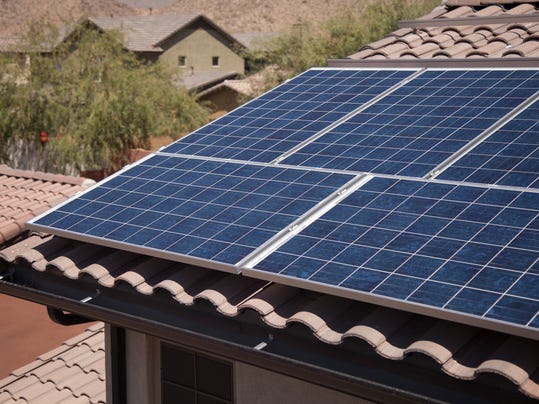
Ind. Municipal Power Assoc. triples size of Peru (IN) solar park project

Posted by Laura Arnold  /   March 19, 2015  /   Posted in solar  /   No Comments

11,850 panels will generate 3-megawatts, net $640,000 in tax revenue

Posted: Wednesday, March 18, 2015 12:00 pm

PERU – After doubling the size of a new solar park to be constructed in Peru, the Indiana Municipal Power Association said it now plans to triple the size of its project.

The company, which provides 59 cities and towns in Indiana with wholesale electricity, last year approved a $2.1 million park that would contain 3,900 solar panels and produce 1 megawatt of energy.

In February, the utility announced it would double the size of the project, which would increase the investment to $3.6 million.

Power company expanding Peru solar park

PERU – The Indiana Municipal Power Association said it will double the size a new solar park to be constructed this year just outside Peru.

The IMPA said this month it will now invest $5.36 million to install 11,850 solar panels that will generate 3 megawatts of energy.

Jack Alvey, IMPA’s senior vice president of generation, said the utility is installing solar parks throughout the state this year in order to meet its goal of generating 10 megawatts of solar energy in 2015.

The company decided to triple the size of the project after hitting roadblocks in acquiring land for solar parks in other Indiana towns, he said.

The Peru park will be built on 30 acres of land the IMPA is leasing from Peru Utilities on East Wabash Road, just outside the city limits.

Brooke Robertson, director of business retention and expansion for the Miami County Economic Development Authority. said another factor in the company expanding the project is the support from county and city officials.

Carson Gerber can be reached at 765-854-6739, carson.gerber@kokomotribune.com or on Twitter @carsongerber1

Due to formatting problems, please find a copy of the story below.

Power association triples size of Peru solar park project - Kokomo Tribune_ News


NYT: Obama to Order Cuts in Federal Greenhouse Gas Emissions

Posted by Laura Arnold  /   March 19, 2015  /   Posted in Uncategorized  /   No Comments

http://www.nytimes.com/2015/03/20/us/politics/obama-order-to-cut-federal-greenhouse-gas-emissions.html?partner=rss&emc=rss&_r=1

WASHINGTON — President Obama will sign an executive order on Thursday to cut the federal government’s greenhouse gas emissions, a White House official said, his latest use of presidential power to address the root causes of climate change.

Having failed during his first term to push a cap-and-trade bill through Congress, Mr. Obama has begun a systematic effort to regulate pollution through the existing Clean Air Act, advancing new rules on emissions from cars and trucks, power plants and oil and gas wells.

While the federal government is a relatively small contributor to greenhouse gas emissions, the executive order is the president’s attempt to lead by example and push the private sector to change its behavior as a consequence.

After signing the directive at the White House, Mr. Obama plans to visit the Department of Energy to tour its rooftop solar panels and talk to private suppliers to the federal government that are committing to reducing their greenhouse gas emissions.

Some of the companies will announce that they are setting new goals for reducing future emissions, the official said.

Iowa bill would require debatable safety feature on home solar; Why now?

Posted by Laura Arnold  /   March 18, 2015  /   Posted in Uncategorized  /   3 Comments


Iowa bill would require debatable safety feature on home solar

Engineers say an emergency cutoff switch is a redundant feature on inverter-equipped solar arrays. (Photo by mjmonty)

An Iowa bill requiring a safety feature that some engineers say is unnecessary has critics questioning whether the legislation is an attempt to stifle distributed generation.

The legislation, SF 406, would require customer-generators to install an external disconnection device. The device itself would add a few hundred dollars or more to the cost of a solar array or other system, but the bill also would impose daily fines of between $1,000 and $5,000 for any energy generator without one.

The requirement would apply to existing systems as well as new ones, according to state Sen. Tony Bisignano, who introduced the legislation.

Clean-energy advocates in the state have been focused on defeating the bill, which they see as an effort to discourage rooftop solar installations, in particular, by piling on an additional – and needless – cost.

“This is something that’s coming from the utility behemoths through the IBEW (International Brotherhood of Electrical Workers),” said Barry Shear, the president and owner of Eagle Point Solar in Dubuque. “They’re the ones pushing this.”

“It’s a well-designed play to talk safety, but it’s really designed to be a barrier to solar,” said Josh Mandelbaum, a staff attorney in Des Moines with the Environmental Law & Policy Center.

Mandelbaum questions why the union didn’t raise concerns about the issue when it submitted comments to the Iowa Utilities Board on distributed generation last year.

“This is exactly the type of issue that would have been appropriate to raise at that time,” Mandelbaum said, “and they were silent. That, to me, suggests that something else is at play.”

‘Create some uniformity’

Bisignano said he introduced the bill to ensure the safety of utility workers making repairs in the event of a power outage. He said repair workers must be assured in such a scenario that no power is coming into the grid from distributed generators, and the only way to be certain of that is for the linemen to manually disconnect any solar panels in the affected area.

Michael Coddington, a senior electrical engineering researcher for the National Renewable Energy Laboratory, doesn’t buy it.

“It’s just….an effort to create barriers to deploying PV,” he said. “When I see these rules enacted, it’s clear the devices won’t be used, and will add cost.”

Bisignano maintains that he “would not want to discourage any alternative renewable energy. That would not be my intention by any means. This bill would ensure that there is no opportunity for energy personnel or electrical workers to be electrocuted. That’s the long and short of why I filed the bill.”

In fact, Iowa’s two major investor-owned utilities, MidAmerican Energy and Alliant, and nearly all of the state’s rural electric co-ops already require their customers to install external disconnect switches. Currently, Iowa leaves requiring the devices at utilities’ discretion.

So why would they support a bill mandating a device they’ve already chosen to require?

Alliant spokesman Justin Foss says the bill “is not about requiring the disconnect. It’s about requiring the uniform placement of the switch.”

Utility linemen and other possibly other electricians looking for these switches need to know where they are, he said. Hence, the need for consistency in their location. The bill does state in some detail where the switches should be placed.

“Our hope with this bill is that we could create some uniformity on the grid,” Foss said. “While there are many different utilities, there is one grid.

‘Completely unnecessary’

But wherever the switch is installed, it’s still redundant and unnecessary, according to a 2008 study done by the National Renewable Energy Laboratory.

Coddington, one of the study’s authors, argued in the paper that there are at least a half-dozen procedures and technologies, now in effect, that prevent power from a small solar array from backfeeding onto a grid – and electrocuting someone in the process.

Rooftop solar panels have inverters, devices that change direct current to alternating current. They only send power out to the grid when they sense power coming from the grid, Coddington said, meaning that when an outage occurs, a home solar system cannot send power out to the grid. Sending a utility worker to shut off a disconnect switch is simply redundant, he said.

It’s also time-consuming, he pointed out, at a time when utilities are under pressure to restore power as quickly as possible.

Eagle Point’s Barry Shear concurred, saying, “From a technical standpoint, it’s completely unnecessary.”

Coddington pointed out that standard safety protocol requires utility workers to assume all electrical systems are carrying power, and to dress and use tools that would insulate them from live wires. Utility workers who follow standard procedures would not have a problem, he said, even in the highly unlikely event that a solar system was feeding power back to a grid experiencing a power outage.

While Iowa is considering adopting an external-disconnector requirement, the NREL report documents a move away from that in other states. As of 2008, utility regulators in eight states had eliminated their EDS requirement. Another nine states had decided to allow utilities to make their own decisions in the matter.

In solar-heavy California, two large utilities dropped their requirement that solar arrays have external disconnect switches.

The reason, according to Coddington: “People started asking them the hard questions.”

Arizona regulators: APS to ask for higher solar fees; AGAIN? Really?

Posted by Laura Arnold  /   March 17, 2015  /   Posted in solar, Uncategorized  /   No Comments

Solar industry Arizona

Arizona regulators: APS to ask for higher solar fees

W. Virginia governor approves previously vetoed net metering bill; AEP lobbied against looking at benefits of solar

Posted by Laura Arnold  /   March 16, 2015  /   Posted in solar  /   No Comments

West Virginia Gov. Earl Ray Tomblin

The bill Gov. Earl Ray Tomblin signed on March 12 includes only minor revisions compared to the one he vetoed on Feb. 24. Office of the Governor

Read more: http://www.pv-magazine.com/news/details/beitrag/west-virginia-governor-approves-previously-vetoed-net-metering-bill-_100018604/#ixzz3UaF3bfdH

West Virginia governor approves previously vetoed net metering bill

16. MARCH 2015 | GLOBAL PV MARKETS, INDUSTRY & SUPPLIERS | BY:  GARRETT HERING

West Virginia Gov. Earl Ray Tomblin on Thursday approved a bill to rewrite net energy metering rules for on-site distributed solar generation in the state after he vetoed virtually the same proposal two weeks earlier.

Read more: http://www.pv-magazine.com/news/details/beitrag/west-virginia-governor-approves-previously-vetoed-net-metering-bill-_100018604/#ixzz3UaDqVArM

Solar industry groups had cautioned the legislative proposal -- HB 2201 -- would jeopardize rooftop solar in West Virginia and encouraged him to veto it.

The bill Gov. Tomblin signed on March 12, however, includes only minor revisions compared to the one he vetoed on Feb. 24. As previously, it requires the Public Service Commission “to prohibit cross-subsidization” through net metering, conduct a general investigation into net metering rules and caps the amount of customer generating capacity eligible for net metering at no more than 3% of total utility peak demand.

In a statement, the governor said: “Today I signed House Bill 2201, which regulates net metering as part of West Virginia’s power generation. I appreciate the increasing role solar and wind power will play in our state, and I encourage the Public Service Commission to continue to evaluate the costs and benefits of West Virginia’s net metering policy to balance the potential for new jobs and investment in alternative energy without unfairly burdening current ratepayers.”

Despite the bill’s essentially unchanged content, solar industry representatives took encouragement from Gov. Tomblin’s words.

“The governor made clear in his public statement that he expects his appointed Commission to consider the benefits of solar," said Bryan Miller, co-chairman for The Alliance for Solar Choice (TASC). According to the group, American Electric Power and other utilities lobbied to prevent the commission from considering any benefits of solar.

"In a desperate attempt to become the thought police for West Virginia, AEP aggressively lobbied to prohibit regulators from considering any solar benefits at all. AEP failed in this extreme effort," charged Miller, who is also a vice president at solar company Sunrun.

Read more: http://www.pv-magazine.com/news/details/beitrag/west-virginia-governor-approves-previously-vetoed-net-metering-bill-_100018604/#ixzz3UaE2hZHm

Copyright 2013 IndianaDG