Author Archives Laura Arnold

Solar park at former Continental Steel site receives favorable recommendation

Posted by Laura Arnold  /   June 02, 2016  /   Posted in solar  /   No Comments

Inovateus Solar logo

Solar park at former Continental Steel site receives favorable recommendation

City officials made progress Wednesday on the development of a much-anticipated solar park at the former site of the Continental Steel plant, a project expected to be completed this fall.

At a Kokomo Plat Committee meeting Wednesday, a favorable recommendation for the project’s development plan approval was sent to the city plan commission, which will hear the case at 7 p.m. June 14 in City Hall.

The solar park – originally slated for completion by the end of 2015 and expected to cost $10 million – is being developed by Inovateus Solar, a solar-integration company based in South Bend which has developed solar-energy facilities in 26 states.

If the plan commission approves the project’s development plan, Inovateus Solar will begin construction work immediately and likely finish by this fall, according to Austin Williams, an Inovateus Solar senior account executive.

The park, which will be located on roughly 30 acres at 1201 W. Markland Ave., will include around 21,000 solar panels and produce seven megawatts of energy.

Wednesday’s development comes after the Indiana Utility Regulatory Commission approved a 20-year purchased-power agreement last August between the company and Duke Energy, which will buy the electricity and distribute it on the grid.

"The usage lines up with between 500 to 1,000 [homes], but one guy could use quite a bit more than the other so it's really, really hard to tell," explained Williams about the potential impact of the park's energy distribution.

Duke Energy Indiana’s operations provide about 7,500 megawatts of owned electric capacity to approximately 810,000 customers in a 23,000-square-mile service area, making it the state’s largest electric supplier, according to a Duke press release.

In relation, Inovateus Solar and city officials are working to finalize a lease which matches the 20-year term with Duke, said Williams, noting the lease could eventually be extended if the panels are still producing power.

“We looked for areas where there was plenty of power draw, plenty of power load, and energy infrastructure,” he explained about the decision to build a park in Kokomo. “With Kokomo as a high industrial area, that was top of the list to start checking out.

“When we starting finding these brownfield sites it really made a lot of sense, and then the city got really excited because they’ve been vacant for a while. Kokomo is a good choice because it’s really got the population we need and the energy infrastructure,” he added later.

Formerly, the Continental Steel site was listed on the Environmental Protection Agency’s list of most dangerous sites because of the high levels of toxic pollutants in the soil.

Continental Steel went bankrupt in 1986, and studies revealed the 183-acre property was contaminated with solvents, PCBs and led. The Indiana Department of Environmental Management and the EPA spent more than $40 million to clean up the site.

City Engineer Carey Stranahan said in a previous interview the city is on board with the new facility, which will revitalize a piece of property that has been vacant for decades.

“The reason we were interested in turning this property into a renewable energy opportunity is because we can reuse property that previously compromised the environment,” he said. “Solar energy has a very low impact on the environment, which was attractive to us.

“This also reduces maintenance by the city. We will be receiving revenue, but we will not have to invest too many resources,” he said.

In addition, Stranahan addressed Wednesday the prospect of an oft-discussed roundabout at the intersection of Markland and Park avenues.

During the meeting, Stranahan said the project will be let in December with construction expected to start next spring.

In accordance with construction, he said numerous trees from the city’s recent Park Avenue beautification project may have to be relocated.

In an effort to reduce congestion and accidents at one of Kokomo’s busiest intersections, the city and Beam, Longest & Neff agreed on March 16, 2011, to enter into a partnership for the Markland and Park avenues intersection improvement project.

George Myers can be reached at 765-454-8585, by email at george.myers@kokomotribune.com or on Twitter @gpmyerskt.

Washington Post: Some states may be making a big mistake about rooftop solar

Posted by Laura Arnold  /   May 31, 2016  /   Posted in solar, Uncategorized  /   No Comments

SolarCity employees install solar panels on the roof of a home in Kendall Park, N.J., in July 2015. SolarCity is scheduled to release earnings figures on July 29. (Michael Nagle/Bloomberg)

Some states may be making a big mistake about rooftop solar

May 26, 2016

Rooftop solar installations are a fast-growing part of the booming U.S. solar sector, which some experts say is poised to experience its biggest year yet. But while the industry’s rapid expansion is considered a clear win for the climate, it hasn’t come without backlash.

Utility companies across the country have begun to raise concerns that the rates and credits given to homeowners with rooftop solar installations — which commonly include payments for any excess power they generate and send back to the grid — may actually be transferring costs back to non-solar customers and the utilities that maintain the electric grid. And they’re pushing for the system to be changed.

But now, new research suggests this is an empty concern. A paper published Monday by researchers from the Brookings Institution reviews a number of studies conducted by state utility commissions, academic institutes and think tanks and suggests that rooftop solar actually benefits all consumers — whether they’re solar customers or not.

The controversy  

Debates about the costs and benefits of rooftop solar tend to revolve around a practice known as “net metering.” This system allows solar customers to sell any excess electricity they generate to their local utility at a retail, rather than wholesale, rate.

However, extra power generated by rooftop solar panels takes the place of electricity the local utility would have otherwise sold. And since those sales are used to help maintain the electric grid, some utilities have argued that net metering unfairly shifts those costs back onto their non-solar customers.

The issue has come to a head in several states already. In California, for instance, investor-owned utilities proposed gradually reducing the rates paid to homeowners with rooftop solar installations for the energy they generated, while the solar industry lobbied for the retail rates to be preserved. In February, the solar backers won out by a narrow vote.

A similar struggle has been playing out in Arizona for the past several years, although a decision on whether to change the rates has yet to be made. And last year, Hawaii actually ended its retail-rate net metering program for new solar customers.

Perhaps the most dramatic example yet, though, took place in Nevada at the end of last year, when the state’s public utilities commission made the decision to cut its net metering rates, as well as apply higher fixed charges to solar customers — both new and existing. The changes have reportedly been a major blow to the rooftop solar business in Nevada, with several large solar installers moving to exit the state’s market entirely.

“Across the country state legislatures and/or utility regulatory commissions in more than 30 states are evaluating current net metering policies and are taking steps to update them to eliminate the shift in costs from customers with private solar systems to customers without these systems,” said Jeff Ostermayer, a spokesman at Edison Electric Institute (an association representing investor-owned electric companies in the United States) by email.

But the Brookings review suggests that these types of policy changes may not be warranted after all — that, rather, the benefits provided by rooftop solar actually outweigh their costs. The review points to state-commissioned studies from Vermont, Mississippi, Minnesota,Maine and even Nevada that suggest net metering results in net benefits for all energy customers.

Similar conclusions appear in several independent studies as well. The Brookings report refers to a study from Lawrence Berkeley National Laboratory, for instance, that suggested that even at a significantly higher rate of solar penetration, net metering would have a modest impact on taxpayers as a whole. And several others, including a review from Environment America Research and Policy Center, suggested net benefits for all customers, whether they employed rooftop solar or not.

Altogether, the authors conclude in the paper that “regulators everywhere need to put in place processes that fairly consider the full range of benefits (as well as costs) of net metering as well as other policies as they set and update the policies, regulations, and tariffs that will play a critical role in determining the extent to which the distributed solar industry continues to grow.”

The fight goes on  

Meanwhile in Nevada, solar supporters have not yet given up on reversing the state’s decision. And a separate paper, also released this week by solar company SolarCity and the Natural Resources Defense Council (NRDC), may help aid their case.

By examining the industry’s impact on a variety of variables — including energy prices, the utility’s capacity for transmission and distribution and the impact of solar on the environment and public health — the researchers concluded that the benefits of rooftop solar generation in Nevada far outweigh their costs.

The study finds that the Nevada program produces at least $7 million in benefits each year for all utility customers — and that’s only when the program’s environmental and health benefits are not considered. When these factors are accounted for, the value soars to $14 million in benefits annually.

The study used a tool developed back in 2014 for a Nevada Public Utilities Commission study on net metering, which identified 11 different variables that could affect the value of the program’s benefits. However, during last year’s negotiations, the Public Utilities Commission stated that it did not have the time or data to quantify nine of those variables, according to Jon Wellinghoff, SolarCity’s chief policy officer and former chairman of the Federal Energy Regulatory Commission. And, ultimately, the state moved forward with its rate-cutting measures.

However, Wellinghoff added that the utilities commission encouraged all parties in any future proceedings to repeat the process including all 11 variables. So, in conjunction with the NRDC, SolarCity re-ran the study with updated information from the local utilities.

“Based upon that new updated data, we determined that … there is a net benefit to the system of over $7 million annually, as opposed to somewhere between $10 and $16 million in costs that were determined when you only put in two of the benefits,” Wellinghoff said. He added that SolarCity will submit these new findings in a general rate case that’s set to be filed in the next week or so.

A statement from Nevada’s Public Utilities Commission, emailed to The Washington Post by spokesman Peter Kostes, noted that “the PUCN continues to be a national leader in adopting progressive approaches to utility regulation that recognize the dynamic nature of energy markets, and it looks forward to receiving any new evidence that will aid the agency in maintaining Nevada’s status as the country’s top state in per-capita solar and geothermal energy development, while also avoiding unnecessary increases to customers’ bills.”

The discussions surrounding net metering are likely just the beginning of a much bigger conversation surrounding the policies that shape our energy landscape. For instance, experts are increasingly suggesting that current utility business models are becoming outdated as more distributed energy resources are coming online.

“Until broad changes are made to the increasingly outdated and ineffective standard utility business model, which is built largely around selling increasing amounts of electricity, net-metering policies should be viewed as an important tool for encouraging the integration of renewable energy into states’ energy portfolios as part of the transition beyond fossil fuels,” the authors of the Brookings report write.

But they’ve suggested a number of other possible reforms as well that could help states arrive at fair rate designs that don’t challenge the expansion of the solar industry. For instance, they suggest that states could adopt a “value of solar approach,” a kind of alternative to traditional net metering that credits solar owners for factors like avoiding less environmentally friendly energy sources and reducing wear and tear on the electric grid.

These types of decisions will likely have an important effect on how easily solar and other renewables can continue integrating into the country’s energy landscape.  For the nation to meet its climate goals, it will be crucial to continue evaluating the policies that affect renewable energy sources, and whether they promote — or discourage — their expansion.


Chelsea Harvey is a freelance journalist covering science. She specializes in environmental health and policy.

Follow @chelseaeharvey

 

WSJ: Solar Panel Leasing Decreases as More Customers Look to Buy

Posted by Laura Arnold  /   May 31, 2016  /   Posted in solar  /   No Comments

Workers install solar panels for SolarCity on the roof of a home. More companies are offering loans to consumers that is making buying more achievable and cost effective.

Workers install solar panels for SolarCity on the roof of a home. More companies are offering loans to consumers that is making buying more achievable and cost effective. PHOTO: SERGIO FLORES/BLOOMBERG NEWS

Solar Panel Leasing Decreases as More Customers Look to Buy

Falling equipment prices and more availability of loans are making purchasing increasingly cost effective

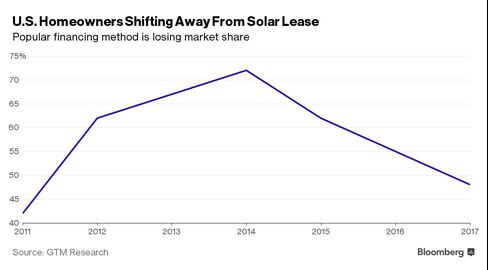
SolarCity, Sunrun and Vivint Solar Inc. together supplied 56% of the home-solar market in the U.S. last year, primarily with leases, according to GTM Research, which tracks renewable-energy markets.

They are on track to serve just 50% this year, according to GTM, as smaller companies such as Sunworks Inc. and PetersenDean Inc. that offer loans to purchase the panels pick up more business.

Solar leases and similar contracts, known as power-purchase agreements, accounted for 72% of home-solar sales in 2014, but their share is projected to drop to 48% by 2017, according to GTM. The companies also install panels at commercial properties. Leasing became a popular way for customers to obtain home solar panels without having to come up with the large upfront amounts needed to buy a system.

Six-kilowatt systems currently cost between $21,000 and $25,800, according to the Solar Energy Industries Association and GTM.

It is a profitable model for companies, which collect lease payments from customers every month for about 20 years, under contracts that often increase payment amounts each year. For example, a California homeowner might pay $17,500 to buy an average-size five-kilowatt system, whereas​ a 20-year lease with monthly payments that start at $150 and increase ​2.9% a year would have lease payments totaling about $36,600.For consumers, owning the panels can bring greater long-term savings, and more companies have begun offering loans, making buying more achievable and cost effective.

Dozens of lenders now offer consumer loans for solar panels, with interest rates between about 3% and 9%, whereas a few years ago, such loans were more difficult to find. SolarCity—whose chairman is billionaire entrepreneur Elon Musk, who also leads Tesla Motors Inc. and Space Exploration Technologies Inc.—has been unprofitable each year since it went public in 2012. The company has a market value of about $2.3 billion, according to FactSet.

The San Mateo, Calif.-based company started offering solar loans again in May, in addition to leases, after initially trying them last year before withdrawing them because of a lack of demand.


Why Lease When You Can Own? Rooftop Solar Facing Tough Question

Posted by Laura Arnold  /   May 28, 2016  /   Posted in solar  /   No Comments

Why Lease When You Can Own? Rooftop Solar Facing Tough Question

Chris Martin, 

May 24, 2016 — 7:00 PM EDT Updated on May 25, 2016 — 9:24 AM EDT

It’s tough to argue with free. That’s why the no-money-down solar lease became the most popular choice for U.S. rooftop power.

Now, though, the equation is changing. Falling costs are making it easier for consumers to buy solar systems outright, and banks and solar installers are promoting loans with no upfront payments. That’s a threat to companies such as SolarCity Corp., Sunrun Inc. and Vivint Solar Inc., which built their businesses on people signing decades-long contracts.

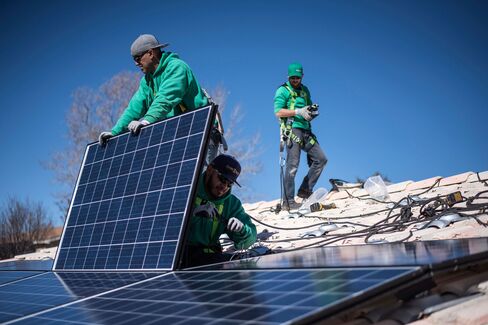
Workers secure solar panels to a rooftop during a SolarCity Corp. residential installation.
Photographer: Sergio Flores/Bloomberg

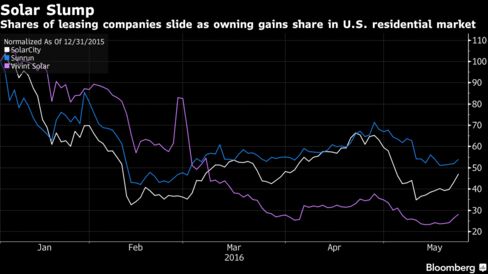
Installation growth is slowing for the big three U.S. rooftop solar installers, and GTM Research, an industry consultant, is forecasting the percentage of consumers buying rather than leasing residential systems will expand to 45 percent this year, from 38 percent in 2014. Shares in all three companies have plunged more than 40 percent this year, for a variety of reasons including a failed acquisition bid for Vivint and questions about SolarCity’s strategy.

“Leasing was the major game but that’s changing quickly,” said Patrick Jobin, an analyst at Credit Suisse Group AG. “Consumers are starting to realize there are better options.”

Greg Gill, a retired IBM employee, was looking for ways to cut his $400 monthly utility bill. He considered leasing, but decided in the end to pay $32,370 for a 7.3-kilowatt system that was installed in September at his home outside Sacramento.

Gill charged it on a credit card (to earn rewards) and then paid it off in cash, he said. His April utility bill was $1.18, he earned a $10,000 tax credit and he’s expecting an 11 percent return on the investment.

“A tree-hugger friend of mine was dead-set on SolarCity,” Gill said. After talking to five installers, he crunched the numbers and concluded that buying was a better deal.

“It really was a no brainer,” he said. “Even if you financed it at 3 percent, you still come out ahead over leasing.”

He’s not alone. By next year, customers who own their systems will make up the majority of the U.S. residential solar market for the first time since 2011, according to Boston-based GTM. Third-party companies, mainly lease providers, will account for the rest. And that shift is accelerating. Last July, Nicole Litvak, a GTM analyst, predicted that owning wouldn’t become the top choice until 2020.

Leasing companies are aware of the trend, including SolarCity, the biggest U.S. rooftop installer, which rolled out a no-money-down loan program this month. That replaced a more complicated financing program introduced in 2014 that ended this year.

“We anticipate loans will continue to be very popular,” Kady Cooper, a spokeswoman, said by e-mail. The financing deals offer returns to SolarCity that are comparable to leases, she said, in part because the company’s volume helps it negotiate terms with lenders. A 10-year loan comes with a 2.99 percent fixed interest rate, and 20 years gets 4.99 percent.

Slowing Growth

SolarCity’s growth is slowing. It expects to install about 1 gigawatt of panels this year, about 15 percent more than last year. In February, the company said 2016 installations would increase as much as 40 percent.

Vivint announced in November that it was offering loans in Utah, its home state, through a partnership with the financing company Solar Mosaic Inc., with plans to expand to other states.

“There is some increasing demand from customers that would like to own their own system,” Casey Briggs, a spokeswoman, said in an e-mail, though leases remain “the primary driver in the market for residential solar.”

At Sunrun, leasing will make up about 80 percent of its business in the fourth quarter, down from 85 percent now. It introduced a loan program in September. The San Francisco-based company installed 60 megawatts of panels in the first quarter, up 63 percent from a year earlier. In the fourth quarter, it added 68 megawatts, an 83 percent increase from the same period a year earlier.

Ownership offers advantages over leases, said Jeffrey Osborne, an analyst at Cowen & Co. Consumers don’t get entangled in decades-long contracts, and because they own the panels they get all tax benefits and other incentives.

“When I put solar on my house it made so much more sense to buy,” Osborne said. Leasing “made a lot of sense in the beginning. Now that there are a million solar rooftops, banks are more comfortable” financing the systems.

Installers say consumers are showing more interest in owning the panels on their roofs.

“We’re definitely taking market share,” said Jim Nelson, chief executive officer of Sunworks Inc. “If you buy a solar system outright with cash, the benefits are twice as good as with leases.”

The Roseville, California-based installer helps customers line up financing. While it’s nowhere near the size of SolarCity -- revenue this year is expected to almost double to $99 million -- Sunworks has been profitable in two of the past three quarters, while the leasing giant has reported only three profitable quarters since its December 2012 initial public offering.

Leasing Rebound

Leasing companies expect demand for the financing tool to rebound when the federal Investment Tax Credit expires for homeowners, said Ed Fenster, Sunrun’s chairman and co-founder.

That’s the 30 percent tax break that helped make ownership more appealing to Gill, the IBM retiree. After 2023 it will no longer be available to consumers, though leasing companies will continue to qualify for a 10 percent credit.

“That’s enough of a driver to encourage consumers to lease,” Fenster said in an interview.

As costs continue to come down, ownership will make more and more sense, said GTM’s Litvak. Consumers will save money from day-one, even if they borrow to pay for the systems.

“It won’t be long before you can just put it on a credit card,” Litvak said in an interview by phone. “It just makes more sense economically than leasing.”

Michigan has thousands of untapped congeneration sites, groups say

Posted by Laura Arnold  /   May 26, 2016  /   Posted in cogeneration/CHP, Uncategorized  /   No Comments

Combined heat and power facilities, like this one in Minnesota, take advantage of waste heat produced from generating electricity.

Combined heat and power facilities, like this one in Minnesota, take advantage of waste heat produced from generating electricity. PHOTO BY Craig Lassig.

Michigan has thousands of untapped congeneration sites, groups say

A new collaboration of clean energy groups says Michigan has vast potential to generate electricity by taking advantage of wasted energy at industrial and other facilities.

Michigan has 10,000 sites capable of deploying more than 4,000 megawatts of electricity from combined heat and power systems, according to Greg Northrup, a principal at Grand Rapids-based Sustainable Partners who is working with a team of clean energy groups on studying the potential for the technology.

The team — which includes modeling consultants, university researchers and clean tech experts — was recently selected for a two-year, $310,000 grant from the state of Michigan and the U.S. Department of Energy. State energy officials want to tap into the potential of CHP as a way to meet carbon reduction and energy efficiency goals embraced this year by Gov. Rick Snyder.

“Because of the number of applications out there, it’s a good market in terms of potential,” Northrup said. “It’s underdeveloped.”

Right now, about 100 sites in Michigan use the technology.

CHP, or cogeneration, involves generating electricity onsite and capturing wasted heat produced from that for other uses – similar to the way a car uses heat from the engine's cooling system to warm the interior.

Gathering heat and electricity from a single fuel source greatly increases efficiency and has proven useful across the Midwest for steel mills, universities, hospitals, and other energy-intensive facilities. President Barack Obama issued an executive order in 2012 calling for 40 gigawatts of new CHP by 2020.

Key for clean energy

Ultimately, the state’s goal is pursuing CHP as a clean energy option on both the supply and demand side.

Earlier this month, the state announced the partnership to improve companies’ electric reliability, reduce their carbon emissions and save money.

“The various combined heat and power technologies present an opportunity for many companies in Michigan to reduce their energy costs and for us as a state to lower carbon emissions in line with the Governors’ Accord for a New Energy Future signed by Governor Rick Snyder and 16 other governors in February 2016,” said Valerie Brader, executive director of the Michigan Agency for Energy, in a statement. “The accord represents a commitment to diversify energy generation and expand clean energy sources, modernize energy infrastructure, and encourage clean transportation options.”

Jamie Scripps, project manager and principal with 5 Lakes Energy (which is also part of the project), said “generic modeling” shows “CHP does very well in any sort of carbon-constrained environment. It performed in a way in which the state would want to look very closely at having more CHP deployed.”

5 Lakes plans to customize its State Tool for Electricity Emissions Reduction (STEER) modeling to see what size and types of CHP could be deployed to best reduce carbon emissions.

“So we can tell that story in a way that’s detailed and actually helpful in guiding policy changes,” Scripps said.

The collaboration also includes the Energy Resources Center at the University of Illinois at Chicago and Detroit-based NextEnergy.

Barriers to expansion

Scripps and Northrup say the lack of deployment so far is attributed to a lack of knowledge among utility customers and policy barriers around standby rates, or what utilities charge for providing a certain amount of backup power. Lower standby rates could provide a quicker return on investment.

Installers have faced challenges in recent years as low natural gas prices have prolonged the payback on what are otherwise expensive systems. According to the Energy Finance Report published by the energy law firm Sullivan and Worcester, installing CHP makes the most sense when a building’s heating needs are high; it has aging boilers; electricity prices are higher than 10 cents per kilowatt-hour; or boiler retrofits “are needed to satisfy new environmental regulations.”

Utilities continuing to provide reliable power is also a factor, Northrup said.

“There is a lack of education in the marketplace about what can be achieved and what can be sustained with cost and reliability,” Northrup said. “The word ‘complacency’ is too strong of a word, but it’s a lack of market knowledge.”

Scripps compared it to the debate around solar net metering in Michigan and concerns utilities have raised about distributed generation affecting their business model.

“One thing we’ll show with this project and with more CHP deployed are the grid resilience benefits and the energy independence that comes with that,” Scripps said. “The key is to get the policy to work in conjunction with utilities. We need to have them on board as well.”

There is also concern among CHP supporters that the standby rates don’t accurately reflect the value of the standby charge being made.

“There are pretty significant regulatory and policy barriers that make (CHP) not as attractive (in Michigan) as other states,” Scripps said. “Where Michigan is now, there’s just a ton of potential.”

The Michigan Public Service Commission has established a “standby rate working group” to look further into the issue and will produce a report in August.

“The return on investment is not as quick as what it needs to be,” Scripps said of Michigan’s standby rates. “Standby rates is an example of an obstacle, but it’s something the Public Service Commission is looking at now. That’s encouraging.”

Advocates also say CHP can delivery electricity more efficiently than traditional utility generation.

Northrup said CHP systems reach between 75 percent and 85 percent efficiency, whereas utility generation is typically around 50 percent.

“Utilities are not happy about it, but from a public policy standpoint, if you’re trying to do what’s the best use of energy and the best way to make companies competitive, then you have to allow people to consider this,” Northrup said. “Utilities are going to be concerned about loss load, but at the same time, utilities can also plan for it.”

Nancy Popa, executive director for renewable energy for Consumers Energy, called CHP deployment “an interesting situation.”

“The economics of CHP will really come into play if customers have to consider what we’ll pay for energy,” she said. “We’re talking to several customers about it — we think it’s a good idea for both (customers and the utility). It’s on our radar to continue to explore.”

Copyright 2013 IndianaDG