GOSHEN — A new solar energy generation facility could be on its way to the city’s north side.
Goshen City Council members Tuesday are set to consider a lease agreement with Toledo, Ohio-based Solscient Energy LLC, involving approximately 54,400 square feet of city-owned property located at 1000 W. Wilden Ave.
According to the agreement, Solscient Energy is seeking to lease the property for a term of 15 years at a cost of $4,200 per year, with periodic adjustments for inflation.
Should the lease be approved by the council Tuesday, Solscient would then use the property as the site of a new solar energy generation system for the purposes of generating electricity for sale to Northern Indiana Public Service Company under NIPSCO’s Rate 665 Feed-In-Tariff program.
According to the agreement, Solscient will design, engineer, procure equipment and components, construct, own and operate a 322.24kW ground-mounted solar array which will include the following components:
• 1,007 solar panels
• Seven SMA Sunny Tripower 30kW inverters
• Solar Flex Rack Series 3GL fixed pitch racking system
• Master distribution panel
• Pad-mounted 480V - 12.47kVA step-up transformer
• NIPSCO meter
• Utility-accessible AC disconnect switch
• Energy monitory system with weather station
• Balance of systems components and equipment
As part of the proposed contract, Solscient has agreed to pay all real estate taxes on the Wilden Avenue property, as well as any personal property taxes resulting from the installation of any equipment or any improvements added or installed by the company throughout the lease term.
The Goshen City Council will meet at 7 p.m. Tuesday at the Goshen Police and Courts Building, 111 E. Jefferson St.
Successful oversight of trade group membership dues has faded away in many states, report says.
Few political organizations have the “luxury of subsidization” enjoyed by the Edison Electric Institute (EEI) and other trade groups that represent the utility industry, according to a new report.
Utility customers foot the costs of “political and public relations” activities of these industry trade groups, the report’s authors contend. Requiring customers to pay a portion of the annual membership dues means customers might be paying for political activities with which they may not agree and from which they may not benefit, the report says.
Electric utility companies routinely receive permission from state regulators to include at least a portion of their dues payments to industry associations in their operating expenses, the Energy & Policy Institute, a research and watchdog group, said in the new report. Those operating expenses are passed on to customers, not to the shareholders of these investor-owned utilities.
“Given how these organizations promote fracking and natural gas infrastructure, propose bailouts for nuclear power plants, and spread misinformation regarding the science of climate change, they are also all political in nature,” the authors wrote in the report.
The report, “Paying for Utility Politics: How Utility Ratepayers Are Forced to Fund the Edison Electric Institute and Other Political Organizations,” focuses on the Edison Electric Institute (EEI), the trade association for the nation’s investor-owned electric utilities, as an example of political influence from a utility association. The report’s authors argued that the membership dues might not be funding activities that EEI defines as lobbying, under the Internal Revenue Code, but they still fund certain types of political activities.
For many years, the National Association of Regulatory Utility Commissioners (NARUC), an association of state regulators, worked with industry trade groups like EEI and the American Gas Association (AGA), which represents gas utility companies, to break out the membership dues and decide which costs could be recovered from ratepayers.
But that system ended more than a decade ago. Today, on its membership invoices to members, EEI highlights what percentage of costs are used for lobbying, based on the Internal Revenue Code. The utility company then uses that percentage to determine what to charge to shareholders. The remaining portion is charged to customers.
When asking regulators for rate increases, electric utility companies provide “evidence to support each recoverable expense, including a portion of trade association dues,” EEI spokesman Brian Reil said in a statement emailed to ThinkProgress.
“The lobbying portion of EEI’s dues, which is not recoverable, is calculated and reported each year using the Internal Revenue Code’s … definition of ‘lobbying and political activities’ as required to be reported on IRS Form 990,” Reil said. “EEI activities in certain regulatory proceedings and communications efforts, for example, are not lobbying as defined by federal law.”
The D.C. metropolitan region is filled with associations that represent almost every business or industry. These groups create educational materials, provide training to their members, and engage in public advertising campaigns, while their lobbyists seek to change policy at federal, state, and local levels. The groups can also conduct fundraising on behalf of political candidates through associated political action committees (PACs).
The American Gas Association, Nuclear Energy Institute, and U.S. Chamber of Commerce are other associations whose annual membership dues are often included in utility companies’ rate requests, according to the report.
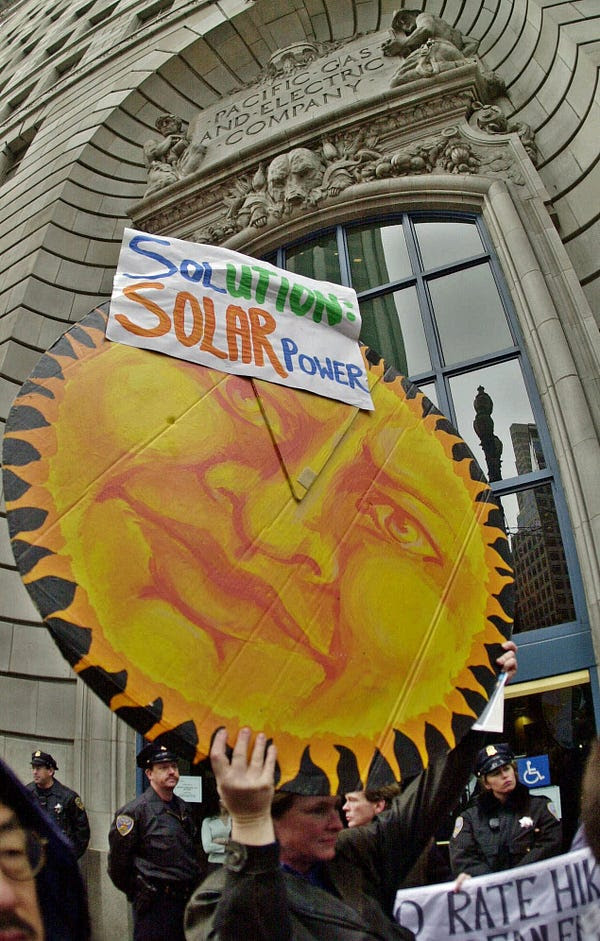
Consumer groups have succeeded in getting a larger percentage of Pacific Gas and Electric’s trade association dues paid by shareholders. CREDIT: AP Photo/Ben Margot
The groups’ political stances might be problematic — or even against the interests of — the ratepayers who are funding their utility’s membership. For instance, renewable energy advocates have complained about EEI’s stance on rooftop solar in some states. The recent growth of solar energy along with net-metering policies have led investor-owned utility companies and EEI to campaign to either weaken or do away with net-metering programs in states, according to the Energy & Policy Institute.
Under net-metering policies, if rooftop solar owners generate more electricity than they use, the utility will buy the excess power at the retail rate. EEI reportedly lobbied to change net-metering policy in Arizona, a state at the center of the debate on how to compensate owners of rooftop solar.
Matt Kasper, research director at the Energy & Policy Institute, contends that state consumer advocates and attorneys general are justified in asking the investor-owned utilities how ratepayers benefit from the fees that go to EEI. In his research, Kasper, who co-authored the report, found that an Oklahoma-based utility submitted invoices to its regulator that revealed the utility company’s EEI dues increased every year from 2011 to 2016, a total of 26 percent over that timespan.
As consumer advocates and offices of attorneys general see the increased membership dues, “they’re probably going to be more inclined to challenge them,” Kasper said.
Under its old relationship with trade groups, NARUC conducted annual audits of the financial records of EEI and other industry trade groups. Based on the audits, state regulators would rule whether utilities could collect a significantly smaller portion of their EEI dues from ratepayers.
However, more than a decade ago, NARUC’s audits of EEI and the other groups stopped, creating difficulty for consumer advocates to understand how the groups spend ratepayer money. The report’s authors recommended NARUC revive its Committee on Utility Association Oversight, a committee charged with reviewing the costs of the utility associations.
The committee, which was disbanded in 2000, could determine the percentage of trade groups’ operations that are political in nature and therefore should not be funded by ratepayers. Some consumer advocates and watchdogs, including the Energy & Policy Institute, believe there are cases where customers should not be required to pay for any amount of a utility’s membership fees in a trade association.
Certain states continue to take a close look at utilities’ membership fees in industry trade groups. In California, The Utility Reform Network in 2013 succeeded in getting 43.3 percent of EEI dues paid by Pacific Gas & Electric Co.’s shareholders during that utility’s rate request and not by ratepayers, rather than the 25 percent the San Francisco-headquartered utility had originally requested.
“But successful oversight of EEI dues has faded away in other states,” the report said. The independent review of industry association dues that was once provided by NARUC has been replaced by “an unreliable system of self-reporting” by EEI and its utility members, which have a “self-interest in maximizing the amount of their dues” that will be paid by customers, the report concluded.
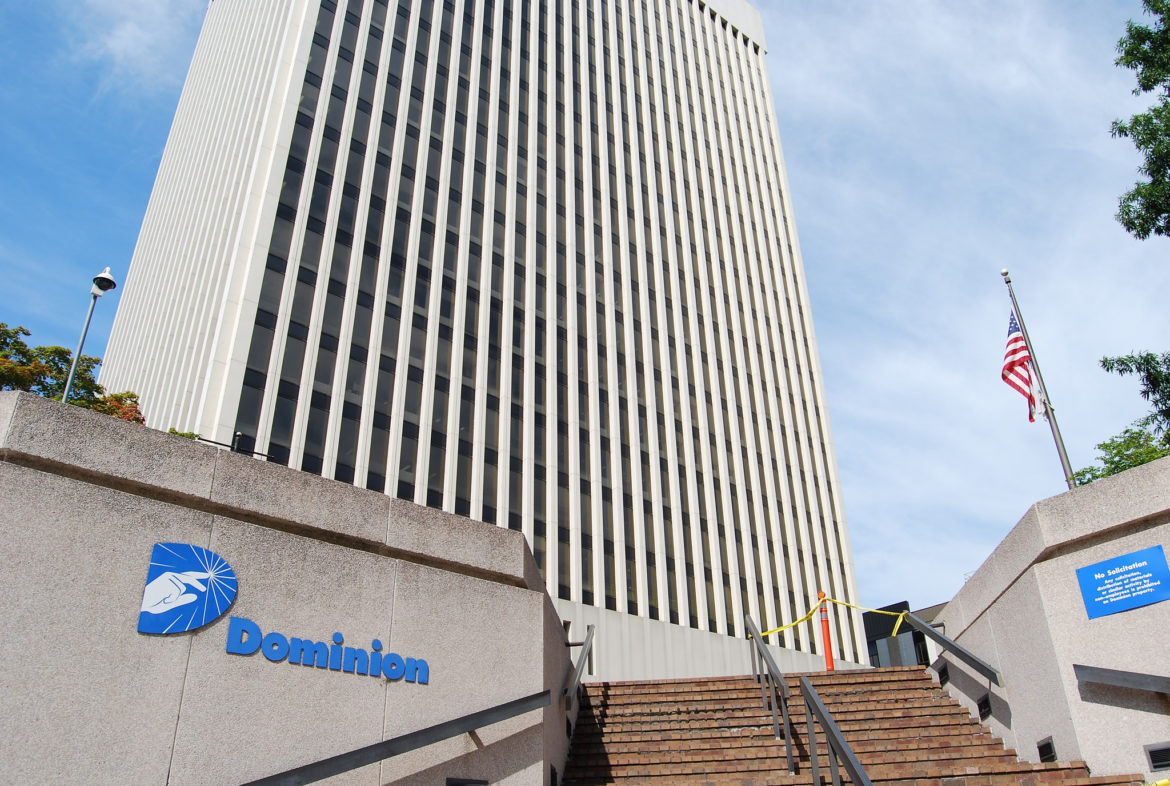
A plan by Dominion Energy to supply 100 percent renewable power to its commercial and industrial customers has been welcomed by some clean energy advocates, but others say it will effectively forbid third parties from competing in this lucrative and burgeoning market.
“This will impede the renewable choices of its customers,” said Ron Cerniglia, Director of Government Affairs for retail supplier Direct Energy, which has been planning to enter the Virginia market. “Essentially, retailers will be locked out of this important class of customers. Dominion is using its monopoly authority to prevent retailers from entering that market.”
Will Cleveland, who follows generation policy developments for the Southern Environmental Law Center (SELC) in Charlottesville, is “suspect” about Dominion’s motives.
“Does Dominion’s filing seek to substantively advance renewable generation in Virginia, or is it really only designed to cut off competition without achieving any measureable increase in renewable generation,” Cleveland asked. “Can a utility just come in and get some really bad tariff approved that nobody actually signs up for, but still blocks third-party competition?”
Dominion Energy did not respond to requests for comment.
Earlier this year, Direct Energy sought permission from the State Corporation Commission (SCC), which regulates utilities, to market a 100 percent renewable energy product. But in its ruling, the SCC allowed that authority only if the state’s investor-owned utilities did not have a similar offering available to their ratepayers.
Beginning on page 2 of its filing, Dominion cites the specific language in Virginia’s legal code (Va. Code § 56-577 A 5) to assert how its offer of a 100 percent renewable product blocks any such offerings from competitors.
“Dominion has had 10 years (since lawmakers in 2007 ended the state’s experiment with customer choice) to file a renewable energy tariff,” Cerniglia said. “We’re very concerned with these developments. It is certainly our intention to intervene” at the SCC.
Dominion is proposing six new voluntary rates, or tariffs, for its “Continuous Renewable Generation” (CRG) Rate Schedules. They are to be available soon for eligible customers for a minimum of five years, or longer if mutually agreed upon. It said the intermittency of solar, wind and other renewable sources will be packaged to supply round-the-clock delivery of power through a portfolio of external and internal options dedicated to would-be customers.
Dominion’s filing states “the renewable energy supplies may take the form of a single PPA (power purchase agreement) to serve a single customer; however, it is anticipated that many customers will prefer a bundle of differing renewable sources. In such cases and depending on the customer interests, the company may assemble a portfolio of multiple resources designed to service individual or multiple customers.”
Any sources of renewable generation from aspiring wholesale suppliers “must be within the geographic scope of the PJM wholesale market,” Dominion states, which includes most of Virginia and all or parts of ten other states.
The SELC’s Cleveland and Tony Smith, president of solar developer Secure Futures LLC in Staunton, said they expect a lot of stakeholders to participate and challenge whether individual rates – if approved by the SCC – are in the state’s best long-term interest.
Smith, a frequent critic of Virginia’s energy policies, said the filing is “very well-orchestrated” and builds on a two failed bids by Appalachian Power Co. to try to achieve the same outcome.
The expected contest over Dominion’s filing may come down to amending the rule prohibiting third-party competition. Smith said he likes to think if Dominion would approve, then its application could sail through the SCC. “That’s where the fight will occur.”
Cleveland added: “Right now, this is just a skeleton of an idea. It’s going to involve a lot of Q & A and digging in the (SCC) docket to figure out what this thing is. Ignoring the monopolistic aspects, it’s not clear this will be a good thing for customers.”
Jim Pierobon is a former Chief Energy Writer at the Houston Chronicle and is the principal writer of The Energy Fix blog. He is a policy, marketing and social media strategist who has reported on, testified and consulted about solar energy, energy efficiency, smarter grids, energy cyber-security, fossil fuel price spikes and the rise and fall -- and the rise again -- of nuclear energy. He resides in Northern Virginia.
A new study by E Source, a “market research” firm that has been telling utilities what they want to hear for 30 years, has outlined a strategy to help utilities win over consumers to utility-scale solar: Tell them half the story.
Lawyers around the world know the old aphorism: “If you have the facts on your side, pound the facts. If you have the law on your side, pound the law. If you have neither on your side, pound the table.”
Utilities in the United States find themselves in a similar position as solar power becomes more prevalent on the grid. More consumers are migrating to rooftop solar, and some utilities are in a panic about the effect those migrations are having on their bottom lines. As a result, they are scrambling to find arguments that will dissuade customers from making the switch.
Now a new study by “market research” firm E Source, which apparently has spent 30 years telling utilities exactly what they want to hear, has provided them with another strategy: Like the wizard in the mythical land of Oz, tell consumers not to pay any attention to the utility behind the curtain.
If the study, which surveyed 7,000 utility customers online, is to be believed, 61% of utility customers say customer-generated solar power reduces costs for the grid – which it does. Additionally, 29% say it has no effect (wrong but harmless), and 10% think it increases costs (which it does not).
The goal, then is clear: Move some of the 90% of consumers who have a proper understanding of solar’s place on the grid to believe the erroneous position of the 10% – and the study lays out exactly how utilities can accomplish the goal because, as the study contemptously assumes, “[c]ustomers are understandably ill informed about the relative costs of electricity from large-scale, community, and rooftop solar.”
Survey participants were asked to allocate a hypothetical $100 to one of four types of solar investments: utility-scale solar, community-scale solar, residential rooftop, and business rooftop, after reading brief descriptions of each one’s benefits and costs. When presented with those facts, consumers allocated the most money ($31) to residential rooftop and large-scale solar ($29).
Then, according to the white paper, the researchers provided the following explanation of costs:
Then we gave respondents some data about the rough costs of solar, stating that rooftop costs twice as much as large-scale solar per unit of electricity, and community solar costs 50 percent more than large-scale solar.
After receiving this information, of course, consumers changed the way they allocated that same mythical $100, favoring utility-scale solar by a wide margin. Allocations for the two rooftop options decreased by approximately 22% and support for community solar stayed about the same.
It’s not that the survey doesn’t tell consumer proper facts – what they say about the relative costs is accurate, as far as they go. But the reason those consumer support numbers shift so dramatically is that the utilities fail to include some inconvenient truths that completely destroy their contention.
What they don’t tell consumers in this survey is that behind-the-meter (BTM) solar – ie residential and commercial rooftop solar – provides net benefits to the grid. They also neglect to mention BTM solar is cheaper to produce because there are no transmission losses, reduces the utilities’ need for transmission-and-distribution investments (meaning higher profits for the utilities) and can, in many cases, increase grid resiliency.
Logically, then, E Source’s strategy is predicated on the fact that consumers won’t know about all the benefits solar brings to the electrical grid. As a result, the utilities can focus on all the “bad” aspects of rooftop solar without having to answer questions about the advantages rooftop solar brings to the consumer. And if utilities can accomplish this goal, then they can slow rooftop solar’s growth and keep electricity profits all to themselves.
Expect utilities to start citing this survey as state-level net-metering battles heat up this summer in support of demand charges and other solar-only fees to recover the “extra costs” that solar consumers place on the embattled utilities – but don’t allow them to get away with using these half-truths to destroy the rooftop solar revolution.
SB 309, the bill designed to kill net-metering prematurely in the state, became law yesterday as Gov. Eric Holcomb affixed his signature to the bill despite strong solar industry opposition.
The solar industry in Indiana put up a valiant fight against Senate Bill (SB) 309, the bill introduced under false pretenses by Sen. Brandt Hershman that will end net-metering prematurely in the state.
In the end, however, the lying side won.
Gov. Eric Holcomb signed SB 309 into law yesterday after it sat on his desk for nearly a month. In his signing statement, Holcomb expressed his support for the solar industry, even as his pen signed a law that could devastate the rooftop solar industry in the state.
“I support solar as an important part of Indiana’s comprehensive energy mix,” Holcomb said. “I understand the concerns some have expressed, but this legislation ensures those who currently have interests in small solar operations will not be affected for decades.”
Decades – or three years, whichever comes first. Under the law, utilities can halt net-metering incentives as soon as they make up 1% of a utility’s peak summer load. For some utilities like Vectren, which serves the southwestern part of the state, net-metering could hit that cap within three years.
Laura Arnold, president of the Indiana Distributed Energy Alliance, said she was disappointed with the governor’s decision and had hoped the governor would send the issue to the Indiana Utility Regulatory Commission (IURC) to do a comprehensive cost-benefit analysis to determine the true effect of net-metering on non-solar customers.
“There is a desperate need for real Indiana based data and information concerning the impact of net metering,” Arnold wrote in a letter to the governor before he signed the bill. “As has been done in numerous other states, Indiana needs a cost-benefit study performed by the IURC. There was considerable discussion among state legislators about the need for such a study to provide state lawmakers with real tangible data to then evaluate and make appropriate energy policy decisions.”
Supporters of the bill suggested that the IURC did not want to do such a study, and that the results of such an IURC study could be worse than the provisions in SB 309. Arnold said she spoke to the IURC chairman and discovered the argument was a complete fabrication.
“During my recent personal discussion with IURC Chairman Jim Atterholt, I was told that the IURC did not convey to state legislators they were not interested or unwilling to do such a study,” Arnold said. “Rather, the IURC wants specific direction on what they should examine and how they should perform such a study of net metering.”
“The notion that the IURC would make proposed changes itself via an order or administrative rulemaking without due process is not plausible,” she added.
Misrepresentations – and in some cases outright lies – plagued SB 309 from the time it was introduced in January. The bill’s sponsor, Sen. Hershman, had come under fire from Senate colleagues for his deceptive testimony before the Committee on Utilities, where he said that without SB 309, everyone making use of solar net-metering would lose the benefit once utilities reached the current 1% cap.
A close examination of the previous law, however, proves no such provision exists under the current law, which makes SB 309’s harsh curtailment of the program unnecessary.
Frank Andorka has been writing professionally for nearly 29 years and spent nearly 20 years in trade publications. He was the founding editor of Solar Power World and has covered all aspects of the solar industry from policy to panels and everything in between. More articles from Frank Andorka