

Author Archives Laura Arnold

IndianaDG Letter to Gov. Holcomb: (1) Veto SB 309; (2) Ask IURC to Do Cost-Benefit Study of Net Metering; and (3) Create State Energy Policy Process with ALL Stakeholders

Posted by Laura Arnold  /   May 02, 2017  /   Posted in 2017 Indiana General Assembly, IPL Rate REP, Northern Indiana Public Service Company (NIPSCO), solar, Uncategorized, wind  /   No Comments

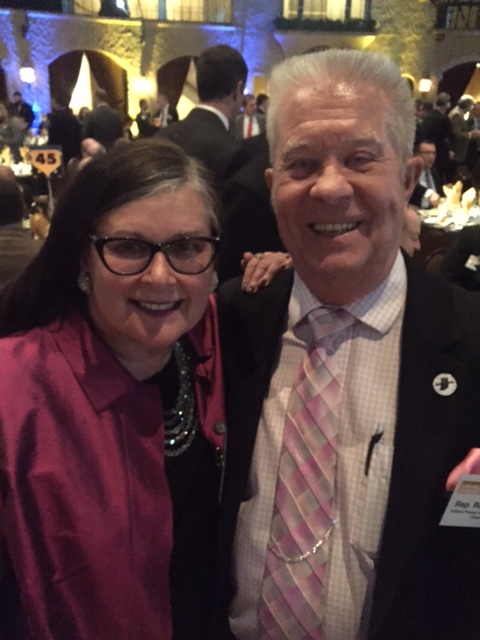
Me and Rep. Ron Bacon_2

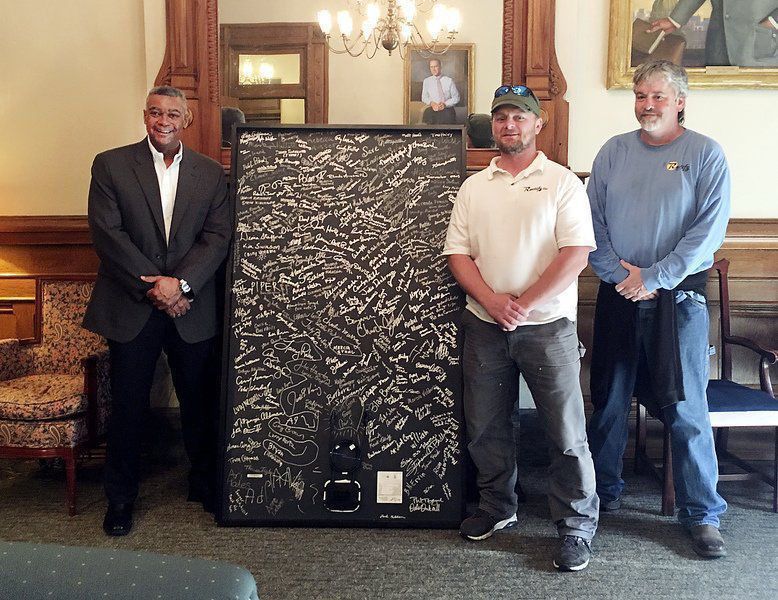
IndianaDG President Laura Ann Arnold on the left and solar home owner Rep. Ron Bacon (R-Chandler) on the right.

Laura Ann Arnold

545 E. Eleventh Street

Indianapolis, Indiana  46202-2627

(317) 635-1701

(317) 503-5123 cell

Laura.Arnold@IndianaDG.net

Laura.Arnold@thearnoldgroup.biz


May 1, 2017


Governor Eric Holcomb

State House

Indianapolis, Indiana  46204


RE: (1) Veto SB 309; (2) Ask IURC to Do Cost-Benefit Study of Net Metering; and (3) Create State Energy Policy Process with ALL Stakeholders

Dear Governor Holcomb:

Indiana Distributed Energy Alliance (Indiana DG), a non-profit corporation with a broad coalition effort amongst businesses, individuals, elected officials, and other organizations, respectfully requests your help and leadership in advancing energy policy for the State of Indiana.  First, we ask that you veto Senate Bill 309.  Second, we ask that you direct the Indiana Utility Regulatory Commission (IURC) to do a cost-benefit study of net metering as it is the agency with the technical expertise most qualified to examine this important policy enacted under the Daniel administration.  Finally, we ask that you lead Indiana with a robust state energy policy process that involves all stakeholders.

  1. Veto Senate Bill 309

First, I respectfully request that you veto Senate Bill 309. On Monday, April 17, 2017, a group of business members with IndianaDG and I met with Rebecca Holwerda, Policy Director and Legislative Affairs for the Office of the Governor.  At that time, I gave a presentation providing background and information concerning our request for you to veto SB 309.  I’d like to clarify a number of issues that will further demonstrate why a veto of SB 309 is the right decision for your Administration.

SB 309 threatens the ability of Hoosiers to install and to recoup the cost of an investment in solar, small wind or other distributed generation energy systems. Under SB 309, after December 31, 2017, investor owned electric utility customers will have a shorter amount of time to (1) recoup the cost of their personal investment in an energy system for their home or business, and (2) enjoy continued energy savings for the duration of the life of this investment. If prospective solar customers merely recoup the cost of their investment without time to enjoy the financial benefits, the majority of them just won’t GO SOLAR.

Two Indiana investor owned electric utilities, Indianapolis Power and Light (IPL) and Northern Indiana Public Service Company (NIPSCO), have already provided extensive incentives for solar and distributed generation through a pricing mechanism called Voluntary Feed-in Tariff (VFIT or FIT) programs. I participated in all three of these cases before the IURC (Cause Nos. 44018, 43922, and 44393).  From those programs, (1) more than 100 MWs of voluntary FIT contracts with IPL and NIPSCO were produced; (2) IPL has 97 MWs of solar photovoltaic (PV) FIT 15 year contracts with payment to customers of $0.20 to $0.24/kWh; (3) NIPSCO has 15 MWs of solar PV FIT 15 year contracts with payments to customers ranging from $0.26 to $0.30/kWh with 2% per year price escalators.  Compare that to the mere 20 MWs of net metering distributed generation that is paid for at the retail rates, or an amount that is 2-4 times the retail rate.  See slide 17 in the attached PowerPoint.  It is also important to note that most of the electricity produced by solar net metering customers is consumed directly by the customer, and thus, at times, NO payment to the net metering customer is necessary.

The fundamental difference between these VFIT programs and net metering is the utility’s cost recovery. It appears that the real issue IS NOT a so-called subsidy but rather the utilities’ ability to obtain quick cost recovery with the VFIT programs via the quarterly Fuel Adjustment Clause (FAC) process filed before the Indiana Utility Regulatory Commission. SB 309 will take away the kWh for kWh swap that net metering provides and instead provide this coveted cost recovery FAC mechanism for net metering experienced by the utility. If the utilities’ real concern is just obtaining this covered FAC cost recovery mechanism for net metering customers, why is there so much more in SB 309 that takes aim at net metering customers and an industry that is growing Indiana’s economy and job opportunities?   

The real question is who will control the utilization of solar technology. Will solar energy be owned and controlled by monopoly electric utilities or individual utility customers? What will the impact of changes in net metering do to the distributed generation market in Indiana?

  1. Direct IURC to Do Cost-Benefit Study of Net Metering

There is a desperate need for real Indiana based data and information concerning the impact of net metering. As has been done in numerous other states, Indiana needs a cost-benefit study performed by the Indiana Utility Regulatory Commission (IURC).  There was considerable discussion amongst state legislators about the need for such a study to provide state lawmakers with real tangible data to then evaluate and make appropriate energy policy decisions.

Several proposed amendments were drafted yet not offered to send this issue to the IURC, however, opponents advanced the notions that (1) the IURC did not want to do such a study, and (2) the results of such an IURC study could be worse than SB 309.  In fact, during my recent personal discussion with IURC Chairman Jim Atterholt, I was told that the IURC did not convey to state legislators they were not interested or unwilling to do such a study.  Rather, the IURC wants specific direction on what they should examine and how they should perform such a study of net metering.

The notion that the IURC would make proposed changes itself via an order or administrative rulemaking without due process is not plausible, yet this is what state lawmakers were told by the opposition. Specifically, opponents compared the IURC to a strange, ill-fated action that occurred before the Nevada Public Utilities Commission (NV PUC). The NV PUC took action on net metering with disastrous results to the solar industry, resulting in the Governor choosing not to reappoint two of the PUC members who were involved in this action and in the Nevada state legislature currently working to reverse the result of the NV PUC action.  However, the NV PUC is not an appropriate comparison to the IURC.  First, the IURC has never done such a thing and is instead awaiting direction from the Governor. Second, the solar market and net metering in Nevada is very different than here in the State of Indiana.

Solar Net Metering Comparison of States

See also Slide 18 from attached PowerPoint.  This shows that Nevada is the 6th state in solar net metering capacity per residential customer, while Indiana is 39th.  The fact of the matter is that Indiana is far behind in terms of net metering, and a cap is already in place in the IURC’s current net metering rule.  Once the cap in the IURC’s current net metering rule is reached, that would’ve been the more appropriate time to have a discussion.  But, if legislators would like to know more information about the impact of net metering now, an IURC conducted investigation would be the more appropriate thing to do, rather than a rush to end net metering in 2022 with state legislation in 2017 that has no IURC-backed investigation to support such a drastic action.

  1. Create State Energy Policy Process with ALL Stakeholders

I implore you to take steps to create a new Indiana State Energy Policy that involves ALL stakeholders and is open and transparent. Former Governor Mike Pence began such a process, however, it was shutdown barely after it was started. I personally participated in another such process conducted by former Lt. Governor John Mutz in the early 1980s.

Net metering is not the only issue worthy of a comprehensive policy review. For instance, updating avoided cost rates would be another worthy exercise that could provide great gains in customer-owned generation if conducted.  The State of Michigan has recently undergone such an exercise, reviewing rates under the Public Utility Regulatory Policy Act (PURPA). See http://www.michigan.gov/mpsc/0,4639,7-159-16393_74342---,00.html.

Other states including Illinois have also initiated comprehensive energy and utility policy reviews.  Before we have another wave of utility-backed legislation, direction like a comprehensive energy and utility policy review from the Governor may prove useful to legislators in the future.

Thank you for your consideration of my three requests: (1) Veto SEA 309; (2) Ask IURC to Do Cost-Benefit Study of Net Metering; and (3) Create State Energy Policy Process with ALL Stakeholders.

I stand willing and ready to assist you and your Administration.

_____________________________

Laura Ann Arnold

545 E. Eleventh Street

Indianapolis, IN 46202-2627

(317) 635-1701

(317) 503-5123 cell

Laura.Arnold@IndianaDG.net

Laura.Arnold@thearnoldgroup.biz


LAA Letter to Governor Holcomb_2017-05-01

This PowerPoint document was shared with the Governor's Office on 4/17/17 and provides additional background and history of net metering in Indiana.

Presentation for Gov Holcomb on SEA 309_v11
IndianaDG Business Members


Governor Holcomb Ignores Pleas to Save Solar and Net Metering, Signs SEA 309 Today

Posted by Laura Arnold  /   May 02, 2017  /   Posted in Uncategorized  /   No Comments

NYT Governor Holcomb

Here is what Governor Eric Holcomb had to say while signing SEA 309.

Senate Enrolled Act 309: Distributed Generation

“I support solar as an important part of Indiana’s comprehensive energy mix.  I understand the concerns some have expressed, but this legislation ensures those who currently have interests in small solar operations will not be affected for decades.”


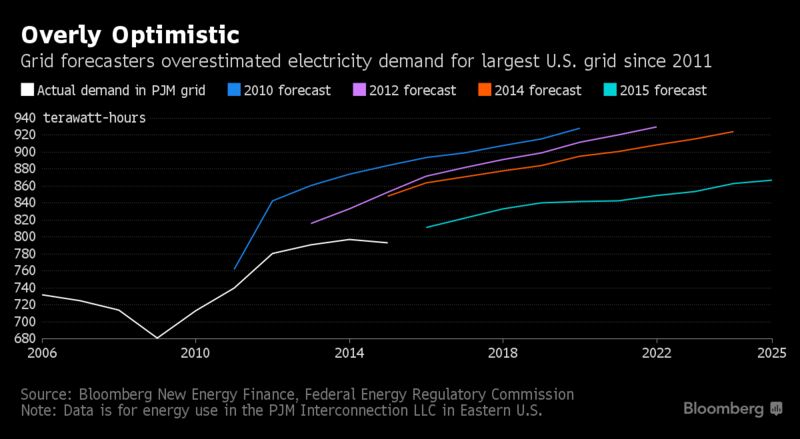
Flatlined Demand Years Ago, and It’s Hurting Utilities

Posted by Laura Arnold  /   May 02, 2017  /   Posted in Uncategorized  /   No Comments

Flatlined Years Ago, and It's Hurting Utilities

From

  • Utility CEOs seek new ways to profit amid historic shift
  • Renewables also cutting in on power generation monopoly

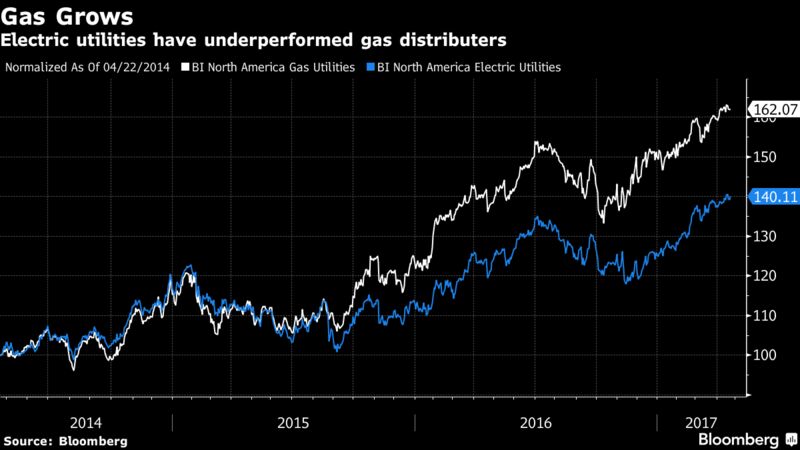
Electric utilities have been doing everything they can to preserve their bottom line from conducting multi-billion mergers to snapping up more profitable natural gas businesses. Their trouble lies in one thing they can’t control: demand.

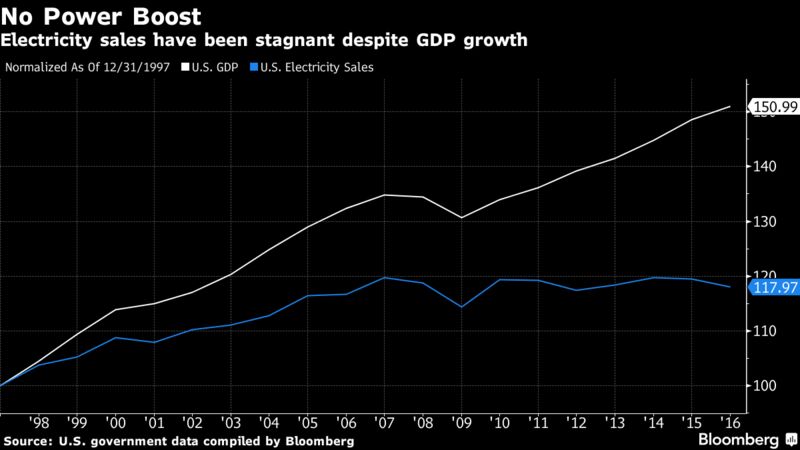
Power consumption in the U.S. has stalled for the last decade, breaking the link the industry has enjoyed with economic growth. For more than a century after Thomas Edison invented the light bulb in the 1870s, electricity demand rose steadily, boosting utility profits in the process.

The lull couldn’t have come at a worse time for the industry, which is already struggling with the end of their historic monopolies. Power-sipping appliances, LED lighting and a shift away from heavy industry all have contributed to the slowdown, and that’s forcing traditional generators from Duke Energy Corp. to Southern Co. to re-examine how they can make money.

“Efficiency cuts utilities’ revenues and not their costs, and this is a big problem,” said Amory Lovins, chief scientist and co-founder of the Rocky Mountain Institute, a non-profit clean energy research group based in Colorado. “The whole business model is upside down.”

Utility executives, policymakers and industry financiers are discussing the trends at BNEF’s annual summit in New York this week. Power sales have remained steady since 2010 as the U.S. economy expanded an average of 2.1 percent, according to government data compiled by the London-based research arm of Bloomberg LP. Government forecasters at the Department of Energy don’t see a significant rebound anytime in the years to come.

Different strategies are emerging.

  • Duke CEO Lynn Good, whose service territory spans Florida and the Carolinas, is seeking to make money upgrading the distribution grid to cope with wind and solar power. “The transformation that is underway gives us opportunity to serve customers in a better and different way," Good said at the BNEF event on Monday.
  • Xcel Energy Inc., which owns utilities in Minnesota and Colorado, CEO Ben Fowke is hoping regulators will authorize him to build $3.5 billion of renewables plants in the next five years and to build those costs into the rates customers pay.

The chart below based on DOE data analyzed by BNEF shows how power sales have broken free of economic growth.

The figures complicate President Donald Trump’s ambition to revive demand for coal, which made up about 34 percent of the electricity generated in the U.S. in January, according to Energy Department. With demand stagnant and independent power producers turning to natural gas, wind and solar plants, utilities have less room for the giant power generation units they traditionally have built.

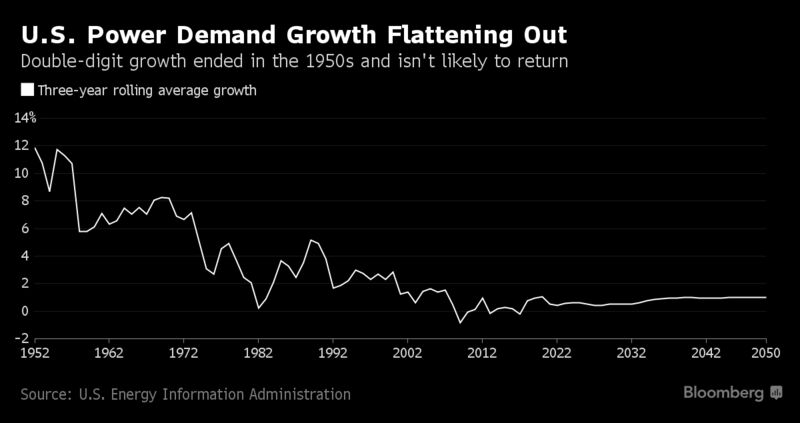
The outlook isn’t for a sudden revival in power demand. Total electricity use is forecast to increase 0.8 percent by 2050 as the economy continues to shift to less energy-intensive industries and equipment gets more efficient, according to a 2017 annual report from the U.S. Depart of Energy’s Energy Information Administration.

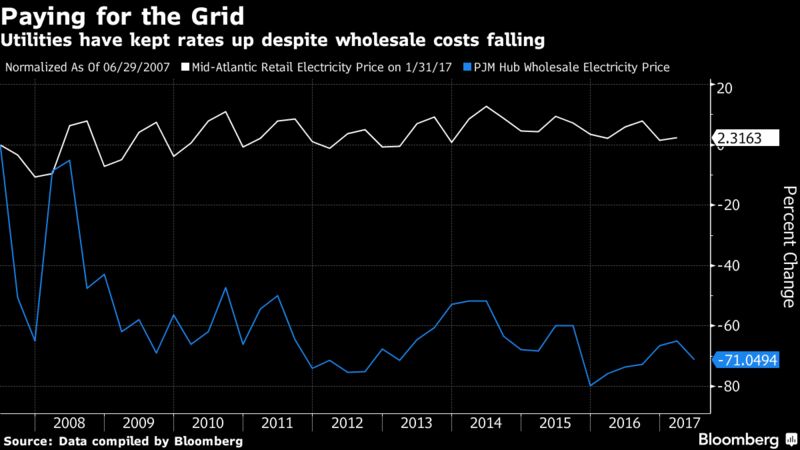
So far, the utilities have managed through a combination of mergers and cut costs, announcing $79.4 billion worth of U.S. deals last year, the most since 2007. They’ve snapped up natural gas assets and pared back their ambitions for building coal and nuclear power plants. And, as the chart below shows, they’ve maintained the price of power they charge to consumers even as the cost of generating that electricity falls.

Those strategies may not work for the long term. Natural gas and renewables are have helped reduce wholesale power prices by about 70 percent since 2007, and policy makers are looking for ways to pass those grid costs on to customers. They see cheaper supplies flowing from alternatives to the traditional coal plants and the potential for efficiency to reduce the need for investments in new generation.

U.S. investment in efficiency doubled from 2008 to 2015, with more than $12 billion spent in 2015, according to data presented Tuesday at the Bloomberg event by Michael Liebreich, chairman for the advisory board of Bloomberg New Energy Finance.

In the U.S., 32 states now offer financial incentives for electric energy efficiency or have changed rate structures so profits aren’t tied to how much power is sold compared with 19 a decade ago, according to Steven Nadel, executive director of the American Council for an Energy-Efficient Economy. Saving a kilowatt-hour of electricity with energy-efficiency costs about half as much as generating one with a new power plant, he said.

Some of the utilities are embracing that future and learning how to profit from efficiency themselves. Last year, Southern paid $431 million for PowerSecure International, which provides efficiency services and manages solar projects for U.S. businesses. The French utility Engie SA has been offering a suite of energy-trimming services for its customers.

Another strategy among the regulated utilities, which can earn a guaranteed return on capital investments they make, is to boost spending on their distribution grid. [Emphasis added] The cost of investments are passed onto customers, like a $13 billion grid upgrade Duke outlined earlier this month. Last year, electric utilities invested $121 billion on infrastructure in the U.S., more than double the amount a decade ago, according to the Edison Electric Institute, the industry’s trade group in Washington.

That spending may trigger a backlash from customers, said Paul Patterson, a utility analyst for Glenrock Associates LLC. Lovins at the Rocky Mountain Institute suggests that to avoid a “catastrophic” collapse of their businesses, utilities should start selling services for a fee -- such as supplying heating and cooling for buildings -- instead of only proving power in the form of kilowatt-hours.

“It’s a good idea to sell customers what they want before someone else does,” he said. “Sooner rather than later utilities need to be selling what the customer wants, which is a service, like hot showers and cold beer.”

Solar power advocates urge veto of SB 309

Posted by Laura Arnold  /   May 02, 2017  /   Posted in 2017 Indiana General Assembly, Uncategorized  /   No Comments

 5907f6cf373ff.image signed solar panel

Today (5/2/17) is the deadline for Governor Eric Holcomb to take action on #SB309. Governor can either 1) sign the #SB309 or 2) veto #SB309. If Governor Holcomb takes no action today, #SB309 becomes law without his signature tomorrow (5/3/17).
 

Ask Governor Holcomb to veto SB 309 by

1) calling the Governor's Office at (317) 232-4567 or

2) email him at GovHolcomb@gov.in.gov.

Solar power advocates urge veto of legislationSolar power advocates urge veto of legislation

Governor considering legislation that would curtail net metering

By Scott L. Miley CNHI Statehouse Reporter • Indianapolis

Solar energy supporters toted a solar panel into Gov. Eric Holcomb’s office Monday to encourage him to veto controversial legislation that would eliminate net metering by 2022.

Net metering pays solar panel owners credits for sending some of the electric power they generate back to utility grids.

Legislation that passed the Indiana General Assembly and awaits the governor’s signature would reduce the buy-back rate from about 10 cents a kilowatt hour to about 3 cents a kilowatt hour.

 Under the bill, by 2022, all investor-owned utilities would be prohibited from offering net metering to new customers unless they install systems before the end of 2017.

Current customers, for the most part, would continue to receive the net metering rate until 2047.

After passing through security at the Indiana Statehouse, the solar energy supporters carried the 50-pound panel to the governor’s office. The panel, measuring about 6 feet by 31/2 feet, was signed by 350 Hoosiers, mostly solar entrepreneurs who oppose Senate Bill 309. The governor was not at the presentation.

Holcomb has not said whether he intends to sign the legislation to end net metering. The deadline for signing the legislation is today.

“It seems fitting for the solar entrepreneurs to present it (the panel) because they’re the ones whose businesses are at stake,” said Jesse Kharbanda, executive director of the Hoosier Environmental Council.

The legislation was opposed by solar energy supporters during a rally outside the Statehouse and through hundreds of phone calls, emails and letters to the governor’s office.

Last week, 16 CEOs and founders of Indiana tech firms signed a letter asking for a veto. The executives included Chris Baggott, co-founder of Exact Target, and Don Brown, founder of Interactive Intelligence.

An estimated 2,700 jobs among 80 companies in Indiana are related to solar energy, according to the Solar Energy Industries Association.

Presenters of the solar panel on Monday said the law would diminish financial incentives for customer-owned solar panels. It would also harm the solar panel industry in Indiana, they said.

“If the governor is committed to Indiana being a jobs magnet, he must veto SB 309,” said Reggie Henderson, vice president and general manager of Carmel-based Telamon.

Phil Teague, co-founder of Rectify Solar, said the bill sends the wrong message to “homegrown entrepreneurs” who have solar panels on their rooftops.

“SB 309 is against the spirit of innovation that the governor is trying to foster,” Teague said.

Solar power advocates urge veto of legislation

Former Duke employee now making ‘clean energy’

Posted by Laura Arnold  /   April 30, 2017  /   Posted in 2017 Indiana General Assembly, solar, Uncategorized  /   No Comments
Your Green Valley: Former Duke employee now making 'clean energy'
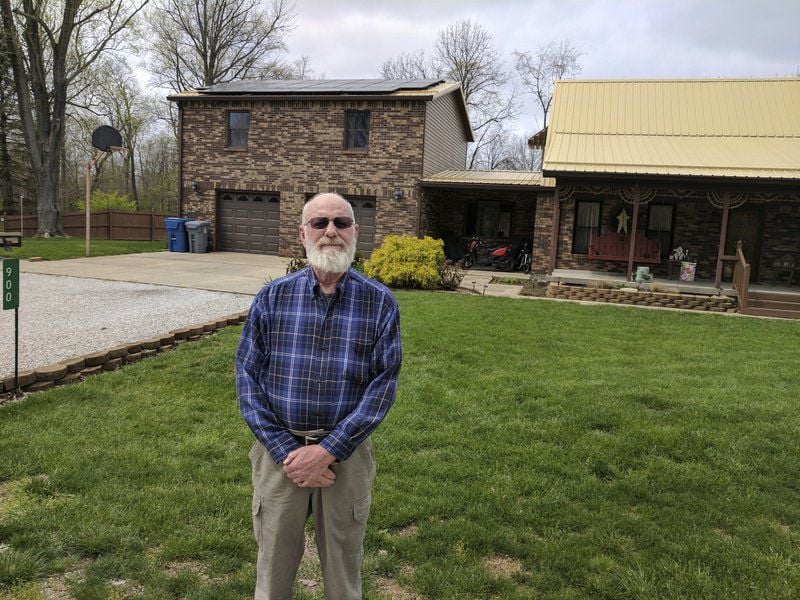
Tribune-Star/Jane Santucci From coal to solar: Stephen Scott, a retired utility company worker, has converted his home to solar power. 

Your Green Valley: Former Duke employee now making 'clean energy'

By Jane Santucci, Special to the Tribune-Star

Scott cautions others about the challenges our nation faces as temperatures rise and the demand that poses to our grid. He has done his part by installing solar on his home. By doing so, he has reduced the amount of electricity he needs from the grid and can also supply his excess back for others to use.

Solar helps during heat waves

 As summer approaches, pay attention to the news and talk about heat waves in cities throughout the United States. Scott says there is a process called wheeling power in which large generation corporations have the ability through their transmission lines to transmit power across state lines and across entire regions to where it is needed most.

For example, if there is a heat wave in Tennessee, and we are sitting here in Indiana with mild 80-degree temperatures, the cost we may pay to generate a megawatt hour is $20. “However, because they need the electricity so bad in these other areas, on the market the cost of a megawatt of electricity can go to $200 to $500 per megawatt hour,” Scott said.

During heat waves in other areas, utility companies in Indiana are sitting with what is known as a rolling reserve. It can only take a matter of hours to release some of those reserves. “I am the consumer in Indiana, also a generating facility because I have solar panels. When they sell their power at $300 a megawatt hour, are they going to pay me the multiple factors instead of the wholesale rate of $0.02 as listed in Senate Bill 309?” Scott asks. He refers to Indiana Senate Bill 309, which passed the House and the Senate during the just-ended legislative session. Senate Bill 309 presents a grim future for solar owners and prospective customers.

Paying to protect

Scott decided to install solar on his home after suffering a lot of physical problems. “I have watched a lot of good fellow employees die very young when they retire. I just wanted to try and make a small little difference in the world. Financially, this does not benefit me,” Scott said.

Before installing solar, he paid $310 a month for electricity; now he pays about $160. He still contributes to the costs associated with transmission and distributing power. He did not borrow money to install solar panels on his house. He elected to remove $40,000 out of his 401K retirement fund to invest in solar energy. “I didn’t have to pay federal tax on the $40,000, but I had to pay $2,500 in state tax because there was no state tax incentive because they view that as income,” he said.

Belief in the future

Scott recalls what President John F. Kennedy said at his inauguration, “ask not what your country can do for you, ask what you can do for your country.”

“Here is the irony of it,” Scott said. “I made my living from helping to produce very dirty energy. Due to making my living that way, I am now capable of making a little bit of clean energy.”

Copyright 2013 IndianaDG