


Author Archives Laura Arnold

SB 309 seeks to drastically reduce value of privately produced solar power

Posted by Laura Arnold  /   February 19, 2017  /   Posted in 2017 Indiana General Assembly, solar  /   No Comments

2-SolarPanels-2.jpg

Bill seeks to drastically reduce value of privately produced solar power

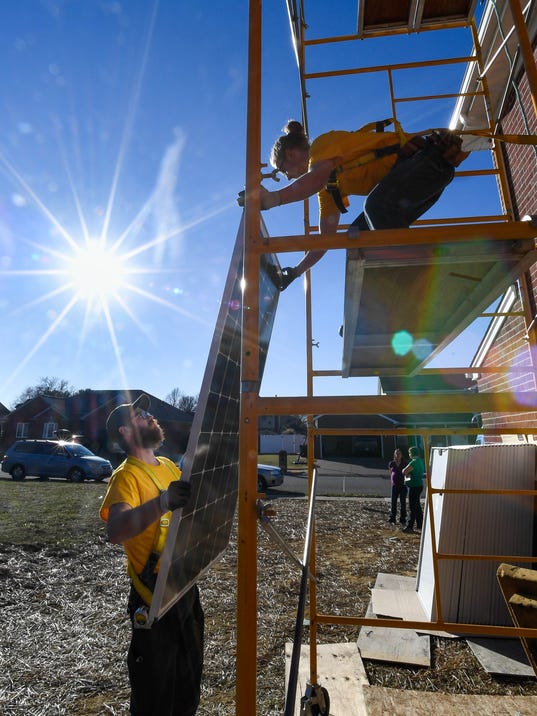
Local solar energy users are facing off against big utility companies this month over a proposed law that would drastically reduce the value of privately generated solar power in Indiana.

Senate Bill 309's supporters say solar users are overpaid for their power, and the bill sets a fairer price.

“People think this bill is anti-solar, and that’s just not true,” said Chase Kelley, a spokeswoman for Vectren.

But, critics fear the move could destroy Indiana’s budding solar industry.

“I’m very concerned for what affect this will have on the solar industry,” said Susan Sirnic, the leader of the Green Team at Bethlehem United Church of Christ, which recently installed a solar system on its church. “It would make it hard to recover your investment.”

Under current state law, utility companies are required to participate in an energy swap with solar users.

The process is called net metering. Solar users take electricity from the grid when their systems don’t produce enough energy to power their homes. But, when the panels produce more energy than the homes need, the excess power is sold back to the grid.

 By law, utility companies must pay solar users the full retail price for that power.

“Right now, all we’re doing is swapping kilowatt hours for kilowatt hours,” Sirnic said. “We receive the same retail rate that we pay.”

The problem, utility companies say, is the power is not worth that much.

“The retail rate includes more than the cost of the energy,” said Mark Massel, the president of the Indiana Energy Association, which is working to get the law passed. “It includes the cost to maintain the grid.”

About 30 percent of the retail price covers the cost of the electricity, Kelley said. The other 70 percent covers grid maintenance, customer service, meter reading, billing and energy efficiency programs.

When Indiana first established net metering in 2005, the system was designed to promote – and subsidize – solar users, Kelley said. Solar panels can cost a home owner tens of thousands of dollars to install, and it takes years for solar users to earn back their investments on the systems. Paying users retail rate for their power helped them earn that investment back quicker.

“It was always meant to be a subsidy,” Kelley said.

And it’s time for the state to lower that subsidy, she added. The cost of solar systems has dropped in the last decade since the state first introduced net metering.

More people are investing in solar systems, and the money they save through net metering is being passed to customers who don’t have personal solar power, Kelley said.

“There are a lot of people who can’t afford to invest in solar,” Kelley said. “They shouldn’t be forced to pay for people who do invest in solar.”

The bill’s opponent’s counter that the cost being deferred to non-solar customers is negligible, a few cents a month. Furthermore, they argue, there is a social and societal benefit to solar electricity.

Local solar installers are calling for the state to postpone changes to net metering laws long enough for an independent group to study the true cost and value of solar power to utility companies in Indiana. [emphasis added]

“There have been studies done in other states that show that the value of solar power is close to the retail rate,” said Ryan Zaricki, the president of Whole Sun Designs, an Evansville based solar system installing company. “It is so frustrating that (lawmakers) are so adamantly against a study. When they pull these numbers out, I keep saying, show me the study.”

If Senate Bill 309 passes, utility companies would be allowed to gradually reduce the rate that they pay solar users for their power to closer to the market rate for raw power.

The bill before the Senate this week, stipulates that anyone who installs solar systems before June 30 will receive the retail rate for the solar power they produce – for the next 30 years. After June 30, the bill allows utilities to gradually reduce the rate they pay.

“There is going to be an onslaught of people getting solar systems installed before that June 30 deadline,” Zaricki said. “We’re going to see a boom, and then it’s going to fall off. They call it the solar coaster.”

Editorial: Pull the plug on Indiana Senate solar net metering bill SB 309

Posted by Laura Arnold  /   February 19, 2017  /   Posted in 2017 Indiana General Assembly, solar, Uncategorized  /   No Comments

Pull the plug on Indiana Senate solar bill; more study needed to determine impact of net metering reduction

Solar energy offers a clean, renewable resource to power and heat homes, businesses, schools and other structures. Its popularity is growing. Still it accounts for only 1 percent of America’s energy.

Hoosiers using solar panels typically lower their utility bills. Homeowners and businesses that generate their own energy with solar panels can get credit on their power bills by routing any excess energy produced into the power grid. That infrastructure is owned by the large utility corporations.

As the Tribune-Star’s Alex Modesitt reported last week, most solar producers in Indiana receive about 11 cents for every kilowatt hour sold to the power grid, which is the retail rate. The practice is known as “net metering.” Utility companies pay only 3.5 cents per kilowatt hour for energy elsewhere. That mark-up, power companies insist, is unfair, especially because they must maintain and service the infrastructure. The corporations also say their non-solar-producing customers are essentially funding the higher solar credits.

The utility corporations want the Indiana Legislature to act on their behalf. State Sen. Brant Hershman (R-Buck Creek) proposed a bill to substantially reduce the reimbursement to people, businesses and other solar users who feed excess energy back to the grid. Changes under that bill would begin in 2022.

Power companies and Hershman present their case as a “reset [of] the marketplace.” The net metering rewards solar energy producers too generously, they contend.

The fledgling solar power industry, and individual Hoosier homeowners and business operators relying on solar panels, need consideration from lawmakers, too. The owner of a Terre Haute solar company said he would likely move his business across the state line to Illinois if the legislation passes. “The only people crying about net metering are the ones on the utility side,” he told Modesitt.

Indeed, lawmakers need to keep the utility corporations’ complaints in perspective. Those companies enjoy monopoly status in Indiana because of the “high costs associated with the duplication of infrastructure,” according to the Indiana Utility Regulatory Commission. That monopoly status diminishes the utilities’ argument that the mark-up credited to solar-using homeowners, businesses and young solar energy firms is too generous. Also, power companies and affiliated political committees donated $76,000 during the past three years to the campaigns of state Senate members of both parties. Those power companies clearly have allies in the Statehouse.

As it is, the change could sideline new, small solar producing businesses, reduce the incentive for Average Joes and Janes to install solar panels, and leave solar energy development to those large power corporations.

This bill should be put on ice. The issue deserves more study.

– (Terre Haute) Tribune-Star

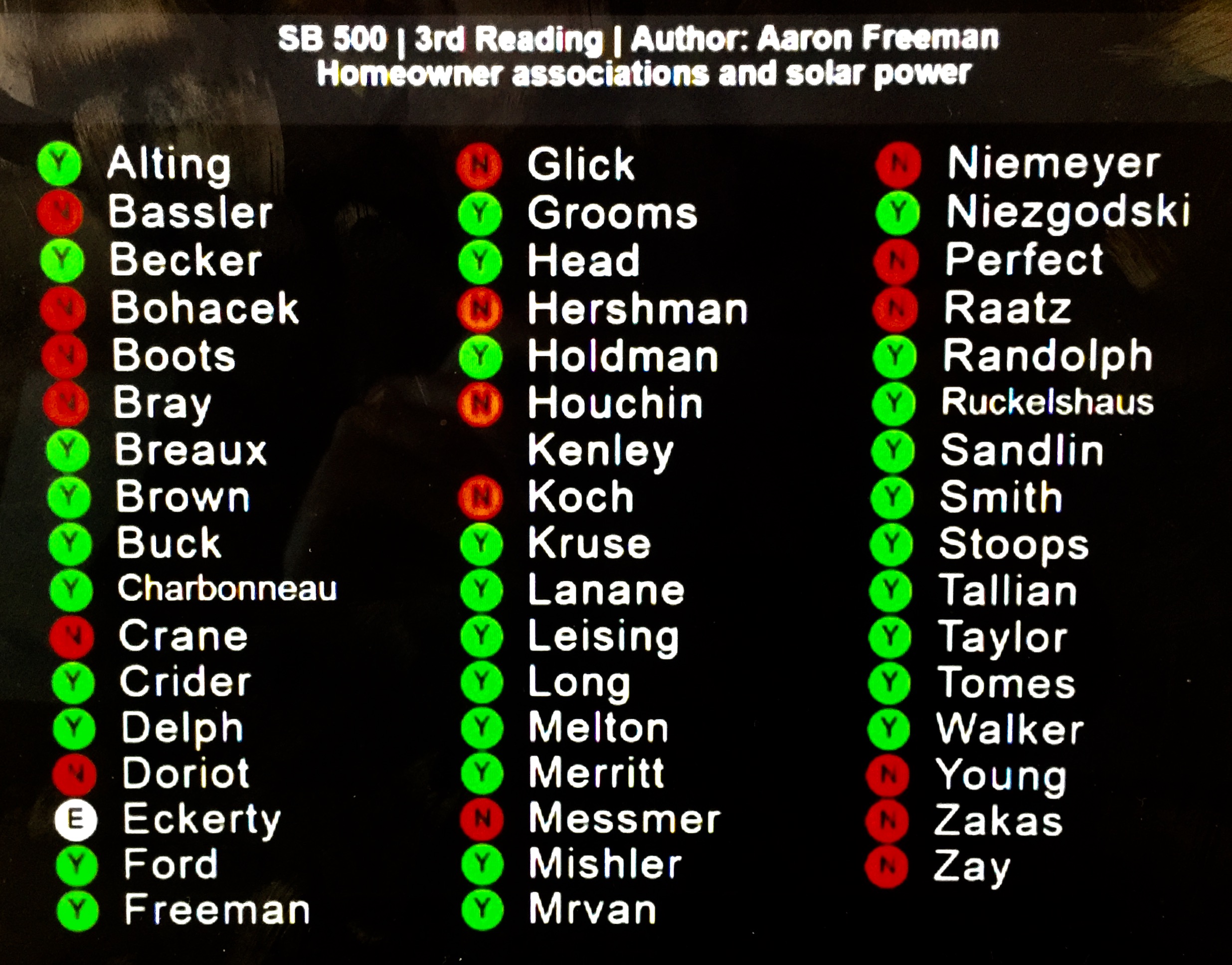
SB 500 fixing HOA solar problem passes 31-17

Posted by Laura Arnold  /   February 16, 2017  /   Posted in Uncategorized  /   No Comments

SB 500 fixing HOA solar problem passes 31-17

Sen. Aaron Freeman (R-Indianapolis) called down SB 500 for third reading and final passage in the Indiana Senate this afternoon shortly after 2:30 pm.

Sen. Freeman made a brief presentation, received no questions and no testimony from other Indiana Senators either for or against.

SB 500 3R Roll Call 31-17

THANK YOU Senator Aaron Freeman!

CAC: DESPITE OUTCRY, INDIANA SENATE PANEL VOTES TO END INDIANA NET METERING PROGRAM

Posted by Laura Arnold  /   February 16, 2017  /   Posted in 2017 Indiana General Assembly, solar, Uncategorized  /   No Comments

Home

FOR IMMEDIATE RELEASE

February 16, 2017


DESPITE OUTCRY, INDIANA SENATE PANEL VOTES TO END INDIANA NET METERING PROGRAM

 INDIANAPOLIS – Despite more than six hours of testimony and countless faith groups, schools, municipalities and citizens opposed to Senate Bill 309, the Senate Utilities Committee this morning passed the legislation ending Indiana’s net metering program in the year 2022.

The bill, authored by Sen. Brandt Hershman (R-Buck Creek), has seen opposition from the coalition of groups due to the harm it would cause local governments, local schools, local churches and residents alike.

“We call on the Indiana Senate to immediately scrap this misguided bill,” said Kerwin Olson, Executive Director of Citizens Action Coalition. “Reasoning for Senate Bill 309’s passage fails to include data-driven information—and disallowing Hoosiers’ ability to partake in lowering energy costs by solar panels is simply unprincipled.”

# # #

A fact sheet concerning SB309 is available here (PDF):

http://www.citact.org/sites/default/files/02-12-17%20SB309.pdf

 The mission of Citizens Action Coalition (CAC) is to initiate, facilitate and coordinate citizen action directed to improving the quality of life of all inhabitants of the State of Indiana through principled advocacy of public policies to preserve democracy, conserve natural resources, protect the environment, and provide affordable access to essential human services. CAC is dedicated to protecting ratepayers and advocating for affordable healthcare and a clean environment. CAC does this through canvassing, lobbying, community organizing and litigation.


Visit us on social at:

www.facebook.com/cacindiana

www.twitter.com/cacindiana

Terre Haute (IN) Tribune-Star Editorial: Pull the plug on solar bill SB 309

Posted by Laura Arnold  /   February 15, 2017  /   Posted in 2017 Indiana General Assembly, solar  /   No Comments

Tribune-Star Editorial: Pull the plug on solar bill

Solar energy offers a clean, renewable resource to power and heat homes, businesses, schools and other structures. Its popularity is growing. Still it accounts for only 1 percent of America’s energy.

Hoosiers using solar panels typically lower their utility bills. Homeowners and businesses that generate their own energy with solar panels can get credit on their power bills by routing any excess energy produced into the power grid. That infrastructure is owned by the large utility corporations.

As the Tribune-Star’s Alex Modesitt reported last week, most solar producers in Indiana receive about 11 cents for every kilowatt hour sold to the power grid, which is the retail rate. The practice is known as “net metering.” Utility companies pay only 3.5 cents per kilowatt hour for energy elsewhere. That mark-up, power companies insist, is unfair, especially because they must maintain and service the infrastructure. The corporations also say their non-solar-producing customers are essentially funding the higher solar credits.

The utility corporations want the Indiana Legislature to act on their behalf. State Sen. Brant Hershman proposed a bill to substantially reduce the reimbursement to people, businesses and other solar users who feed excess energy back to the grid. Changes under that bill would begin in 2022.

Power companies and Hershman present their case as a “reset [of] the marketplace.” The net metering rewards solar energy producers too generously, they contend.

The fledgling solar power industry, and individual Hoosier homeowners and business operators relying on solar panels, need consideration from lawmakers, too. The owner of a Terre Haute solar company said he would likely move his business across the state line to Illinois if the legislation passes. “The only people crying about net metering are the ones on the utility side,” he told Modesitt.

Indeed, lawmakers need to keep the utility corporations’ complaints in perspective. Those companies enjoy monopoly status in Indiana because of the “high costs associated with the duplication of infrastructure,” according to the Indiana Utility Regulatory Commission. That monopoly status diminishes the utilities’ argument that the mark-up credited to solar-using homeowners, businesses and young solar energy firms is too generous. Also, power companies and affiliated political committees donated $76,000 during the past three years to the campaigns of state Senate members of both parties. Those power companies clearly have allies in the Statehouse.

As it is, the change could sideline new, small solar producing businesses, reduce the incentive for Average Joes and Janes to install solar panels, and leave solar energy development to those large power corporations.

This bill should be put on ice. The issue deserves more study.

Copyright 2013 IndianaDG