

John Farrell: Electricity’s Un-Natural Monopoly

Posted by Laura Arnold  /   April 04, 2015  /   Posted in solar, Uncategorized  /   2 Comments

Electricity’s Un-Natural Monopoly

 John Farrell  April 02, 2015  |  9 Comments

The U.S. electricity system is undergoing the biggest change in its 130-year history, undermining the rationale for monopoly ownership and control.

Until recently, electricity service was similar to water or roads, where a natural monopoly was most efficient. Only a single, standardized electric grid was needed to connect each building. Technology options were limited to steam-powered turbines fueled by coal and oil, or large hydro dams with massive economies of scale. There was very little long-distance transmission of power, as each utility was responsible for electricity service within its own territory. Growth in demand was exploding and monopoly utilities could wield the most cost-effective financing for new power plants. These natural monopolies paid off for customers, with falling costs of reliable electricity even as demand rose rapidly.

But the 21st century electricity system is radically different.

The scale of electricity generation is rapidly shrinking, from coal and nuclear power plants that can power a million homes to solar and wind power plants that power a few to a few hundred nearby homes. Electricity demand has leveled off, so that every unit of new wind and solar power produced for the grid displaces a unit of fossil fuel energy. Batteries and electric vehicles provide new tools for distributed energy storage. Smartphones and smart appliances are giving electricity customers unprecedented opportunities to manage their energy use.*

It no longer makes sense to preserve last century’s forms of utility ownership and control in a century where cost-effective technology enables widely distribution production and ownership of electricity. And yet, a majority of state laws governing electricity service still preserve this monopoly model. Even those that do not have made little progress on democratizing the electricity system.

Incremental Changes

There have been incremental changes. In the last three decades of the 20th Century, federal regulators opened the utility market to competition from non-utility generators who used higher efficiency or renewable-fueled power plants and opened the wholesale market to competition by making the transmission system a common carrier. These moves showed that utilities did not have a natural monopoly over power generation and emphasized the public nature of the grid infrastructure by allowing fair and non-discriminatory access. Competition was introduced between big players who could own and operate large power plants.

Changes in the 1990s also introduced retail sales “competition” that proved elusive. California’s near-bankruptcy due to price manipulation by Enron and others led many states to freeze or reverse retail deregulation. Even in states where retail competition has been maintained, public advocates warn it has offered little innovation in electricity service (other than promotional rates like offered by the cable industry). More to the point, retail competition does little to empower electric users, who are still just consumers of power.

The most potent change has been the growth of conservation and energy efficiency. These tools offer non-utility and cost-effective alternatives to new power plants, and as such, illustrate the unnatural nature of utility monopolies. Many states have shifted to independent, non-utility delivery of conservation and energy efficiency services (e.g. Efficiency Vermont).
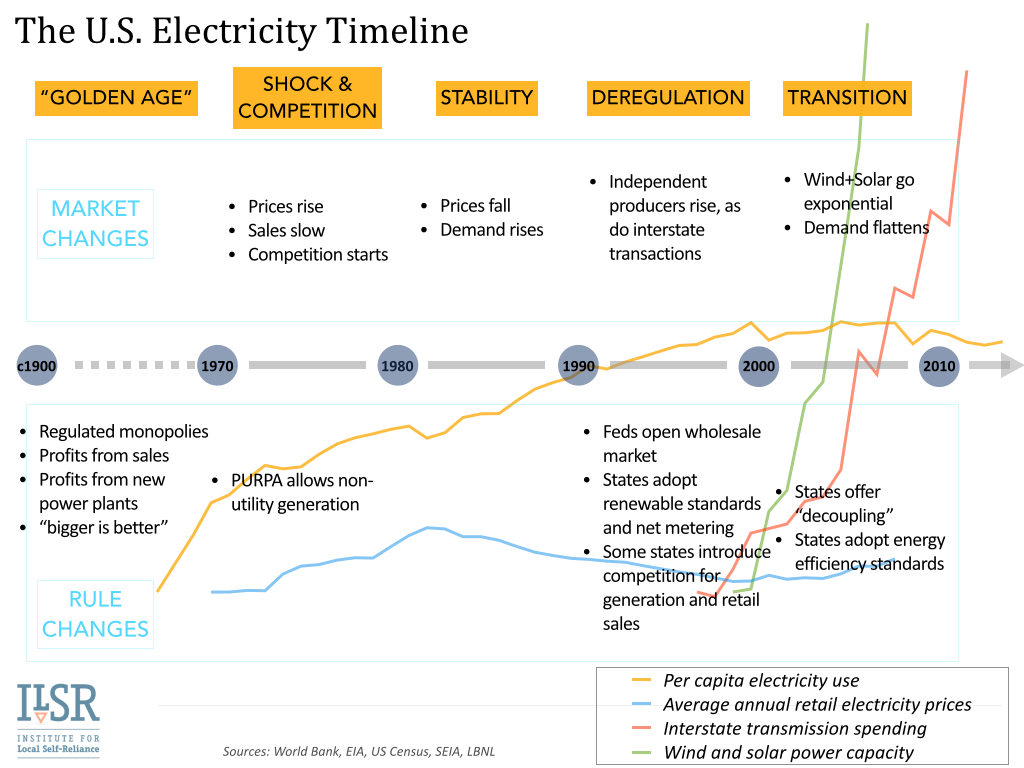
U.S. Electricity System Timeline

Retaining Market Power

At the present, however, utilities still maintain monopoly or exercise market power over many aspects of the grid. On the transmission system, for example, planning rules make it very difficult to implement less costly, non power line alternatives to utility power line proposals (see Beyond Utility 2.0 to Energy Democracy, p21). In particular, planning is rarely integrated with distribution level planning, where distribution energy generation (like solar) can serve reliability and energy needs. Distribution planning also suffers from utility monopoly, because as utility expert and former utility manager Karl Rabago says, “utilities simply do not think things they do not own or control can be resources.” Thus, system planning rarely incorporates customer-owned solar, electric vehicles, energy storage, and many other cost-effective strategies for meeting electricity needs.

In other words, the natural monopoly has become unnatural, with utility managers wedded to costly legacy infrastructure solutions (like poles and wires) in an era of remarkable local and non-utility resources.  New utility power plants and power lines will last for 40-50 years, but distributed energy resources will be competitive well within the lifetime of these legacy investments. For example, by 2022, on-site solar power could provide less costly electricity than the electric utility for at least 10 percent of residential and commercial customers in nearly every state. In that time frame, electric vehicles and other energy storage options combined with powerful “apps” will give utility customers unprecedented control over their energy use.

Replacing an Unnatural Monopoly

Monopoly is no longer natural or even cost effective. But what will replace it?

For one, it must be a grid built on the principles of a 21st century electricity system. I offer five pillars of a Utility 3.0 model, or energy democracy. Three of these derive from the prominent Utility 2.0 conversation.
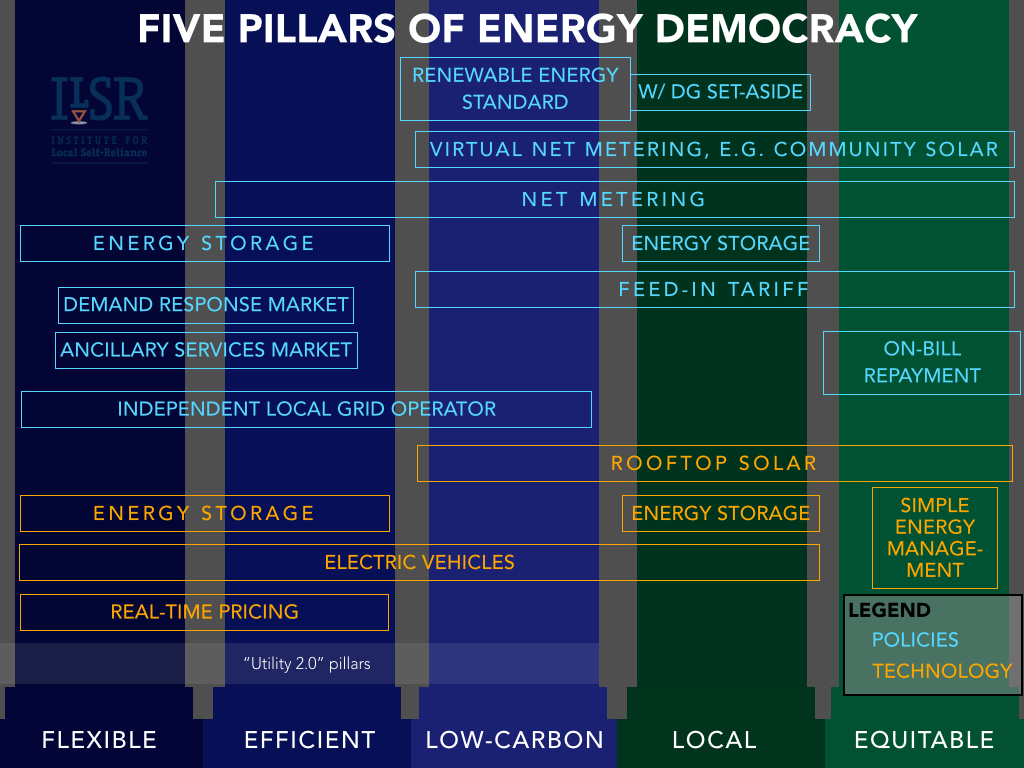
Five Pillars of Energy Democracy

How will these principles be applied to the end of the natural utility monopoly?

On the transmission system, there’s a clear need for policy to re-integrate planning with the local level, where there are many more opportunities for conservation, efficiency, and distributed energy to meet regional needs than ever before. There are a few other suggestions, for federal regulators, in this post.

On the distribution system, the answer is new management and, likely, ownership. The New York Public Service Commission’s Reforming the Energy Vision process has already outlined a plan for an independent manager for the distribution system, but it may fall short of the necessary steps to make the distribution system a tool for energy democracy.

Until the turn of the 21st century, the distribution system was simply the last mile of lines bringing power one-way from utility operated power plants to customers. But now the distribution system can facilitate energy democracy. Individual and community solar arrays can produce local electricity; electric vehicles, energy storage, and smart appliances can manage energy use; networked thermostats and smartphone apps can give individuals and businesses unprecedented power as energy managers. The following graphic provides a very simplified picture.
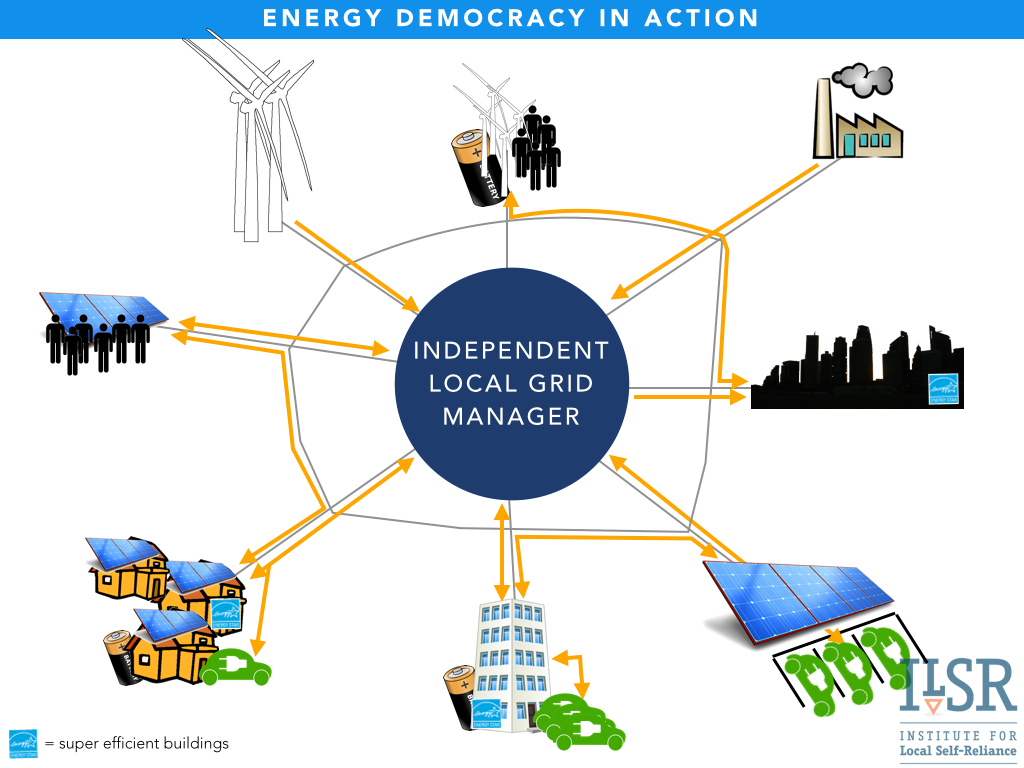
Energy democracy in action

To facilitate this network, the distribution system needs to be a common carrier, with non-discriminatory access to all. But the infrastructure of the local grid (substations, transformers, etc) also has to be vastly upgraded and smartened to enable local ownership and management of energy systems, and the transactions between these local owners. These investments, in the public interest and not the manager’s interest, necessitate complete separation from utility ownership and management as long as utility’s still have a vested financial interest in particular outcomes (e.g. a guaranteed rate of return from building new infrastructure). The grid could be owned as a commons, like the roads or municipal water supply, or not. But it must be built and operated to facilitate maximum economic opportunity for electric customers.

Maintaining an unnatural monopoly is inefficient, but failing to correct it is enormously costly. Energy efficiency and distributed energy offer electricity customers $48 billion economic opportunity, and the rules for the electricity system should allow them to seize control.

This article originally posted at ilsr.org. For timely updates, follow John Farrell on Twitter or get theDemocratic Energy weekly update.

*This paragraph copied from ILSR’s new report, Beyond Utility 2.0 to Energy Democracy (Dec. 2014)

Gov. Snyder wants Michigan to generate more electricity from renewable sources of energy

Posted by Laura Arnold  /   April 02, 2015  /   Posted in Uncategorized  /   No Comments

Michigan Gov. Rick Snyder Carves Out Own Niche Inside GOP

By PATRICK O'CONNOR

Gov. Rick Snyder is, for now, more focused on balancing the demands of his rural, urban and suburban constituents than making a splash on the national stage. Pictured, Mr. Snyder speaks about using cleaner sources of electricity at the Detroit Electrical Industry Training Center in Warren, Mich., on March 14. Associated Press Don’t expect Michigan Gov. Rick Snyder to provoke the kind of media firestorm that has engulfed his neighbor to the south, Indiana Gov. Mike Pence. That’s because Mr. Snyder, a fellow Republican, seems almost allergic to hot-button political debates.And yet, that aversion hasn’t stopped the soft-spoken Michigan governor from carving out his own provocative niche inside the GOP as a Republican who often seems eager to stray from the party’s conservative orthodoxy.
 

The Michigan governor proudly supports controversial education standards known as Common Core. He has tried to avoid fights with organized labor. And he wants to see his state generate more electricity from renewable sources of energy. [emphasis added]

Mr. Snyder’s latest crusade is a May ballot measure that would increase Michigan’s sales tax by one percentage point to generate more money for the state’s crumbling roads. The former accountant frames the debate in economic terms: good roads are much cheaper to maintain than bad ones.

“It’s a good investment,” he said during a recent interview with the Wall Street Journal.

In an era of heightened partisanship, Mr. Snyder represents something of a throwback – the centrist Midwestern governor more focused on balancing the demands of his rural, urban and suburban constituents than making a splash on the national stage.

Rick Snyder, after all, is no Scott Walker, the Wisconsin governor who parlayed his landmark fight with the state’s public-sector unions into near front-runner status for the Republican presidential nomination.

Mr. Snyder, for example, is unapologetic in his support for Common Core, arguing high standards are better than low ones – a view he shares with former Florida Gov.  Jeb Bush, one of the leading contenders for the GOP nomination. Mr. Snyder, who said he has discussed the issue with Mr. Bush, likes to remind voters that under the program states and local school boards have the flexibility to design their own curriculum. And he mocks Republicans, like Texas Sen. Ted Cruz, who call for its repeal.

“There’s nothing to repeal,” he said. “It was done by the states.”

And unlike Mr. Walker, Mr. Snyder has tried to avoid fights with Michigan’s powerful labor unions. One big exception was his decision to sign right-to-work legislation, prohibiting any requirements that would force workers to pay union dues. But more recently, he has opposed Republican efforts to repeal a state law that sets compensation for construction workers on government projects.

Mr. Snyder also expresses concern that the country’s anti-tax fervor may occasionally go too far. “Government should have a limited role, and it needs to be extremely efficient about using its resources,” he said. “But there is an appropriate role for government to make investments, particularly in infrastructure.”

The Michigan governor is one of the few Republicans to refuse to sign Americans for Tax Reform President Grover Norquist‘s pledge not to raise taxes. “I don’t sign pledges like that,” he said. “If you’re going to govern, you have to have flexibility to make those decisions.”

And unlike other governors, Mr. Snyder is skeptical of using tax credits to lure business to Michigan, worrying about the long-term loss of tax revenue. He said he warned one chief executive looking to move jobs to Michigan that if he wanted some kind of tax credits, they would have a very short conversation.

Of all the Republican governors in the Midwest, Mr. Snyder may have the lowest profile but he has one of the best track records when it comes to job creation. Michigan’s unemployment rate has dropped from 11.2% when he took office to 5.9% today, the lowest since 2001, and the nearly 400,000 private-sector jobs the state has added since he became governor is the fifth highest tally in the country and the best in the Midwest.

Given Mr. Snyder’s obvious aversion to conflict, he isn’t one to critique other officeholders, but the contrast between his governing style – “relentless positive action” – and that of other governors, including Mr. Walker, is obvious enough.

“Scott has done some very good things,” he said in the recent interview. “I’m proud to say, in over four years as governor, I have not fought with a single person, and I haven’t blamed anybody. I’ve stuck to this problem-solving approach. And I think it’s really allowed us to do things in a very positive way.”

Mr. Snyder has been mentioned as a possible contender for the Republican presidential nomination in 2016, but with the field starting to emerge, the Michigan governor has dropped out of the conversation. He plays coy on the subject of his own presidential ambitions, saying he would decide after the May vote on raising the state’s sales tax. He is also recovering from a tear of his Achilles tendon.

“I’ve got an Achilles and an election in May,” he said.

But after that, he plans to tour the country promoting Michigan’s revival – and presumably himself.

Wayne, Randolph and Henry Counties (IN) Could Get EDP Renewables Wind Farms

Posted by Laura Arnold  /   April 02, 2015  /   Posted in wind  /   No Comments
wind turbine.jpg

Wayne, neighbor counties could get wind farms

Bill Engle, bengle@richmond.gannett.com5:43 p.m. EDT April 1, 2015

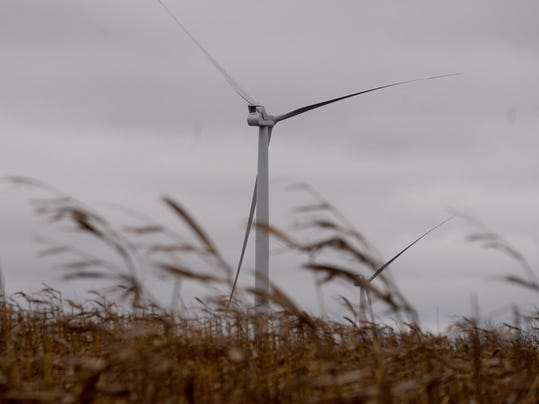
A Texas-based firm will study portions of Wayne, Randolph and Henry counties in the months ahead looking for a site to build one or more wind farms.

Two representatives of EDP Renewables, Jeffrey Nemeth and Chris Brooks, outlined plans to study east-central Indiana during a presentation to the Wayne County Commissioners on Wednesday.

EDP is the firm that built the Headwaters Wind Farm in Randolph County that was completed in December 2014.

“It could be that we would build one in each county or one that straddles all three counties,” said EDP project manager Jeffrey Nemeth. “We just don’t know at this point. We are in the very, very early stages of development, and there’s a lot of studying to do.”

Nemeth said there also is a possibility that, after study, the firm would elect not build in this area.

“Right now, it’s too early to tell,” he said.

The firm is based in Houston, Texas, with offices in Indianapolis and Chicago. It built the wind farms that straddle Interstate 65 in White County, north of Lafayette.

That sprawling locale is actually four wind farms that include 303 turbines and produce 500 megawatts of electricity. Nemeth said initial plans in this area are to build a wind farm that includes 100 turbines and produces 200 megawatts, which is the same size as the current farm in Randolph County.

Nemeth said the Randolph County project involved 180 landowners.

“We’ve had a great experience with property owners in Randolph County,” he said. “We had significant support, strong landowner support.”

If the firm did build in Wayne County, it would construct 300-foot towers that would stretch to 495 feet with blades fully extended.

Nemeth said the first steps include studying the county’s wind ordinance, zoning laws, wildlife and construction costs before contacting homeowners and building a tower to test wind speed.

“When we build a farm, we make a significant investment in the project and we are here for the next 30 years,” he said.

Nemeth said a ballpark estimate of the project costs is $1.5 million to $2.2 million.

“But that’s just an estimate. It depends on construction costs and where the turbines come from,” Nemeth said.

He said landowners receive financial compensation for placing turbines on their land and his company has “a neighbor agreement” that offers a financial incentive to neighbors within 1,500 feet of the farm.

When asked how soon construction might start, Nemeth said, “It might be one and a half years or 10 years or never.” He said that decision will be influenced by whether the company has a taker for the electric power being produced.

One reason the Headwater farm moved so quickly was that the power company AEP “wanted 200 megawatts.”

“These projects are obviously influenced by a utility who wants to buy the power,” Nemeth said.

His firm does not currently have a request from a utility company to buy additional power.

The commissioners were pleased to hear of the project.

“We want you to know that we are excited about this project,” said Commissioner Mary Anne Butters. “We welcome you, and we hope you will keep the lines of communication open.”

Bob Wotherspoon, who lives north of Richmond, has long been a proponent of wind energy. He told the EDP representatives, “I have 40 acres of ground for the test site.”

“I just want to ask how we can speed this up because I’m here to help you,” Wotherspoon said.

Staff writer Bill Engle: (765) 973-4481 or bengle@pal-item.com. Follow him on Twitter at http://twitter.com/billengle_PI.


SeekingAlpha: Duke Energy-The Dark Side of Solar Energy; An Investment Perspective

Posted by Laura Arnold  /   April 01, 2015  /   Posted in solar, Uncategorized  /   No Comments

Summary

  • Duke Energy, a regulated utility, is considered a safe investment.
  • However, solar energy poses an existential threat to Duke Energy.
  • Updating antiquated policies may determine if solar and utilities can coexist.

Abstract:

Electric companies, such as Duke Energy (NYSE:DUK), are considered safe investments.

However, the industry faces existential threats as Washington D.C. aggressively promotes renewable solar energy.

Similar German policies, which advocated for renewable energy, resulted in large losses for German utilities that focused on fossil fuels.

Duke Energy, which has a large stake in fossil fuels, may not be a safe investment as the United States enters into a brave new world of renewable energy generation.

Company Overview

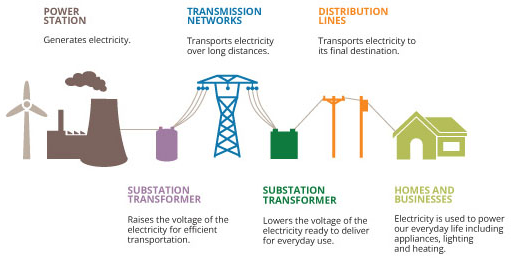
Duke Energy is in the electric generation, transmission, and distribution business. The company has a total capacity to generate 57,500 MegaWatts of electricity. The company's energy portfolio primarily consists of fossil fuels, broken down into 38% coal, 38% fuel, 17% nuclear and 7% hydro/solar. The company maintains 262,900 miles of distribution wires and 32,400 miles of transmission wires. The company services 23.0 million residents and generates $23.9 billion in revenues. Duke Energy's activity is best summarized by the figure below. The slide was provided courtesy of Origin Energy.

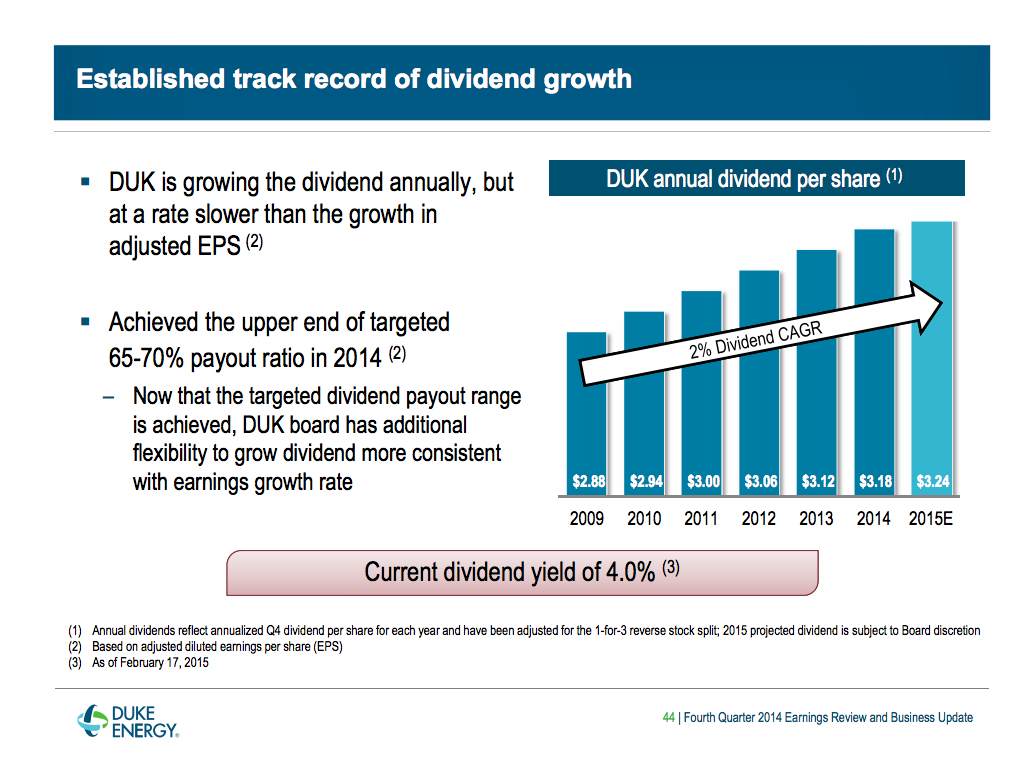
For retirees, Duke Energy is considered a safe investment. The company has a healthy payout ratio and a high dividend yield. According to the company's earnings call, Duke Energy has a sustainable payout ratio of 65%-70%. The company has a dividend yield of ~4.0% and a historical dividend growth rate of ~2.0%. The side below, on Duke Energy's dividends, is provided courtesy of Duke Energy.

The Disruptive Potential of Solar

However, solar energy poses a threat to Duke Energy. While solar energy only generates 1% of the electricity in the United States, it is the time of day at which it generates electricity which causes the biggest troubles for utilities.

Under the current system, electricity prices spike during peak hours in the afternoon and early evening. Companies, like Duke Energy, make all of its money during peak hours. But the afternoon is when solar generation is strongest. Net-metering policies allow solar to receive grid priority. Therefore solar grabs a majority of the peak demand.

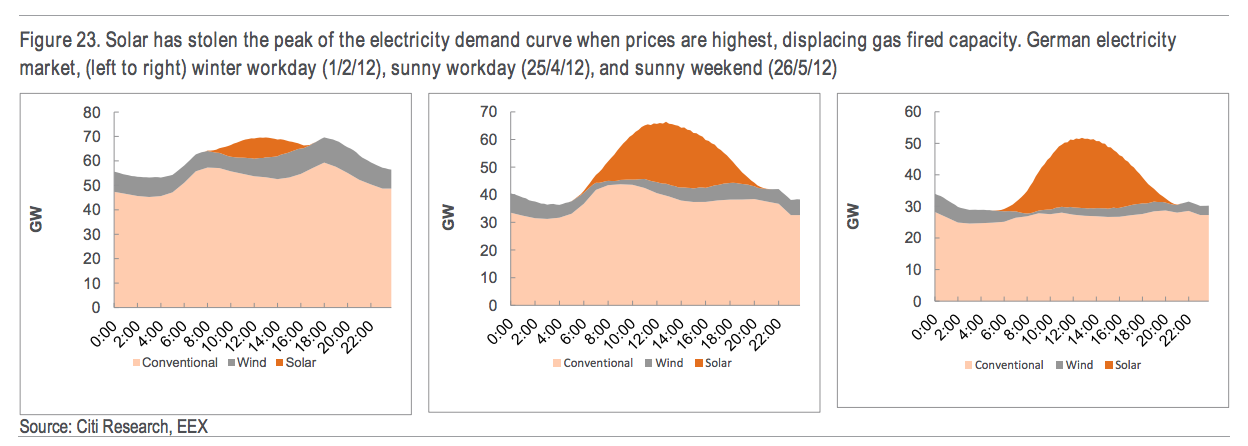
Accordingly, gas/fuel power plants, which provides peak energy, is the first to suffer the effects of solar energy. Unfortunately, Duke Energy's portfolio comprises of 38% of gas/fuel. The figure below, provided courtesy of Citigroup, demonstrates how solar has stolen the peak of electricity demand, when the prices are the highest, and displaced gas/fuel-fired capacity.

Duke Energy has realized the disruptive potential of solar and has started its own solar program. The company purchased REC Solar for $225 million. REC Solar provides comprehensive solar and energy solutions nationwide.

However, Duke Energy's solar leasing program cannot adequately compete with solar leasing programs from companies such as SolarCity (NASDAQ:SCTY) because of Washington D.C.'s net-metering policy. Net metering allows SolarCity's customers to "resell" excess solar energy back to utilities at retail prices, while Duke Energy's solar leasing program only allows customers to "resell" excess solar energy at lower wholesale prices. Provided below, from Duke Energy's website, is Duke Energy's solar leasing policy on net metering.

Therefore, it is important to monitor the changes in net metering policies, which could allow Duke Energy's solar leasing program to become more cost competitive. Furthermore, policy changes could replace antiquated pricing structures and allow utilities to adequately recover costs from customers with solar panels that intermittently utilizes the electric grid. The Edison Electric Institute, which represents all investor-owned utilities on Washington D.C., proposes the following changes to net-metering policies:

Net metering policies and rate structures in many states should be updated so that everyone who uses the electric grid helps pay to maintain it and to keep it operating reliably at all times. This will ensure that all customers have safe and reliable electricity and that electric rates are fair and affordable for all customers. Current state net energy metering policies that compensate at the retail price for electricity sales to the utility are outdated and need to be updated to align with today's technology and the ongoing transformation of the grid.

German Solar Initiatives Lead to Utility Losses

The disruption of solar technology has already unfolded in Germany. Germany's largest utility, E.ON (EOAN) lost 3.2 billion euros last year. RWE (RWE), one of Germany's largest utilities, lost 1.3 billion euros last year. According to the economist:

The decline of Europe's utilities has certainly been startling. At their peak in 2008, the top 20 energy utilities were worth roughly €1 trillion ($1.3 trillion). Now they are worth less than half that. Since September 2008, utilities have been the worst-performing sector in the Morgan Stanley index of global share prices. In 2008 the top ten European utilities all had credit ratings of A or better. Now only five do (The Economist).

Furthermore, E.ON, Germany's largest electric company, has cut its dividend. Shareholders of the company received a $0.17 dividend in 2014, down from $1.1 in 2013.

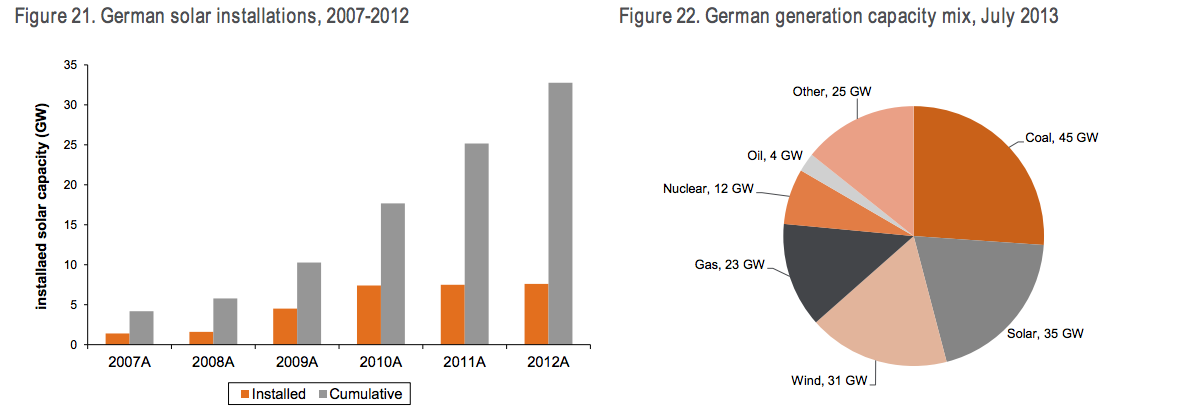
Germany's renewable energy policies are the primary culprit of the country's proliferation of solar technology. This policy increased solar capacity in Germany from 4GW in 2007 to 33GW in 2012 as shown below. The following charts were provided courtesy of Citigroup.

US Solar Initiatives Lead to Utility Losses

More startling is that Washington D.C. have passed similar solar energy initiatives. The Renewables Portfolio Standards (RPS) policy will increase solar capacity, in the U.S., from ~20GW to ~93GW in 2035. The slide below provides Washington D.C.'s RPS policies as described by The Berkeley Lab.

In Closing

Duke Energy may not be a safe investment as the U.S. enters into a brave new world of renewable energy. Duke Energy makes the bulk of its profits during peak hours, in the afternoon, when prices are the highest. However, these profits are eaten away by solar panels. These profits will be further eroded as Washington D.C.'s initiatives, namely the renewable portfolio standard, will increase solar capacity from 20GW to 93GW in 2035.

Similar renewable energy initiatives, in Germany, resulted in the proliferation of solar technology. Similar antiquated electricity pricing policies did not allow utilities to be adequately compensated for providing electricity when solar could not. The confluence of these factors resulted in large losses in German utilities.

Therefore, it is important for an investor to monitor how Washington D.C. restructures its net-metering policies and the renewable portfolio standards. Changes to these policies may allow renewable solar energy to grow hand-in-hand with utilities.

Ideally, solar energy would provide energy during the day and utilities would provide energy during the night. Furthermore, utilities would ideally be adequately compensated for providing energy, when solar energy is not available.

Duke Energy Indiana Contribution for Battery Storage Due to OUCC Settlement Agreement

Posted by Laura Arnold  /   March 31, 2015  /   Posted in Edwardsport IGCC Plant, Office of Utility Consumer Counselor (OUCC)  /   No Comments

solar panels wind turbines

The research will include installing energy storage systems at two schools served by Duke Energy in Indiana, probably schools that already have renewable-energy installations on site.
 

Duke Energy gives $1M to Indiana battery center for energy storage research

 UPDATED: Mar 30, 2015, 11:34
, Senior Staff Writer-Charlotte Business Journal
Email  |  Twitter  |  Google+

IndianaDG: As Paul Harvey used to say, here is the rest of the story. Just in case you read the News Release we posted here on this story and wondered about the background on this announcement. 

Duke Energy is contributing $1 million for research at the Indiana Battery Innovation Center on using battery storage with rooftop solar and small wind turbines.

The funding makes good on an agreement Charlotte-based Duke (NYSE:DUK) made with the Indiana Office of Utility Consumer Counselor in 2012 as part of a settlement of cost overruns at Duke’s Edwardsport gasified coal plant.

The research will look at ways battery storage can be used with smaller sun and wind installations to maximize the power available from such projects and integrate them more easily with the power grid.

School storage

The effort will include installing energy storage systems at two schools served by Duke Energy, preferably with renewable-energy sources already on site. The systems will test the benefits of energy storage and serve as a learning lab for students. The schools have not yet been selected.

“Through this new partnership between the OUCC, (the innovation center) and Duke Energy, Indiana will continue to grow the public/private partnerships necessary to bring together the talent and resources to make our state a leader in energy storage,” says Indiana Lt. Gov. Sue Ellspermann, who announced the grant Monday.

Testing through 2016

Duke Energy Indiana President Doug Esamann says the research is aimed at resolving an inherent problem with distributed generation from small independent sources.

“Electricity is a unique commodity because it must be produced at the exact time it’s needed,” he says. “Technology that can store energy is a way to advance renewable energy sources such as wind and solar which are clean, but not always available when power is needed.”

The innovation center expects to begin testing the benefits of storage with small solar and wind projects this fall. The school programs will begin in the winter. Testing will continue through 2016.

Settlement deal

Cost overruns at the Edwardsport plant raised the operation's total cost from the initial $2 billion estimate to about $3.5 billion.

In 2012, Duke worked put an agreement with the state's consumer counselor to limit the portion of the plant construction charged to customers to $2.6 billion.

As part of that agreement, Duke agreed to with the counselor’s office to fund $1 million in clean-energy research. That is the money being given to the battery center.

Copyright 2013 IndianaDG